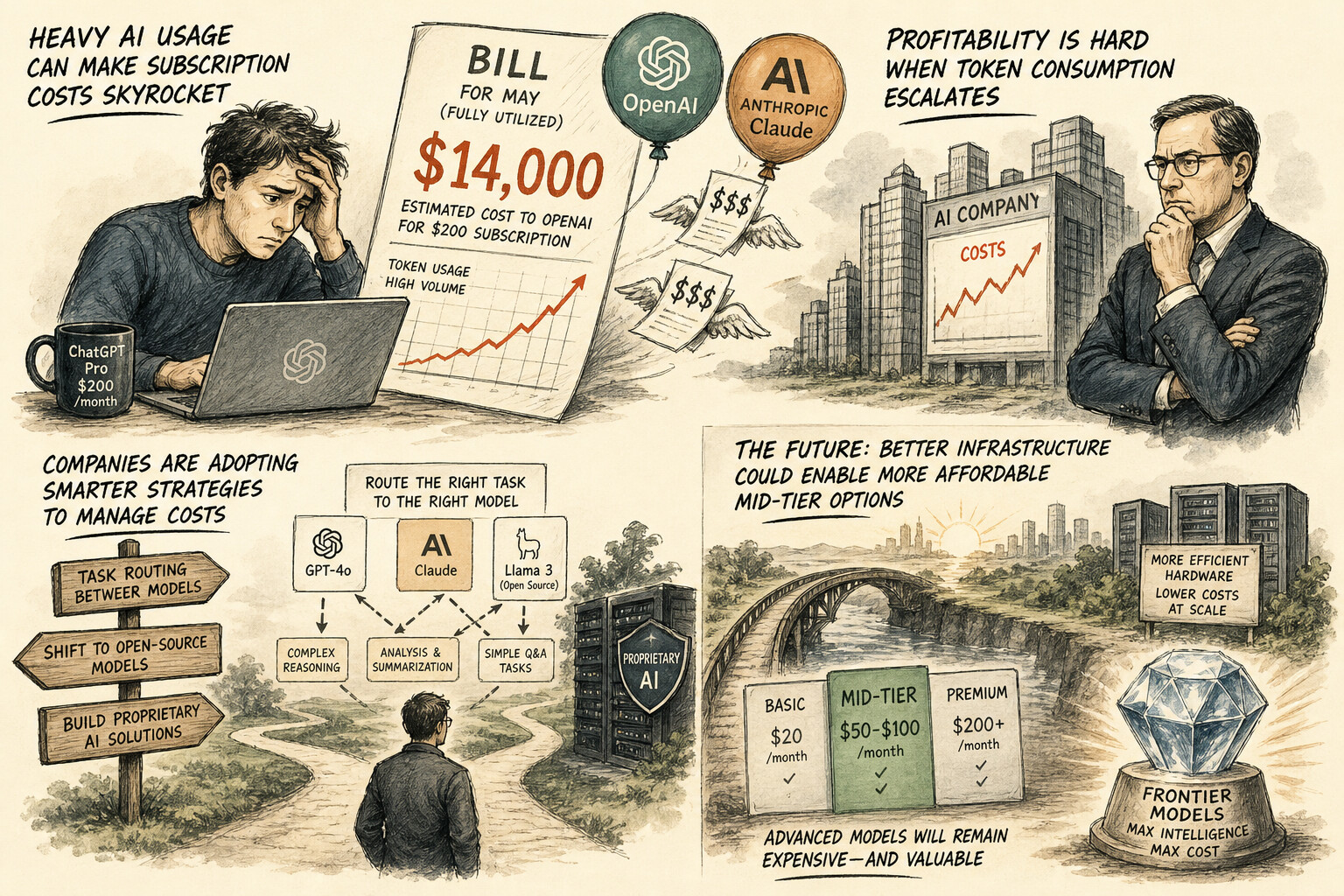
Heavy usage of AI subscription services like OpenAI’s ChatGPT Pro and Anthropic’s Claude can drive costs far beyond their flat monthly fees, making profitability challenging as token consumption escalates, with OpenAI potentially incurring up to $14,000 in costs for a $200 subscription if fully utilized. To manage expenses, companies are adopting strategies such as task routing between models and shifting to open-source or proprietary AI, while future infrastructure improvements may enable more affordable mid-tier subscriptions, though advanced models will likely remain costly.
The economics of AI subscription services like OpenAI’s ChatGPT and Anthropic’s Claude are becoming increasingly challenging as heavy usage drives costs far beyond flat monthly fees. Analysis by SemiAnalysis reveals that a $200 ChatGPT Pro 20x subscription, if fully utilized, could cost OpenAI up to $14,000 based on standard API pricing. Similarly, Anthropic’s Claude Max 20x plan, also priced at $200 per month, could incur around $8,000 in token costs at maximum usage. This stark disparity highlights the financial strain on AI providers when users push these systems to their limits.
Utilization rates are critical for profitability. SemiAnalysis found that Anthropic breaks even on some plans at about 20% usage, while OpenAI’s margin is thinner, with losses starting once ChatGPT Plus and Pro 5x usage exceeds 11.4%. At the highest subscription tiers, profitability drops sharply; Anthropic reaches zero gross margin at roughly 10% utilization, and OpenAI turns unprofitable at just 5.7%. This means even moderate heavy use can quickly erode the financial viability of these subscription models.
The rising token consumption, especially from agentic AI systems that demand exponentially more tokens than standard prompts, is a major factor driving costs. Large companies like Microsoft, Meta, and Amazon have reportedly scaled back internal AI usage due to escalating expenses. One notable case involved a company spending $500 million in a single month on Anthropic’s Claude because of unrestricted employee access, underscoring the need for controlled deployment to manage costs effectively.
To address these challenges, organizations are adopting strategies such as routing tasks between different AI models based on complexity, using expensive frontier models only for demanding queries while delegating routine tasks to cheaper alternatives. This approach can reduce costs by up to 95%, according to reports. Some companies are also shifting entirely to more cost-effective open-source models or developing proprietary AI systems tailored to their needs, which can offer better cost control and performance for specific applications.
Looking ahead, there is hope that infrastructure improvements and newer model generations will lower costs for mid-tier AI services, potentially enabling profitable subscriptions around $20 per month. However, the most advanced frontier models will likely remain expensive and may be priced separately via APIs rather than included in flat-rate subscriptions. OpenAI CEO Sam Altman has acknowledged the tension between user demand for powerful, affordable AI tools and the high infrastructure costs, emphasizing ongoing efforts to help users maximize value while minimizing expenses.