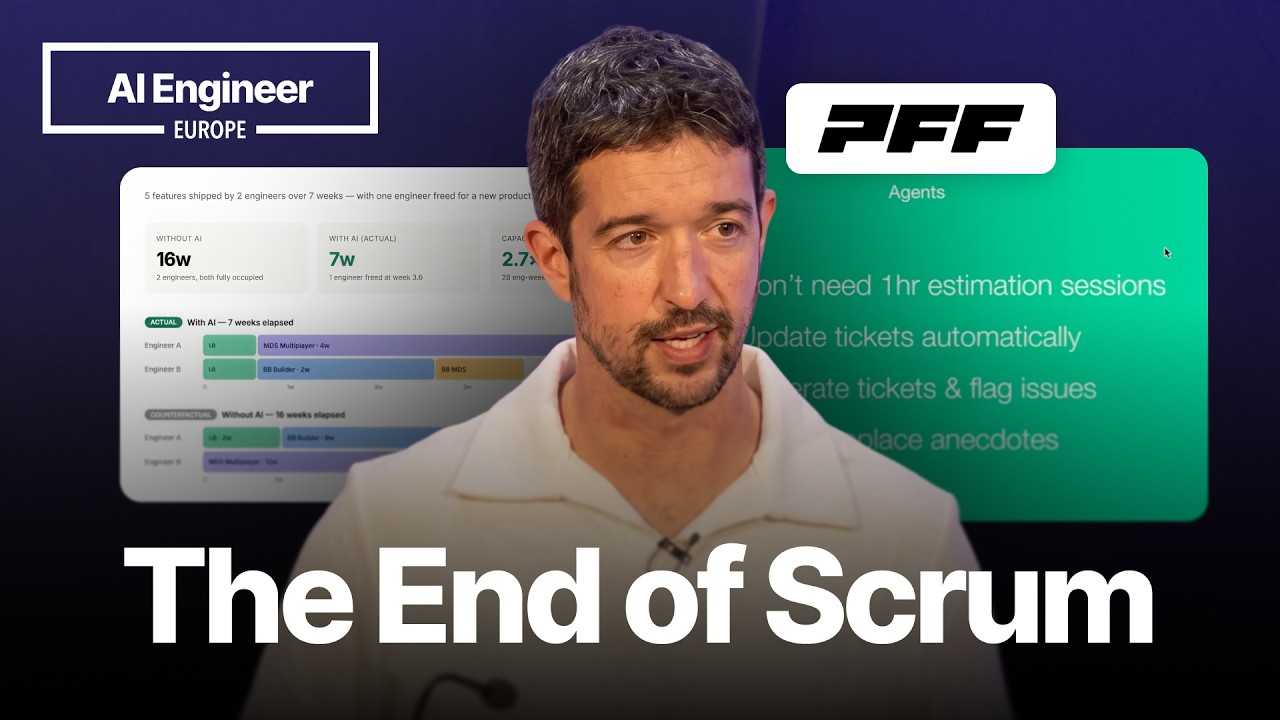
Mike Spitz from PFF demonstrated how integrating AI agents to automate repetitive engineering tasks dramatically increased deployment frequency and improved product quality by replacing traditional Agile ceremonies with automated workflows and continuous feedback. This phased approach empowered engineers to focus on complex problem-solving while ensuring consistency and scalability, highlighting the competitive advantage of adopting AI-driven engineering processes.
Mike Spitz from PFF presented a case study on transforming their engineering organization by leveraging AI agents to enhance productivity and delivery speed. PFF, a sports data company serving NFL and NCAA teams as well as fantasy football consumers, faced challenges with a distributed engineering team of about 20 engineers falling behind competitors. Starting with a small experiment involving two top engineers, they explored how to make engineers more efficient by automating repetitive and blocking tasks rather than simply pushing engineers to output more code.
The results were striking: the small team using AI agents achieved 25 times more deployments compared to the larger team, with deployment frequency increasing from once every five days to multiple times daily. Importantly, the quality of output improved as well, with customer satisfaction scores rising from around 7-7.5 to 8.6 out of 10. This was achieved by focusing on rapid MVP deployments, continuous feedback loops, and eliminating traditional Agile ceremonies like sprint planning, daily standups, and retrospectives, which were replaced by automated ticket updates and customer satisfaction surveys.
The new engineering process centered around a lightweight design document (LDD) created and refined with the help of AI agents, which ensured consistency and adherence to company standards. AI agents also automated ticket creation, pull request management, and even QA testing on staging environments, flagging issues early and enabling a self-healing development flow. This allowed engineers to focus on high-level design and complex problem-solving while offloading mundane tasks to AI, improving both speed and quality.
Spitz emphasized the importance of a phased approach to adopting this new model, starting with the best engineers and non-critical systems to build trust and refine workflows. He noted that not all engineers would adapt easily, especially those accustomed to highly prescriptive specs, but those who are curious and proactive would thrive. He also highlighted the need to encode company-specific engineering patterns and guardrails into AI skills to maintain product consistency and quality.
Finally, Spitz advised organizations to rethink their engineering lifecycle as a factory of composable tasks, automating boring, repetitive work first and removing redundant processes. He cautioned against trying to onboard everyone at once and stressed the competitive risk of falling behind as other companies accelerate adoption of AI-driven engineering. The talk concluded with an invitation to explore the tools developed during the case study, underscoring the transformative potential of AI agents in modern software engineering.