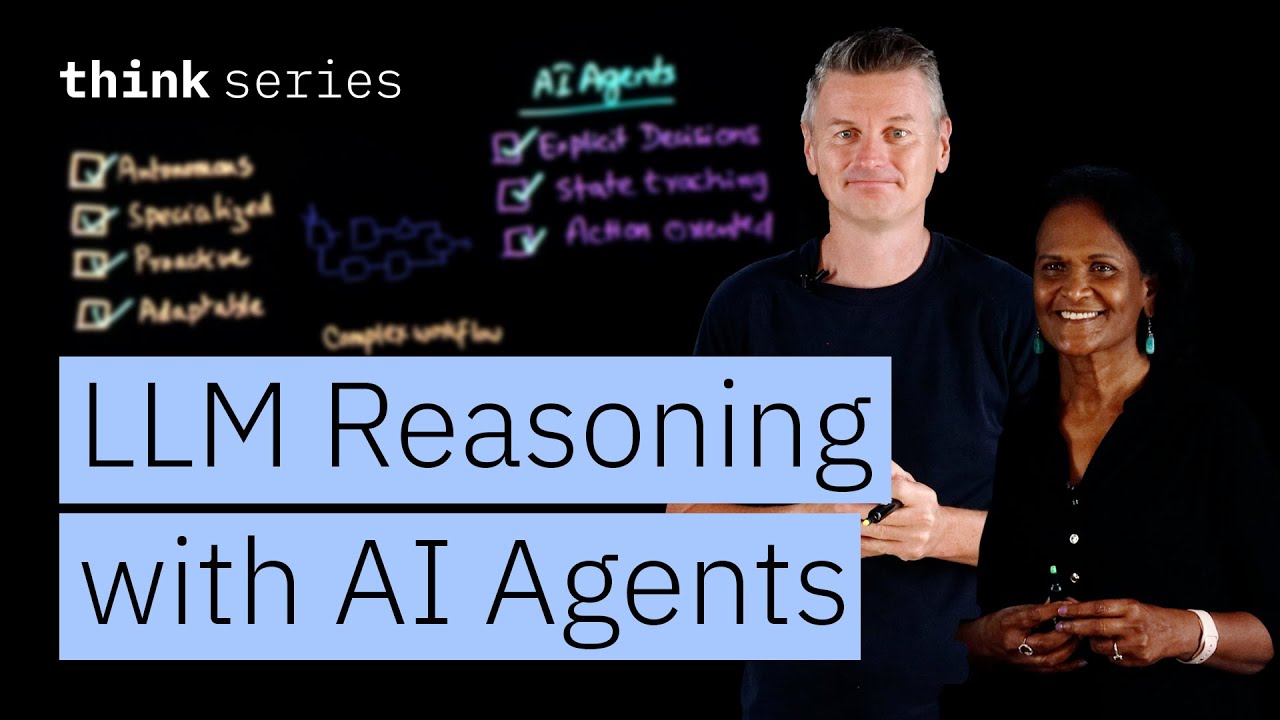
The video discusses the concept and significance of AI agents, emphasizing their role in advancing large language models (LLMs) from mere information retrieval to autonomous decision-making and execution. AI agents are characterized by their autonomy, specialization, proactivity, and adaptability, especially when encountering outlier situations. Unlike LLMs that primarily generate text based on trained knowledge, AI agents are action-oriented, capable of performing tasks and making decisions within complex enterprise workflows such as CRM, HR, and procurement systems. They integrate tools, business rules, and data pools to operate autonomously without manual intervention, ensuring that tasks are executed effectively.
A key distinction between AI agents and LLMs lies in their reasoning capabilities. While LLMs perform reasoning through pattern matching within a limited context window and focus on singular tasks with non-persistent memory, AI agents engage in explicit decision-making, state tracking, and action-oriented reasoning. They remember previous states and tasks, manage complex workflows, and execute actions such as API calls to fetch data or implement decisions. This explicit reasoning enables AI agents to handle multi-step processes and adapt dynamically to changing conditions within business environments.
The video further explores various reasoning techniques employed by AI agents, including conditional logic, heuristics, and the popular REACT (Reasoning and Acting) prompting method. Conditional logic uses simple if-then-else rules but struggles with outliers, while heuristics apply quick, rule-of-thumb decisions. REACT combines reasoning with action, allowing agents to understand rules, diagnose situations, and execute appropriate actions. Self-reflection is also highlighted as a critical component, enabling agents to refine decisions based on previous outcomes. Additionally, multi-agent architectures allow multiple AI agents to collaborate on solving complex problems.
An illustrative use case presented involves AI agents managing software installations. The agent first understands the software requirements, such as memory and disk space, and determines the necessary tools and installation methods. For known software, the agent follows a streamlined, pre-established workflow to complete the installation. For unknown software, the agent adapts by identifying new tools, APIs, and rules required, demonstrating the REACT method’s power to handle unfamiliar scenarios without needing entirely new workflows. This adaptability ensures efficient and secure installations across diverse software environments.
In conclusion, the video underscores the transformative potential of AI agents in business applications through their autonomous decision-making, adaptability, and action-oriented nature. Unlike traditional LLMs that focus on text generation, AI agents actively execute tasks, learn from experiences, and adjust to complex, dynamic workflows. Their ability to self-learn and adapt makes them invaluable for enterprises facing non-standardized processes and frequent deviations. Ultimately, AI agents represent a significant step forward in leveraging AI for practical, real-world problem-solving and operational efficiency.