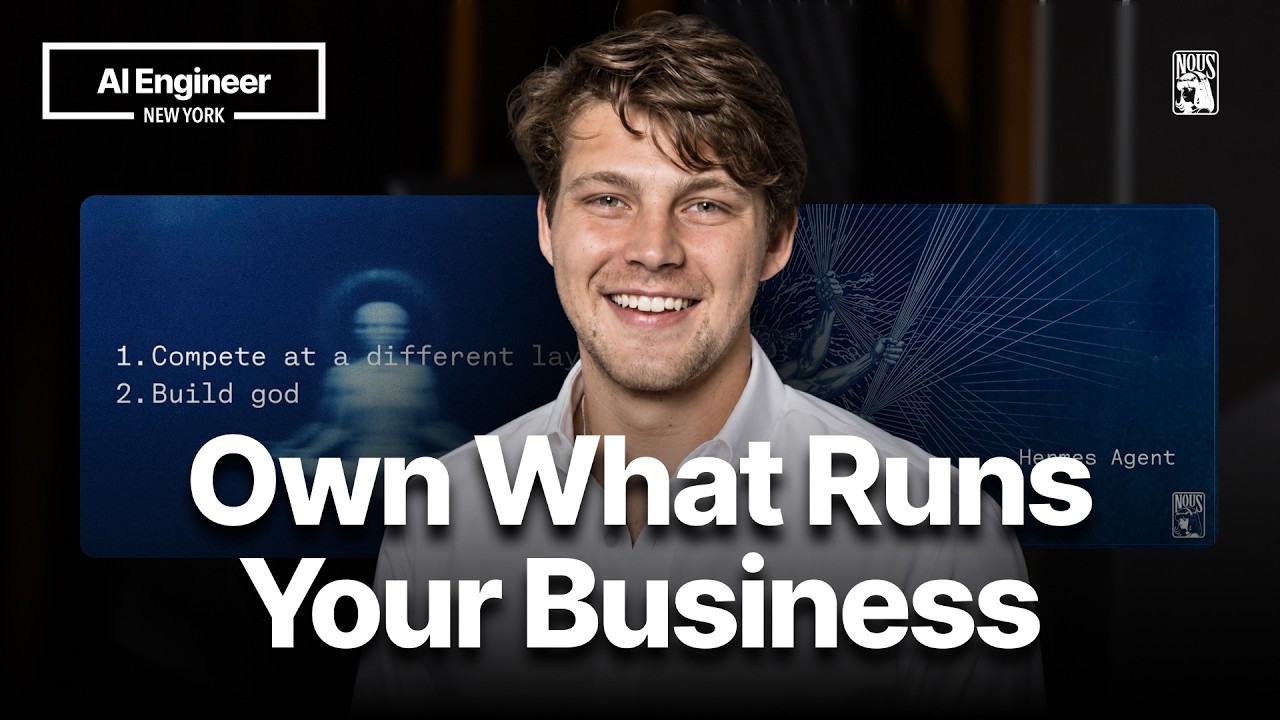
Dillon Rolnick, CEO of Nous Research, discusses the current landscape of AI development, emphasizing the massive investments—hundreds of billions to trillions of dollars—poured into building sophisticated intelligence systems. He highlights a critical issue: as AI models become commercialized and widely accessible, the profit margins on these models are shrinking due to increased competition and stable infrastructure costs. Rolnick argues that to reclaim these vast investments, companies must either compete at different levels of the technology stack—either infrastructure or user-facing layers—or create a superior, almost god-like AI system that can solve the most profitable problems directly.
Rolnick points out that the battle for AI dominance is shifting towards the agent level, where AI systems interact directly with users and businesses. He stresses that businesses, unlike fickle consumers, have significant economic incentives to integrate AI deeply into their operations, potentially organizing a large portion of their workforce around AI agents. This integration creates a form of entrenchment, making it difficult for companies to switch providers and thus allowing AI developers to leverage asymmetric power to change market dynamics or raise prices. The ultimate goal for labs is to build AI systems that can autonomously solve complex, profitable problems, particularly in industries like finance, where they are already collaborating with experts to gain necessary domain knowledge.
A key theme in Rolnick’s talk is the importance of open foundations and avoiding reliance on proprietary, centralized AI systems. He warns against building on “quicksand”—closed platforms that can trap users and limit autonomy—and advocates for open-source solutions like the Hermes Agent, developed by Nous Research. This open approach counters the traditional software moat, which has eroded due to the ease of software reproduction and the rapid pace of innovation in open-source communities. Rolnick emphasizes that the real competitive advantages now lie in network effects, reputation, and reliability rather than proprietary code or architectures.
Rolnick also explains that AI agents are evolving beyond simple chatbots into complex operating systems that blend deterministic code with non-deterministic reasoning, judgment, and intelligence. This hybrid nature allows agents to create new applications that are more adaptive and intelligent, combining data, routine code, and human insights. He encourages companies to build their AI systems on flexible foundations that allow them to integrate various models and tools without being locked into a single provider. This approach enables organizations to focus on their core competencies while leveraging state-of-the-art AI capabilities as they evolve.
In conclusion, Rolnick calls for a collaborative, open-source-driven future in AI development, where companies maintain control over their AI tools and destinies. He positions Nous Research’s Hermes Agent as a leading open-source platform designed to empower users with autonomy, scalability, and reliability. Rolnick urges the AI community to embrace open foundations to ensure that the trillion-dollar investments in AI benefit a broad ecosystem rather than centralized entities. By doing so, organizations can both harness advanced AI features and preserve their independence, ultimately shaping a more equitable and innovative AI-driven future.