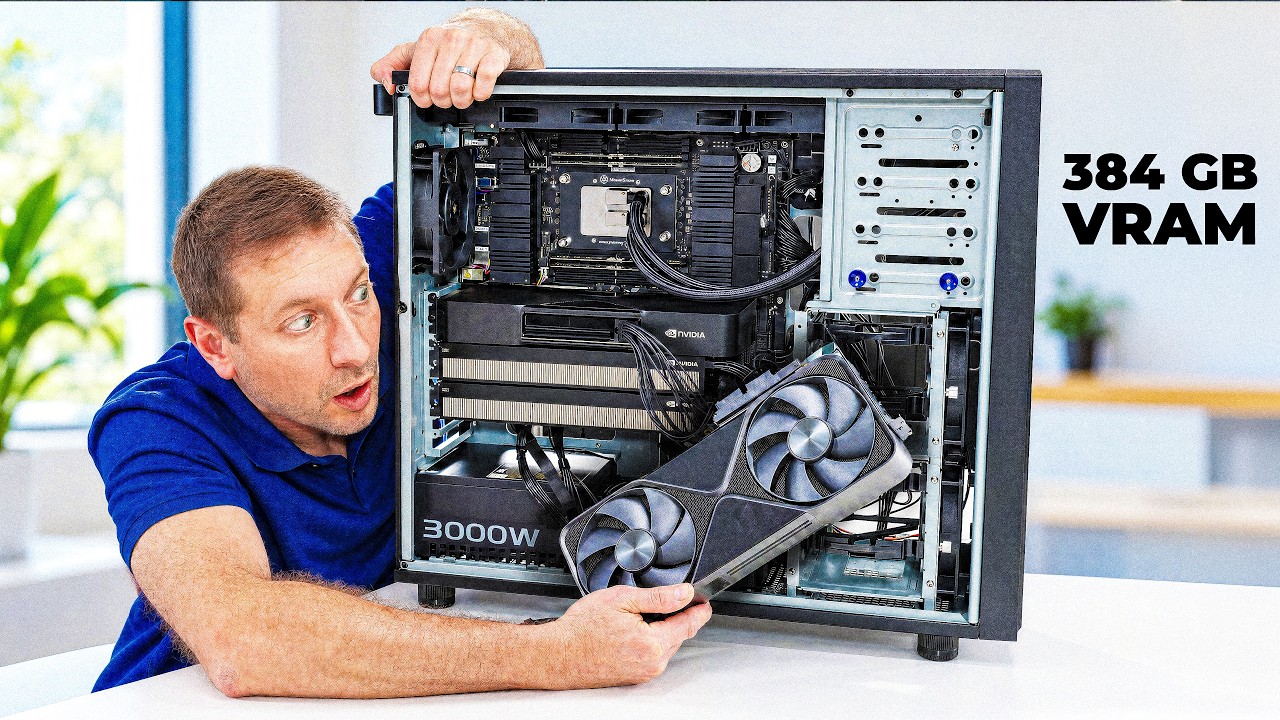
The video begins with the creator excitedly unboxing and preparing to build a high-end workstation featuring the NVIDIA RTX Pro 6000 GPUs and an AMD Threadripper Pro CPU. The new ASUS ET900 AX9 case and ProWRX90E Sage motherboard, designed to support Threadripper Pro processors and up to 2TB of ECC RAM, set the stage for a powerful AI-focused machine. The creator visits Micro Center to select the appropriate Threadripper Pro CPU, weighing options between 16, 24, 32, 64, and even 96-core models, ultimately choosing the 32-core 9975WX as a sweet spot for multi-GPU workloads.
Building the system involves careful installation of the CPU, RAM, and cooling solutions. The Threadripper Pro CPU requires a specialized liquid cooler due to its high power draw (up to 350 watts), and the creator opts for a Silverstone cooler known for its performance despite some noise. RAM installation is limited by availability and cost, so only 128GB is installed initially, with plans to expand later. The power supply is upgraded to a massive 3,000-watt unit to support up to four GPUs, two of which can draw 600 watts each, ensuring sufficient headroom for stable operation.
Once assembled, the system is configured with Linux (Ubuntu 24.04) and the BIOS is updated to support multiple GPUs and enable features like resize bar support. The creator installs four RTX Pro 6000 GPUs, noting the importance of each GPU having its own PCIe root complex to avoid bandwidth bottlenecks. Initial benchmarks running AI models demonstrate impressive token generation rates across multiple concurrent agents, highlighting the system’s capability to handle parallel workloads efficiently.
A key insight from the video is the workload distribution between GPU and CPU when running AI agents. While GPUs handle the model inference, a significant portion (around 71%) of the agent’s processing time is spent on CPU tasks such as scaffolding, compiling, running tests, and packaging results. This shifts the focus from just GPU power to the importance of a strong CPU with many cores and threads to manage multiple agents simultaneously. The creator compares the Threadripper Pro to a consumer-grade AMD 9700X CPU, showing that while single-agent performance is similar, the Threadripper excels dramatically as the number of concurrent agents increases.
In conclusion, the video emphasizes that while GPUs remain critical for AI model execution, the evolving workflows involving multiple agents require powerful CPUs to handle the non-GPU workload efficiently. For users running only a single agent, a consumer CPU may suffice, but for scaling up concurrency, investing in a high-core-count Threadripper Pro system is beneficial. The creator invites viewers to share their own setups and points to additional content exploring similar builds, underscoring the changing landscape of AI hardware needs in 2024.