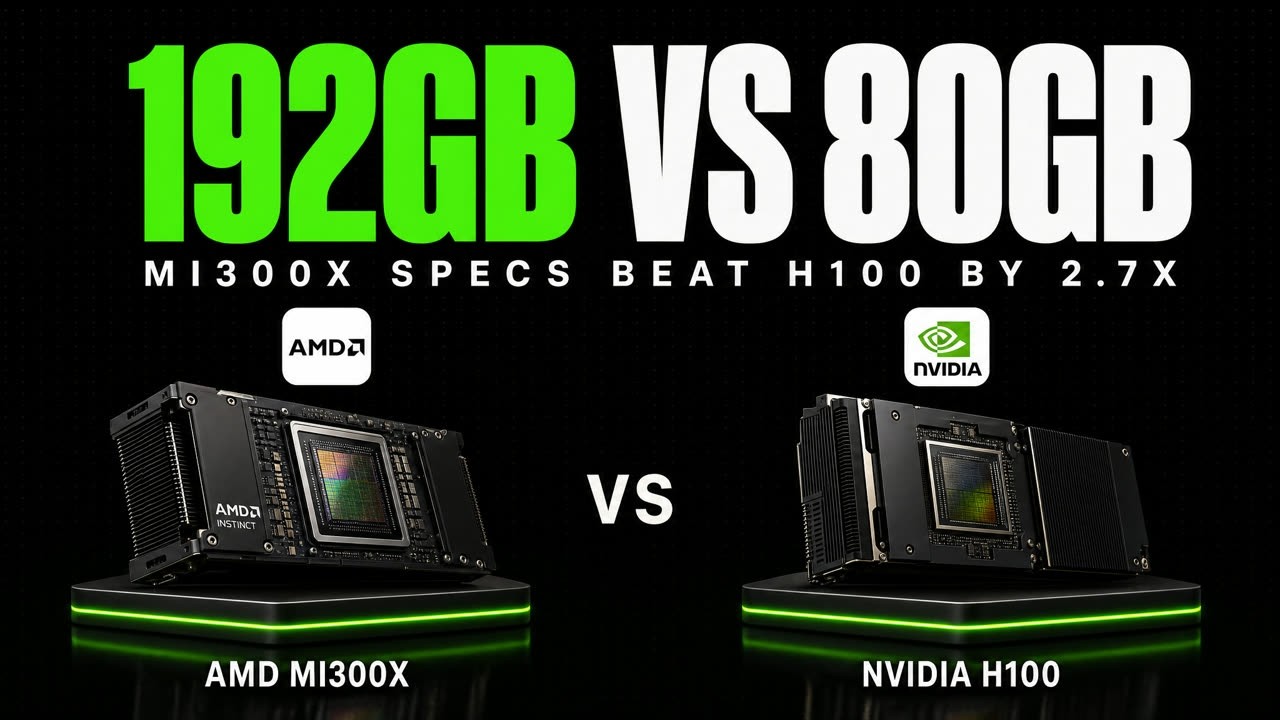
The video explores why AMD, despite having superior hardware specifications compared to Nvidia, continues to lose market share in the GPU space. AMD’s Instinct MI325X boasts higher memory capacity, bandwidth, and computational power than Nvidia’s H200, a fact publicly confirmed by AMD itself. However, despite these advantages on paper, Nvidia dominates 92% of the enterprise GPU market, raising the question of why buyers overwhelmingly choose Nvidia hardware over AMD’s seemingly better silicon.
The key factor behind Nvidia’s dominance is not just the hardware but the software ecosystem that accompanies it, specifically Nvidia’s CUDA platform. CUDA acts as a critical translation layer that integrates seamlessly with popular AI frameworks like PyTorch and TensorFlow, enabling developers to run complex AI models without dealing with low-level hardware details. This entrenched software ecosystem has created a massive network effect, where developers, universities, and third-party tools are all optimized for Nvidia’s platform, making it the default choice for enterprises despite AMD’s superior hardware specs.
AMD has attempted to compete with its own open-source software stack, ROCm, launched in 2016. However, Nvidia’s nine-year head start since 2007 gave it a near-monopoly on developer mindshare and tooling. This long lead time allowed Nvidia to build a vast installed base of hardware and software, creating a “moat” that is difficult for AMD to cross. Independent benchmarks have shown that while AMD’s hardware performs well, its software stack is buggy and frustrating to use, which discourages enterprises from adopting it for critical AI workloads.
The video also highlights efforts to break Nvidia’s software lock-in, such as Huawei’s open-source CANN toolkit and Spectral Compute’s SCALE compatibility layer, which allows unmodified CUDA binaries to run on AMD hardware. These innovations aim to separate software ecosystems from hardware choices, potentially enabling buyers to leverage AMD’s superior silicon without abandoning the CUDA ecosystem. Early signs suggest Nvidia’s market share may decline from 87% to around 75% by 2026, but AMD is not the primary beneficiary of this shift.
Finally, the video points out that much of the lost Nvidia market share is being captured by custom in-house chips developed by large tech companies. These custom solutions bypass the need for broad software compatibility by focusing on proprietary models and internal optimization, further complicating the competitive landscape. Ultimately, the video concludes that AMD’s hardware advantage is real but insufficient to overcome Nvidia’s entrenched software ecosystem and the growing trend of custom silicon, explaining why the better chip still loses in the market.
Useful Links
- Nvidia CUDA Toolkit — Central to understanding Nvidia’s software ecosystem advantage over AMD.
- PyTorch — Explains the developer ecosystem reliance on Nvidia’s CUDA.
- TensorFlow — Supports the explanation of Nvidia’s software ecosystem dominance.
- JAX — Part of the software ecosystem that locks in Nvidia’s market share.
- AMD ROCm Documentation — Explains AMD’s software stack and its challenges competing with CUDA.