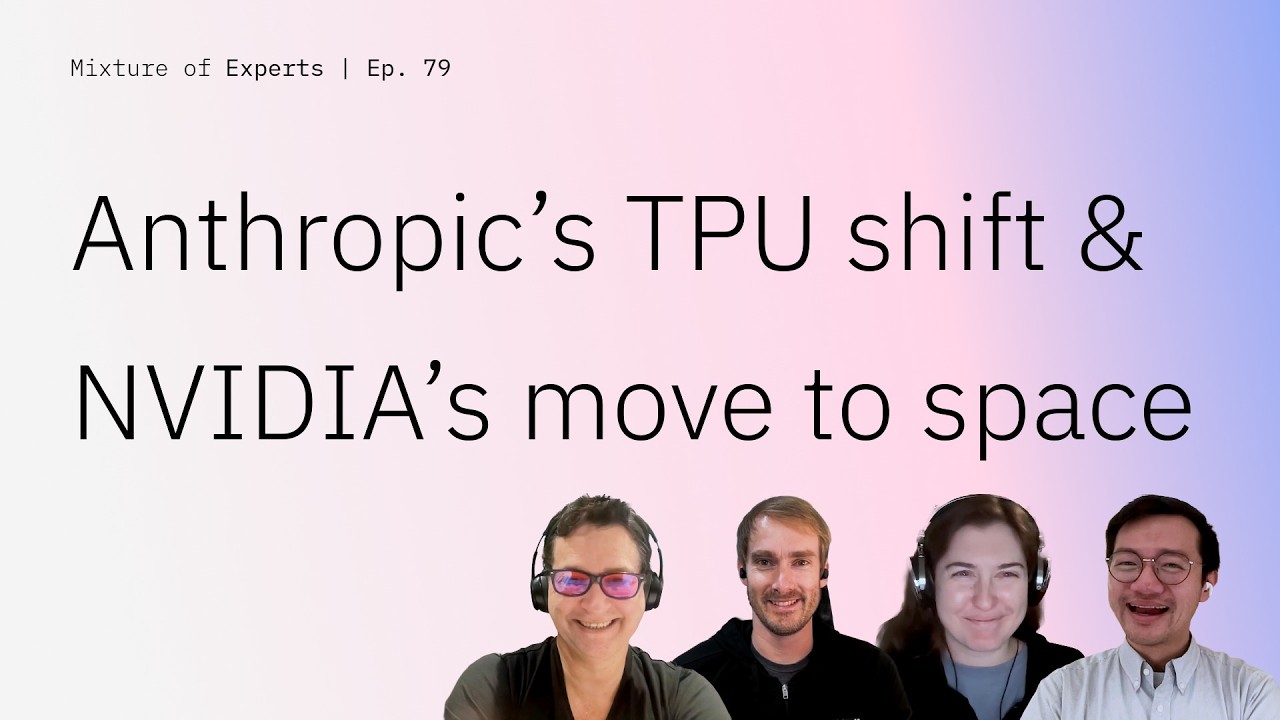
In this Halloween episode of Mixture of Experts, host Tim Hoang and a panel of experts discuss several key topics in artificial intelligence, starting with Anthropic’s recent announcement to significantly expand their use of Google’s TPUs (Tensor Processing Units). Anthropic plans to deploy up to one million TPUs by 2026, marking a major shift from their previous reliance on Nvidia GPUs. The panelists explore the strategic reasons behind this move, highlighting the benefits of diversifying hardware platforms to manage supply constraints and reduce inference costs. They also discuss the technical challenges of supporting multiple chip architectures and the likelihood that Nvidia GPUs will remain the primary choice for training cutting-edge models due to their mature CUDA ecosystem.
The conversation then shifts to the emerging role of insurance in AI, sparked by a recent essay on underwriting superintelligence. The panel debates whether third-party insurance for AI risks is practical or necessary, with skepticism expressed about the feasibility of insuring complex AI models given their novelty and the difficulty in assessing risks. Instead, they suggest that model developers themselves are best positioned to manage and indemnify risks, especially since AI risks tend to be highly use-case specific. Concerns are also raised about the global competitiveness of AI companies, noting that differing regulatory and insurance environments across countries could impact innovation and deployment.
Next, the group examines OpenAI’s blog post on managing sensitive conversations within ChatGPT, particularly around mental health emergencies. They discuss the challenges of addressing rare but critical cases where users may exhibit signs of distress, and the limitations of relying on data-driven fine-tuning due to the scarcity of such examples. The panel appreciates OpenAI’s transparency and efforts to engage experts but remains cautious about the company’s incentives and the effectiveness of their safety measures. They also debate the philosophical question of whether AI should serve as a companion and how models should respond when users become emotionally reliant on them, acknowledging the complexity and potential risks involved.
Finally, the episode explores a futuristic concept introduced by Nvidia about deploying data centers in space through a company called StarCloud. The idea leverages the advantages of space, such as abundant solar energy and natural cooling, to power massive AI workloads. While the panel finds the concept intriguing and acknowledges the potential benefits, they express significant concerns about the practical challenges, especially maintenance and hardware upgrades in orbit. They also highlight the growing problem of space debris and the geopolitical complexities of operating infrastructure in outer space, concluding that terrestrial improvements in hardware efficiency might be a more viable path forward.
Throughout the episode, the panel balances enthusiasm for AI advancements with a healthy dose of skepticism about the operational, ethical, and regulatory challenges facing the industry. They emphasize the importance of diversification in hardware, cautious management of AI risks, transparency in safety practices, and realistic assessments of futuristic ideas. The discussion reflects the dynamic and rapidly evolving nature of AI technology and the multifaceted considerations that companies and society must navigate as the field progresses.