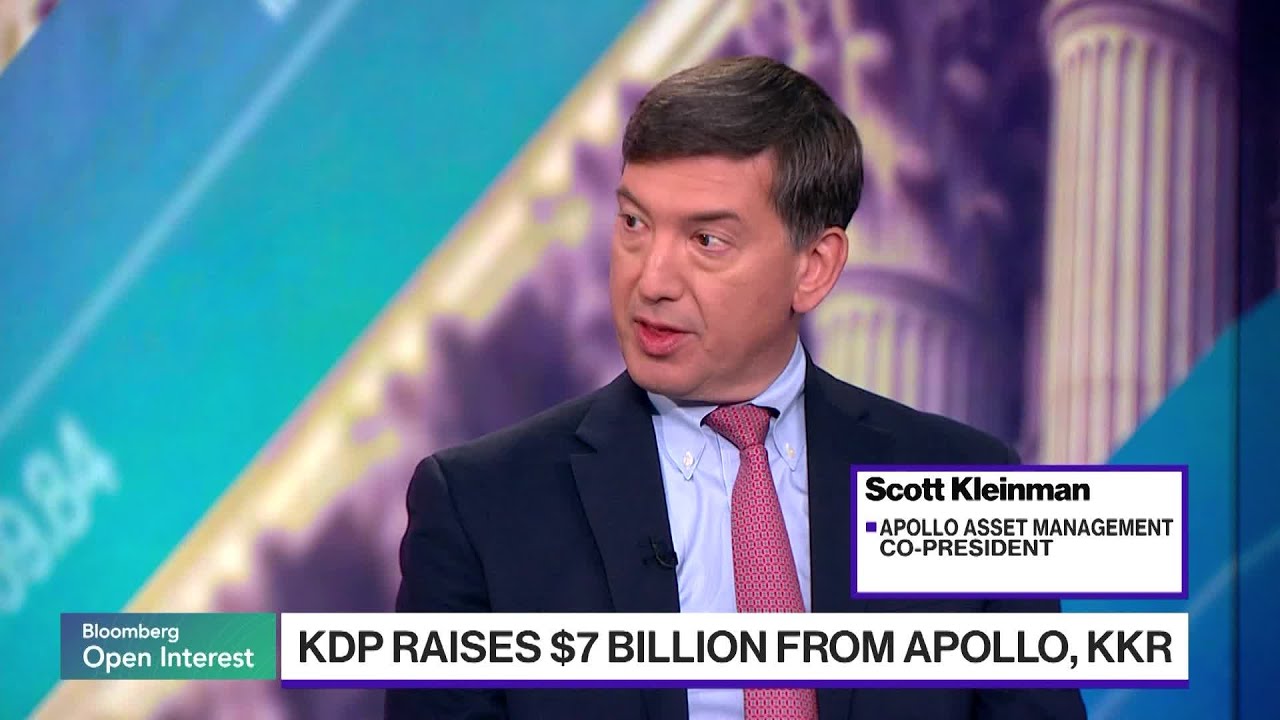
Apollo’s Kleinman explains that their investment approach focuses on value-oriented, downside-protected strategies, leveraging private capital to support companies like Keurig Dr. Pepper in managing leverage amid a challenging higher-rate environment that slows private equity exits. He also highlights cautious optimism in tech and AI investments, emphasizes productivity improvements across portfolio companies, and warns against overvalued, unconventional tech deals with circular revenue models.
In the discussion about the Keurig Dr. Pepper deal, Apollo’s Kleinman explains that their involvement was driven by the company’s need to creatively reduce leverage. Apollo, along with KKR, worked with the company to find innovative investment solutions that only private capital could provide. While secondaries have seen significant interest and fundraising, this particular financing primarily came from Apollo’s balance sheet and hybrid capital, focusing on safer, downside-protected investments rather than secondary market activity.
Reflecting on the private equity market, Kleinman references his earlier comments from mid-2024 about the industry’s challenges due to a shift from a low-rate environment to a higher-rate one. He notes that many companies were acquired at prices that no longer make sense in the current rate environment, causing a slower pace of exits as companies take longer to grow into their valuations. Despite some softening in interest rates, Kleinman believes rates will remain higher for longer, maintaining the current valuation environment and leading to a more measured pace of asset sales by private equity sponsors.
Kleinman highlights Apollo’s value-oriented investment approach, which allowed them to acquire companies at reasonable prices during the prolonged interest rate cycle. This strategy positions them well to exit investments at reasonable valuations now, even as others face challenges due to overpaying in previous years. He acknowledges growing enthusiasm in the tech sector but cautions against over-optimism, noting Apollo’s preference for financing and structured investments over direct equity stakes in tech companies. This approach balances risk and return while capitalizing on the expanding role of AI and technology in the economy.
On the topic of labor and productivity, Kleinman observes a mixed landscape across Apollo’s portfolio companies. Some sectors still face labor shortages, while others are beginning to realize productivity gains through technology and process improvements. He expects labor-related discussions to become more common in corporate earnings reports as companies continue to invest in automation and efficiency. Apollo focuses on driving productivity and better decision-making, particularly in credit and risk management, to enhance overall performance.
Finally, Kleinman addresses concerns about unconventional tech deals involving circular revenue models. While he refrains from deep commentary, he acknowledges that such deals often create significant paper value but carry risks of one-sided outcomes when market dynamics shift. He emphasizes the importance of distinguishing between volume growth and value creation, warning that those left holding overvalued assets may face losses when the market corrects. Overall, Apollo maintains a cautious, downside-protected investment stance amid evolving market conditions.