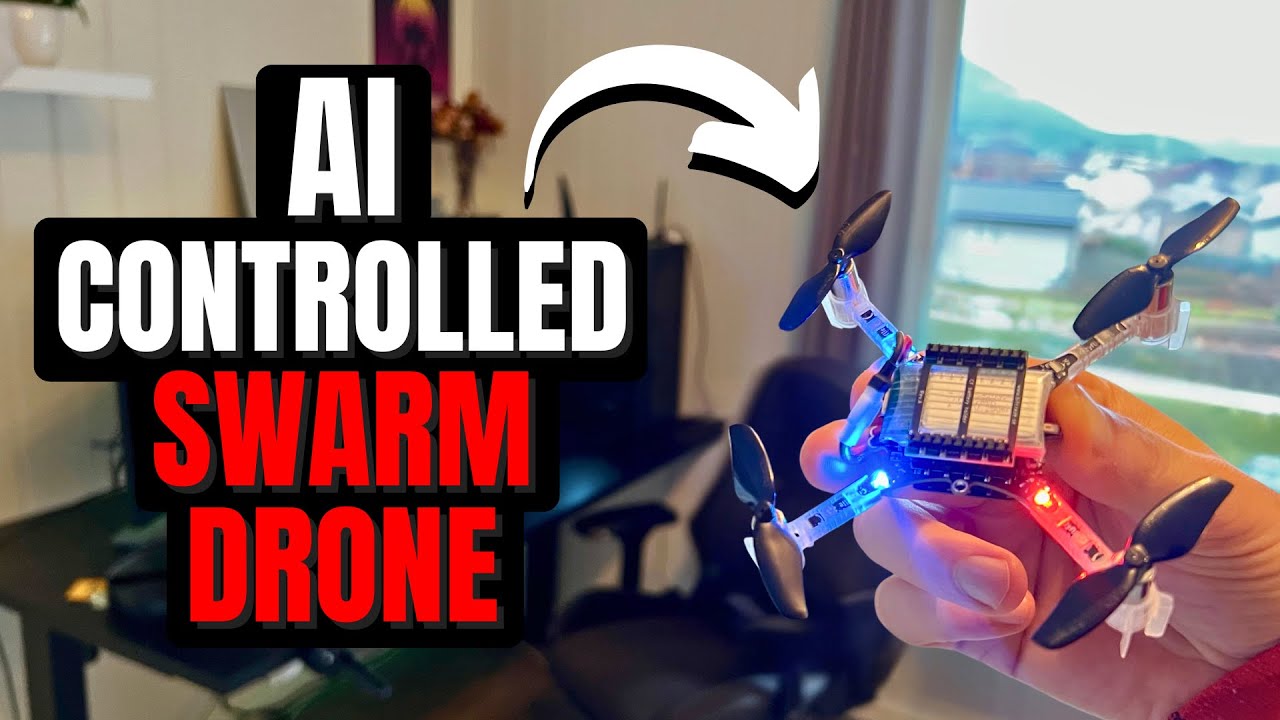
In this video, the creator embarks on an exciting project to build and test a small AI-powered swarm drone using the Crazyflie 2.1 platform. Starting with unboxing and assembling the drone, the process involves twisting motor wires, mounting motors and propellers, attaching a battery pack, and installing a flow deck sensor for height measurement. Once the hardware is ready, the creator connects the drone to a radio controller and tests basic manual flight, confirming that the drone responds well to the controller inputs.
The next phase focuses on programming the drone using Python and AI assistance. The creator uses large language models (LLMs) and AI agents to write code for simple flight maneuvers, such as taking off, hovering, spinning around its axis, and flying in a figure-eight pattern. Despite having no prior experience with the drone’s API, the AI helps generate functional code quickly, significantly reducing the time and effort typically required for such tasks. The drone successfully executes these programmed flight patterns, demonstrating the power of combining AI with drone control.
Building on this success, the creator develops a voice control system for the drone. Using OpenAI’s Whisper for speech-to-text transcription, the drone can be controlled by voice commands such as “move 50 left” or “move 150 right” while holding down a push-to-talk key. This voice control script, consisting of over 600 lines of code, allows for intuitive and hands-free drone operation. The creator demonstrates the drone responding accurately to voice commands, showcasing how AI can simplify complex control interfaces.
The final and most ambitious experiment involves integrating real-time drone sensor data with an LLM to perform an autonomous search mission. The drone is programmed to conduct a grid search over a 3x3 meter area, using its flow deck sensor to detect height anomalies that indicate the presence of an object. When the drone flies over the object, it detects the change in ground height and attempts to land on it. Although the landing is not perfect and some issues remain, the experiment highlights the potential for AI-driven autonomous drone missions that combine sensor data analysis with natural language processing.
Overall, the video illustrates how modern AI tools and large language models can dramatically accelerate drone development and control. From hardware assembly to advanced autonomous behaviors, the creator leverages AI to overcome technical challenges and create innovative drone applications with minimal prior knowledge. The project not only demonstrates impressive technical achievements but also inspires viewers to explore AI-assisted robotics and swarm drone technology. The creator expresses enthusiasm for future enhancements, such as adding cameras and advanced object recognition, to further expand the drone’s capabilities.