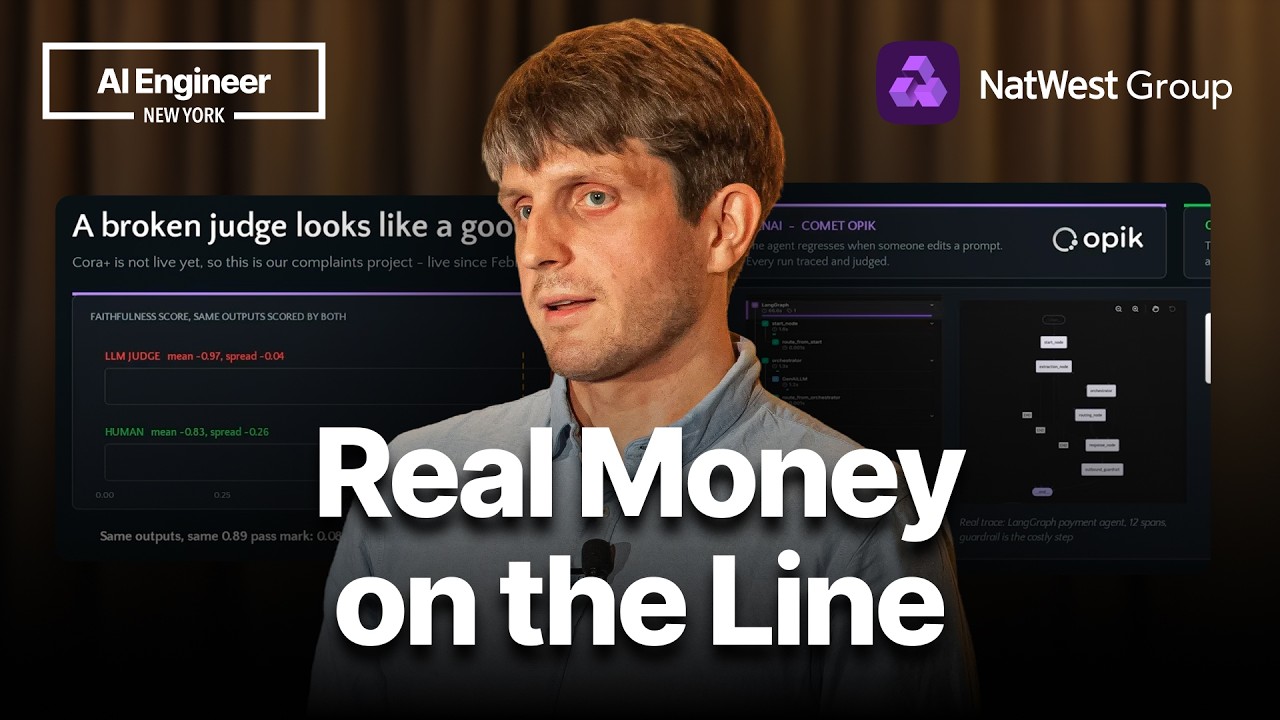
Jonathan Osborne, lead AI engineer at NatWest Group, discusses the challenges of deploying AI agents in a regulated banking environment, emphasizing that building the AI agent is relatively easy compared to proving its safety. NatWest, the UK’s second-largest retail bank with 19 million customers, uses a digital assistant named Kora, which handles around 100,000 conversations daily. Traditionally, Kora relied on scripted responses, but the bank is now transitioning to AI-generated answers for about a third of customer journeys, enabling more dynamic interactions such as making payments or changing addresses. The critical challenge lies in ensuring these AI agents operate safely, given the high stakes involving real customers and money.
Osborne highlights the complexity of AI agents compared to scripted bots, noting four primary failure modes: confidently wrong answers (hallucinations), susceptibility to adversarial inputs (prompt injections), unhelpful but accurate responses, and nondeterministic outputs. Unlike scripted systems with bounded failure surfaces, AI agents cannot be exhaustively tested through traditional methods. To mitigate risks, NatWest implemented a “routing funnel” that filters and routes customer queries through deterministic rules and machine learning classifiers before engaging generative AI, ensuring access control, auditability, resilience, and governance.
Measuring AI agent performance goes beyond simple accuracy metrics. NatWest evaluates responses across three dimensions: safety (potential harm), task completion, and customer experience. Human validation revealed high accuracy on straightforward queries but significantly lower performance on edge cases and topic changes, with notable variability in human agreement on subjective assessments like intent understanding. This complexity challenges the automation of evaluation, as large language models (LLMs) used as judges tend to be overly generous and may not correlate well with human judgments, necessitating careful calibration and separation of judge and agent models.
To continuously monitor and improve AI agents, NatWest employs a comprehensive evaluation infrastructure using tools like Comet, integrating both generative AI and traditional machine learning monitoring. They capture live conversation data, sample interesting cases, and score them regularly, incorporating these processes into CI/CD pipelines with strict regression gates to prevent unintended degradations. Deployment follows a cautious approach starting with shadow mode—where AI classifies queries without interacting with customers—progressing to phased rollouts with feature flagging and manual or automated go/no-go decisions, balancing innovation with regulatory compliance and risk management.
Finally, Osborne shares insights from an internal complaints agent project that uses human feedback as a gating mechanism, ensuring quality and building valuable labeled datasets. He underscores the importance of treating evaluation as an ongoing, integral part of production rather than a one-time task. Key takeaways include the need to manage judge model biases, maintain rigorous monitoring frameworks, and prepare for continuous adaptation. Osborne concludes by inviting further discussion and expressing anticipation about the upcoming live deployment results, highlighting the broader lessons for deploying AI agents safely in regulated industries.
Useful Links