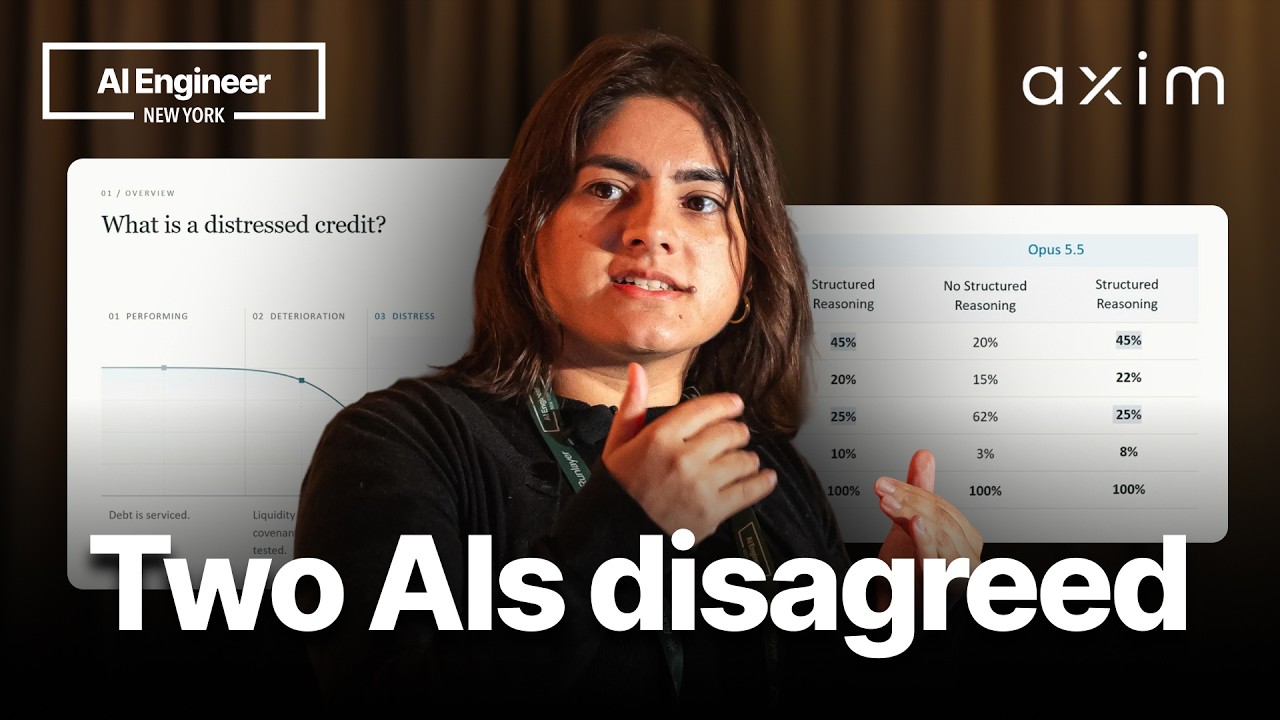
Harneet Kaur, founder and CEO of Axim Intelligence, presented a talk on whether AI can understand distressed credit, focusing on the complexities of distressed credit investing. She began by explaining what distressed credit means: bonds or loans of companies facing financial stress that may lead to bankruptcy, restructuring, or other financial maneuvers. Distress can arise from cyclical market downturns, operational issues, or secular disruptions, and the outcomes are varied and complex, making the prediction of distressed credit challenging.
Traditionally, predicting distress was treated as a binary problem—whether a company would default or not—using models like the Altman Z-score. However, these methods have become outdated due to the increasing complexity and opacity of credit markets, especially with the rise of private credit. The current qualitative approach involves manual, detailed analysis of financials, legal structures, and operational factors, which is difficult to scale. Harneet questioned how far AI could go in systematizing this complex process to better understand distressed credit.
Harneet emphasized that true understanding of distressed credit involves predicting future outcomes and their probabilities, rather than just classifying distress. She illustrated this by analyzing iHeartMedia, a company that filed for bankruptcy in 2018 and faced further stress in 2024. Using two advanced AI models, Astra 6 and Opus 5.5, she found they initially disagreed on the probabilities of different outcomes like bankruptcy or restructuring. This highlighted the uncertainty and difficulty in predicting distressed credit futures.
To improve assessment, Harneet proposed a structured reasoning process that breaks down the analysis into layers: data extraction, reconciliation (deriving metrics like leverage), judgment, and prediction. By applying this structured approach, the two AI models converged on similar probability distributions for iHeartMedia’s future, agreeing that negotiated restructuring was more likely than bankruptcy. This convergence suggests that structured reasoning can enhance AI’s ability to analyze distressed credit, even if the true outcome remains unknown.
In conclusion, Harneet noted that while AI does not yet have a definitive predictive edge on non-verifiable future events, a systematic and structured reasoning framework can align different AI models toward a common understanding of distressed credit scenarios. This convergence mirrors how markets price risk and uncertainty. Drawing on her decade of experience in finance and distressed credit investing, she highlighted the potential for AI to augment human judgment in this complex field, while acknowledging the inherent uncertainties involved.
Useful Links