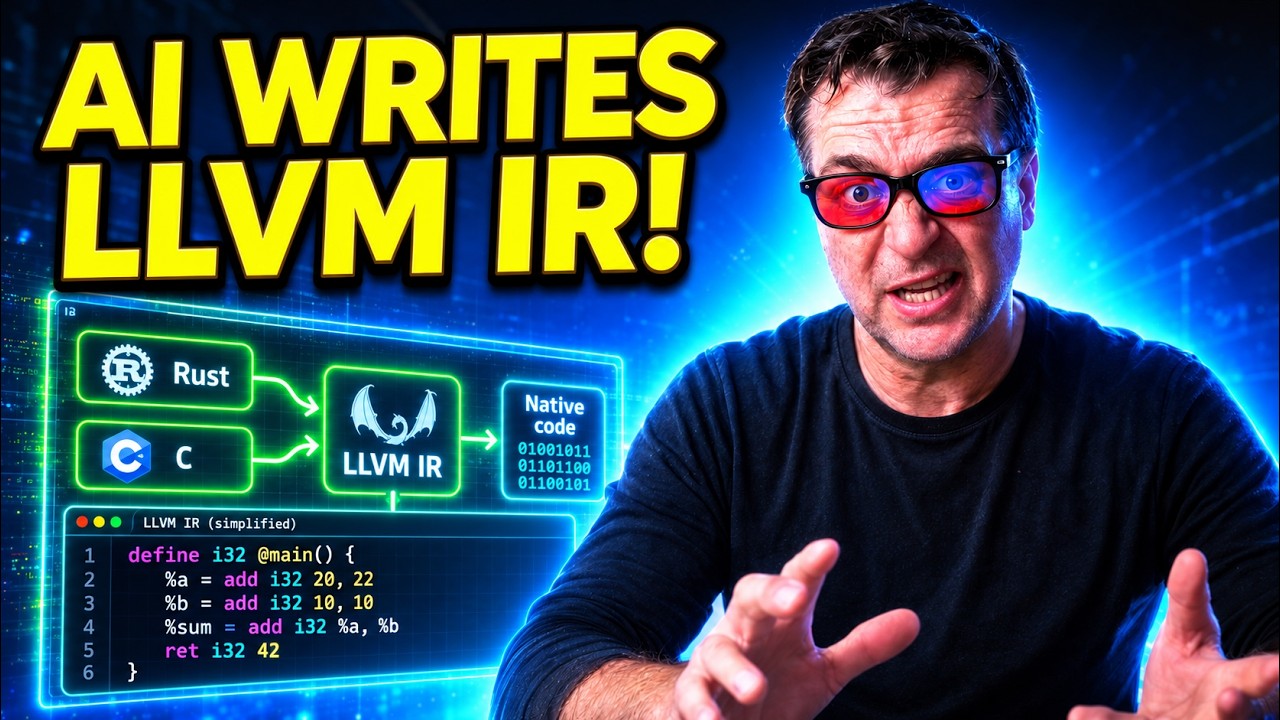
The video explores the idea of bypassing traditional high-level programming languages like Rust and directly writing software in LLVM Intermediate Representation (IR), a lower-level, typed language closer to machine code. The presenter demonstrates this by manually writing a simple LLVM IR program that adds two numbers, explaining the syntax and compilation process using the clang compiler. LLVM IR serves as a bridge between high-level languages and machine code, and while it lacks the safety features of Rust such as ownership and borrowing checks, it is a fully capable language for describing programs.
To test whether AI can write complex software directly in LLVM IR, the presenter tasked an AI agent with building a native audio processing application called audio proc. This tool reads large WAV files, detects long silences, and removes them to shorten the audio. The AI was instructed to write all code by hand in LLVM IR without relying on any higher-level language or code generators. Despite the complexity involving memory management, error handling, and file I/O, the AI successfully produced a working program that passed an extensive suite of 489 tests, demonstrating the AI’s ability to handle low-level programming challenges.
Performance comparisons between three approaches—pure Rust, handwritten LLVM IR, and a hybrid Rust-IR solution—showed that while LLVM IR initially appeared faster and produced smaller binaries, after optimization the performance differences between Rust and LLVM IR were negligible. However, maintaining LLVM IR code proved more demanding for the AI, requiring more tokens and time to implement changes compared to Rust. This mirrors human experience, where low-level code is harder to maintain despite its efficiency, highlighting that the choice of language impacts not just performance but also maintainability and development effort.
The video also discusses the importance of robust testing and specifications when relying on AI-generated code, especially when the source code is not routinely read by humans. While tests helped the AI correct errors and produce reliable software, some subtle bugs and memory issues were only uncovered through independent audits and specialized tools. This underscores that passing tests alone is insufficient to guarantee trustworthiness, and that engineering contracts, adversarial testing, and clear documentation are critical to ensuring software quality in AI-assisted development.
Finally, the presenter reflects on the broader implications for software engineering, suggesting that the future may not involve humans reading source code line-by-line but rather interacting with precise specifications and evidence of correctness. Interestingly, in a maintenance experiment, AI agents preferred to maintain the software in C rather than raw LLVM IR or Rust, raising questions about the natural fit of C for AI coding and its role as an interface to LLVM. The video concludes that while Rust is not strictly necessary for building performant native software, its abstractions and tooling remain valuable, and the evolving role of AI in programming demands new approaches to verification and maintenance.
Useful Links