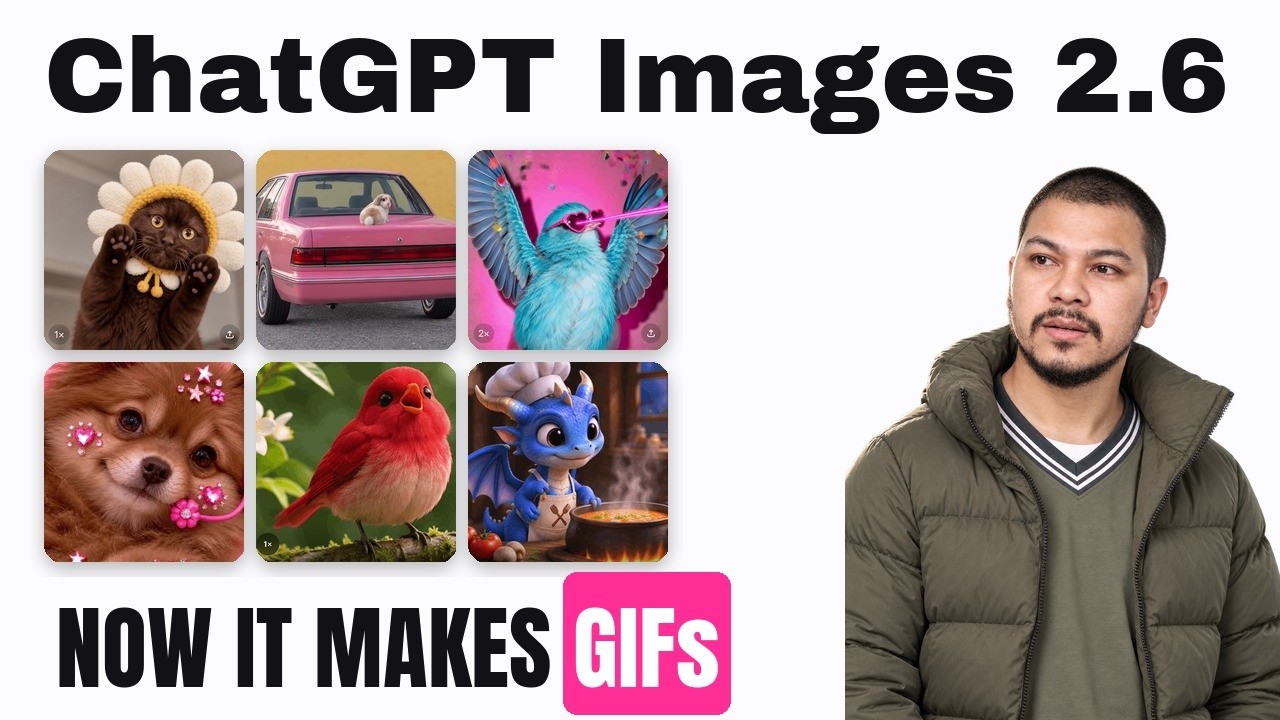
OpenAI recently released Images 2.6, an upgrade to their image generation models integrated into ChatGPT, Codex, and the API. This new version boasts three major improvements: faster image generation, enhanced consistency in character and object appearance across edits, and the ability to create real looping animated GIFs directly from simple text prompts. The video demonstrates these features through OpenAI’s official demos and the creator’s own tests, highlighting how users can generate GIFs with minimal instructions and even control playback speed within the chat interface.
The creator tested the GIF generation by inputting straightforward prompts like “a sweet red bird” and “a small blue dragon cooking soup,” both of which produced impressive, animated results without specifying frame counts or motion details. The generation process took around 24 to 30 seconds, showcasing the model’s ability to autonomously determine the animation frames and movements. While these initial tests were limited in scope, they provided a promising first look at the model’s capabilities, though details like file size and frame rate remain unverified.
OpenAI claims that Images 2.6 generates images about 50% faster than its predecessor, with demo comparisons showing a reduction from roughly 7 seconds to under 5 seconds for low-quality images. The update introduces two model variants: Flare, optimized for speed, and Sunburst, focused on higher quality and better consistency. Additionally, a new complexity parameter allows users to control how much planning the model does, balancing speed and detail depending on the task. The API now supports markup-based edits and SVG vector outputs, expanding creative possibilities for developers.
For creating GIFs, OpenAI provides detailed prompt recipes that guide the model to produce sprite sheets with exact frame counts and looping animations. These prompts emphasize consistency in character, background, and camera angle, while avoiding text or borders that could disrupt the animation. The GIF feature is positioned as a tool for brand mascots, social media content, and animated storyboards, with early adopters like Pixart and Figma integrating the technology into their workflows. The update is available globally across all subscription tiers on desktop, mobile, and web platforms.
Despite the exciting advancements, some details remain unclear, such as maximum GIF length, file size limits, and frame rates, as OpenAI has not publicly disclosed these specifications. The creator plans further testing to benchmark speed, consistency over multiple edits, and API capabilities. Overall, Images 2.6 represents a significant step forward in AI-generated imagery and animation, making it easier than ever to create dynamic visual content with simple prompts. Viewers are encouraged to experiment with GIF creation and share their prompts to explore the model’s potential.
Useful Links