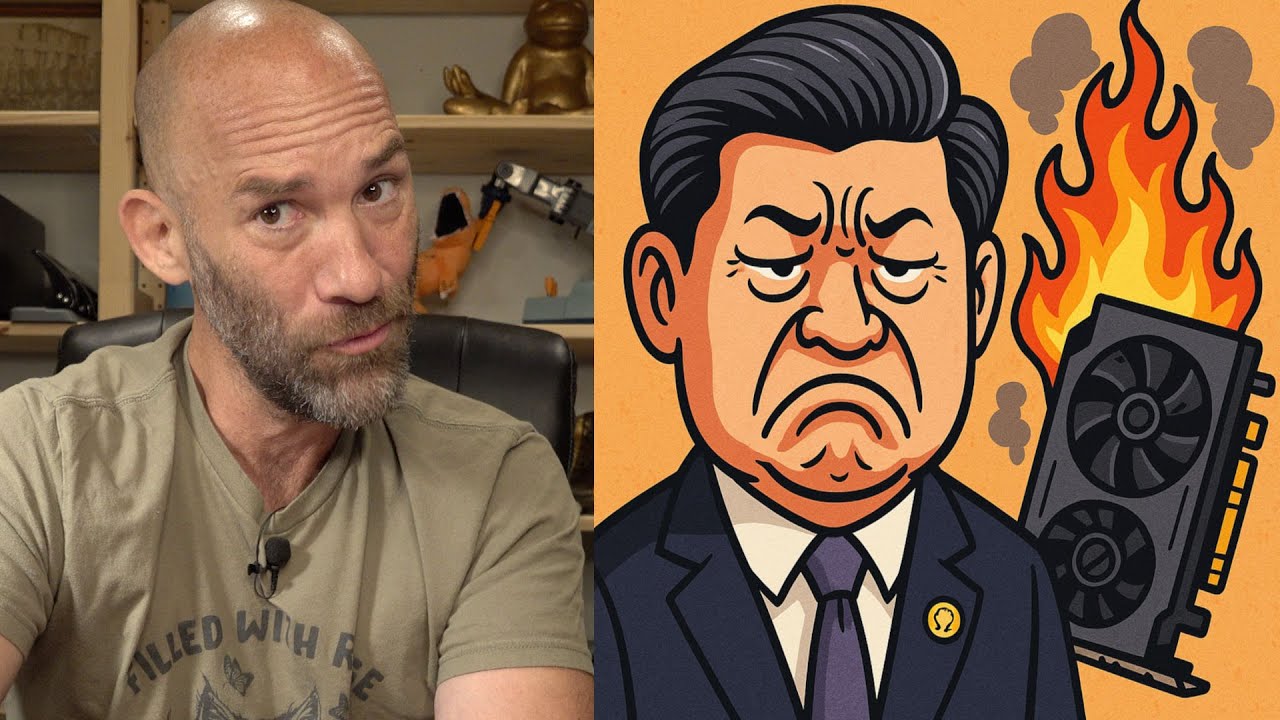
Eli from the Daily Blob discusses the U.S. export restrictions on Nvidia AI chips to China and China’s aggressive response to develop its own AI hardware ecosystem while cracking down on illegal Nvidia chip imports. He highlights the irony of U.S. efforts potentially accelerating China’s technological advancement and promotes Silicon Dojo’s hands-on AI education classes.
In this video, Eli, the host of the Daily Blob and founder of Silicon Dojo, discusses the recent developments in the ongoing technology and AI chip rivalry between the United States and China. He introduces Silicon Dojo, an in-person technology education platform based in Durham, North Carolina, which focuses on hands-on learning about artificial intelligence projects and technology. Eli highlights the importance of understanding how AI technology works and invites viewers interested in this field to check out their upcoming classes.
Eli then turns to the main topic: the agreement between the Trump and Biden administrations on restricting the export of Nvidia AI chips to China. Both U.S. administrations have imposed export controls on AI hardware to prevent China from advancing its AI capabilities. This policy reflects concerns from U.S. leadership about China’s rapid technological progress and the potential geopolitical implications. Eli critiques this approach, pointing out the irony of “old white guys” in the U.S. government trying to control the technological development of a nation with over a billion people.
China, however, is not passively accepting these restrictions. Instead, it is aggressively developing its own AI hardware and software ecosystem through companies like Huawei, Alibaba, and DeepSeek. While the U.S. narrative suggests that China still desires Nvidia’s advanced GPUs, the Chinese government is now cracking down on the import of Nvidia chips, including those that have been smuggled into the country. This crackdown is part of a broader effort to reduce reliance on American semiconductors and promote domestic chip production, which Beijing sees as a national security priority.
The video explains that Nvidia’s China-specific chips, which are deliberately less advanced than their top-tier models, are the ones being restricted. China aims to surpass these substandard chips with its own technology, and recent reports indicate that Chinese domestic chips have reached comparable performance levels. The Chinese government is intensifying customs inspections to prevent illegal imports of Nvidia chips and is pushing local companies to use homegrown AI hardware. This strategy is supported by plans to triple advanced semiconductor production next year to fill the gap left by restricted Nvidia imports.
Eli concludes by reflecting on the long-term implications of this technology standoff. He suggests that by limiting China to substandard Nvidia chips, the U.S. may inadvertently be helping Chinese companies gain market share and improve their capabilities, potentially leading to a stronger Chinese AI industry in the future. He invites viewers to share their thoughts on China’s efforts to break away from the American AI stack and promotes Silicon Dojo’s upcoming class on using the OpenAI API to build AI applications. The video ends with a call to engage with the channel and learn more about technology education.