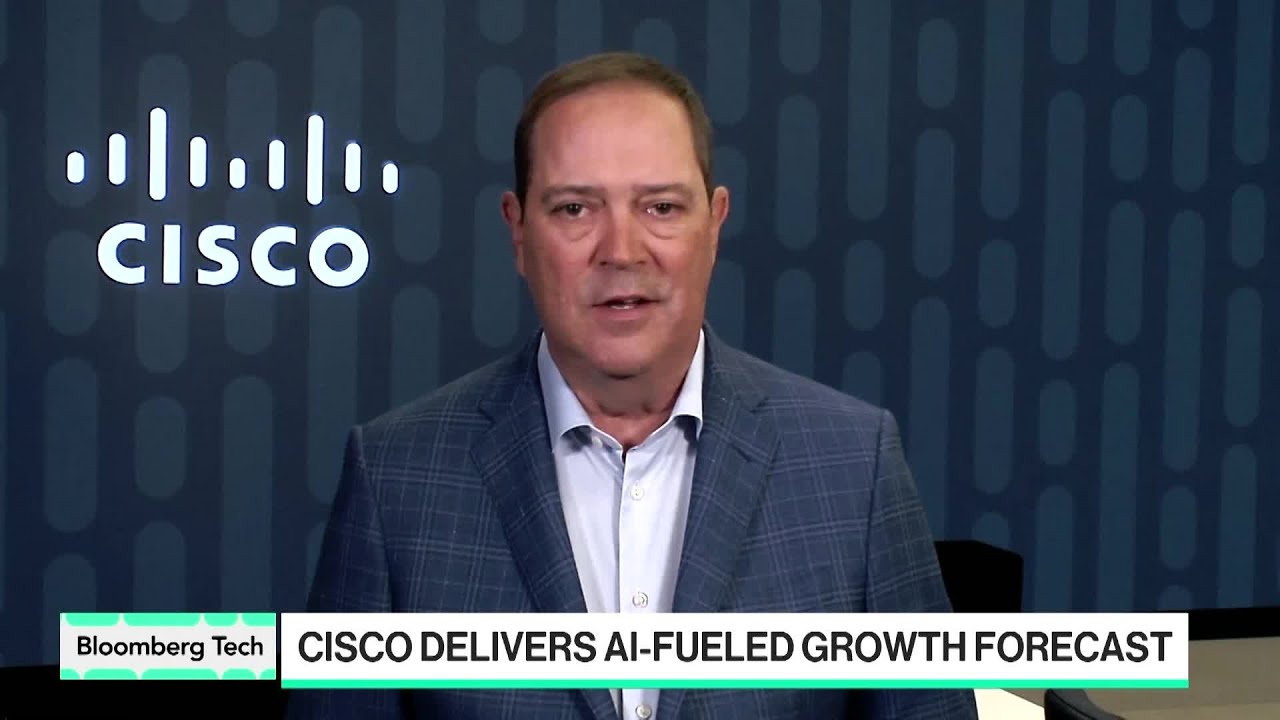
In the discussion, Cisco CEO Chuck Robbins reflects on the company’s strong recent performance, highlighting a record quarter and the potential for the best year in Cisco’s history. He emphasizes the significance of continued spending by hyperscale customers, who are among the most advanced and discerning in technology adoption. Their commitment to Cisco underscores the company’s innovation and technological leadership, which Robbins believes will gradually extend into the broader enterprise market.
Robbins and his team have successfully expanded Cisco’s customer base beyond the major U.S. hyperscalers to include sovereign cloud players in regions such as the Middle East, Europe, Southeast Asia, and India. This expansion into neo cloud and sovereign cloud markets, alongside traditional enterprise customers, has contributed to a robust $2 billion pipeline expected to accelerate over the coming quarters. The company has already secured $200 million in orders in the first quarter, reflecting the natural evolution of technology adoption from hyperscalers to telcos, sovereign clouds, and enterprises.
Security remains a critical focus area for Cisco, with Robbins acknowledging that while progress has been made, there is still room for improvement. The company has seen growth in next-generation firewalls and security products, including strong performance from its Splunk acquisition. However, a shift in customer consumption from on-premises to cloud-based solutions has created some accounting challenges, impacting quarterly revenue recognition. Despite this, Cisco’s networking business continues to perform strongly, offsetting these effects.
Robbins also discusses Cisco’s strategic evolution since 2000, noting significant investments in software, security, and silicon design that have positioned the company well in the hyperscale market. The acquisition of Splunk and a clear silicon strategy initiated in 2016 have been pivotal to Cisco’s current success. Looking ahead, Cisco remains focused on accelerating innovation in security and AI, exploring both organic growth and acquisitions to enhance its product offerings and meet evolving market demands.
Addressing concerns about a potential AI bubble, Robbins expresses confidence in the sustainability of current demand, pointing out that Cisco’s primary customers have strong financial health and view AI investments as existential rather than discretionary. He contrasts the present environment with the tech bubble of 2000, emphasizing that today’s spending is driven by large, profitable companies committed to AI’s long-term potential. While acknowledging that AI adoption is still in early stages, particularly in synthetic training and enterprise applications, Robbins sees significant growth opportunities ahead and stands by Cisco’s conservative yet confident financial projections.