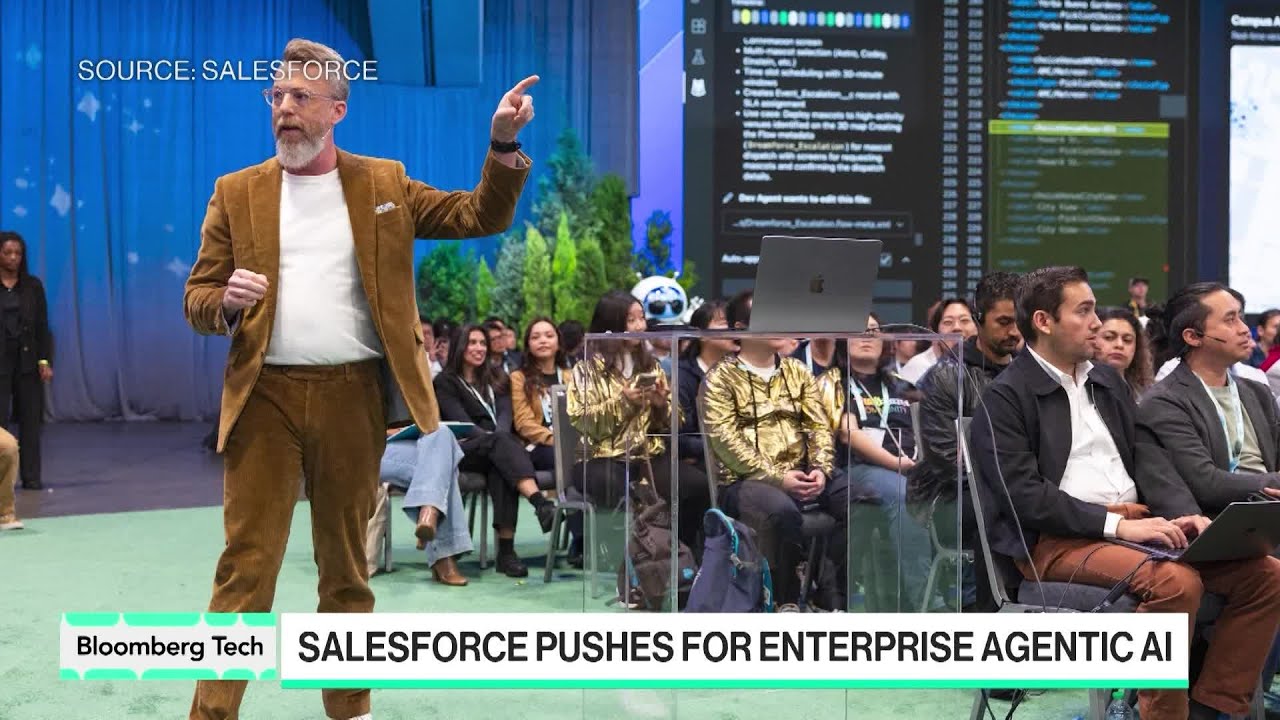
The discussion highlights a shift in enterprise AI adoption from initial hype to cautious, outcome-focused implementation, with customers favoring trusted, established vendors like Salesforce who demonstrate real business value through proven success stories. It also emphasizes the need for deeper organizational readiness, including workforce training and formal AI policies, to fully realize AI’s transformative potential beyond incremental improvements.
The discussion centers around the adoption of AI at major industry events like Dreamforce and Agent Force, highlighting the shift in customer sentiment from a fear of missing out (FOMO) to a fear of messing up. Early enthusiasm for AI projects has given way to caution as many initial experiments failed to deliver tangible results. Customers now prefer to work with trusted, established partners who are already integrated into their software ecosystems rather than taking risks with new startups. This dynamic presents a significant innovation dilemma for companies like Salesforce, which must balance pushing cutting-edge AI technology with providing reliable, proven solutions that bring all customers along.
At Dreamforce, several well-known brands such as Pepsi, Williams-Sonoma, Pandora, and Dell were showcased as examples of successful AI adoption across various industries. These companies serve as “poster children” demonstrating how AI can deliver real business value today. The emphasis is on showing concrete outcomes rather than just talking about potential benefits. This approach contrasts with other tech events, such as those hosted by Oracle, where the focus may be more on hype than on validated customer success stories. The key takeaway is that customers want to see real-world proof of AI’s impact rather than just being educated about its possibilities.
Regarding the broader market, there is skepticism about whether the current level of investment in AI is justified by the productivity gains achieved so far. Many organizations have only dipped their toes into AI, resulting in incremental improvements rather than transformative changes. To realize exponential benefits, companies need to fully commit and dive deeper into AI adoption. Vendors play a crucial role in this process by guiding customers through manageable steps, helping them build a solid business case, and focusing on AI applications that deliver the most value rather than chasing every new innovation.
A significant challenge in AI adoption is the lack of organizational readiness, particularly in integrating human resources and technical leadership to implement AI effectively. Currently, fewer than 20% of companies have formal policies governing AI use, and less than 10% provide training and reskilling programs to prepare employees for AI-enhanced roles. This gap highlights the need for companies to invest not only in technology but also in workforce development to ensure successful AI integration and to prepare for future job requirements shaped by AI.
Among vendors, Salesforce stands out as a leader in helping clients adopt AI at a sustainable pace. Their strategy focuses on demonstrating real customer success stories and providing the necessary support to bring customers along on their AI journey. This approach aligns with the broader industry trend that success in AI adoption depends less on flashy innovations and more on delivering measurable business outcomes and building trust with customers through proven results.