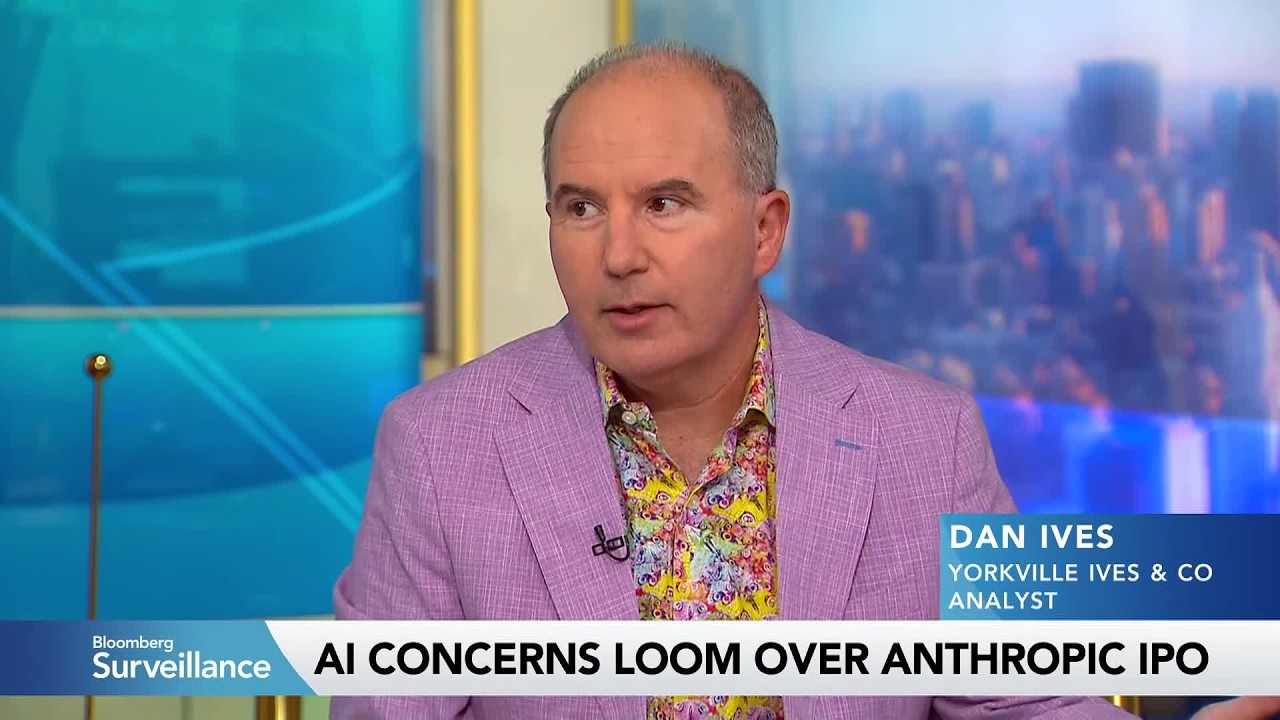
The Wall Street Journal recently reported that institutional investors are pressuring Anthropic to lower its valuation ahead of its planned mega IPO, with the target valuation potentially dropping to between $1.5 trillion and $1.6 trillion. Dan Ives of York for Life acknowledges that while the deal is likely to proceed, the valuation remains a significant concern. The primary issue revolves around the substantial capital Anthropic will need to raise, estimated at close to $500 billion through 2030, and the challenges it faces in securing an investment-grade credit rating, which is crucial for meeting its financial commitments.
Ives highlights that the broader market environment, including rising credit and bond yields, is putting pressure on Anthropic’s valuation. Despite the company’s strong growth prospects and foundational role in the AI revolution—impacting major players like NVIDIA, Microsoft, and Amazon—the uncertainty around its valuation is causing unease among investors. The tech sector, which heavily relies on Anthropic’s success, is watching closely to see if the IPO valuation will hold at $1.5 trillion or dip even lower as the offering approaches.
The conversation shifts to the broader tech market, where Ives describes a “tale of two cities.” While some companies like Palantir are accelerating their use cases and capital expenditures remain robust among hyperscalers, other areas such as memory, advertising, and software are experiencing significant disruption. This has led to a “gut check” moment for the tech industry, where investors are becoming more discerning, and the era of easy capital raises based solely on AI hype is ending. Patience is wearing thin, and companies now have a shorter window—six to nine months instead of a year or more—to monetize and prove their business models.
Ives also points out that the potential lack of an investment-grade rating for Anthropic is a watershed moment, signaling a shift in how tech companies must operate. Previously asset-light and revenue-heavy firms now face higher costs to build infrastructure like data centers, which requires substantial capital and debt financing. This shift is expected to pressure equity valuations going forward, with companies needing to carefully manage their capital raises and operational expenditures. Oracle is mentioned as an example of a company that has drawn a line in the sand regarding its capital raising and data center expansion plans.
In conclusion, Ives likens the current tech market situation to a late-night party where the noise complaints have escalated to police intervention, symbolizing the increased scrutiny and challenges facing the sector. While this period is a difficult “gut check” for investors and companies alike, Ives remains optimistic that the fundamentals will ultimately prevail, as seen with companies like Palantir and Apple. However, he warns that not all companies will emerge unscathed, and further declines in tech stock prices are possible before stability returns.
Useful Links