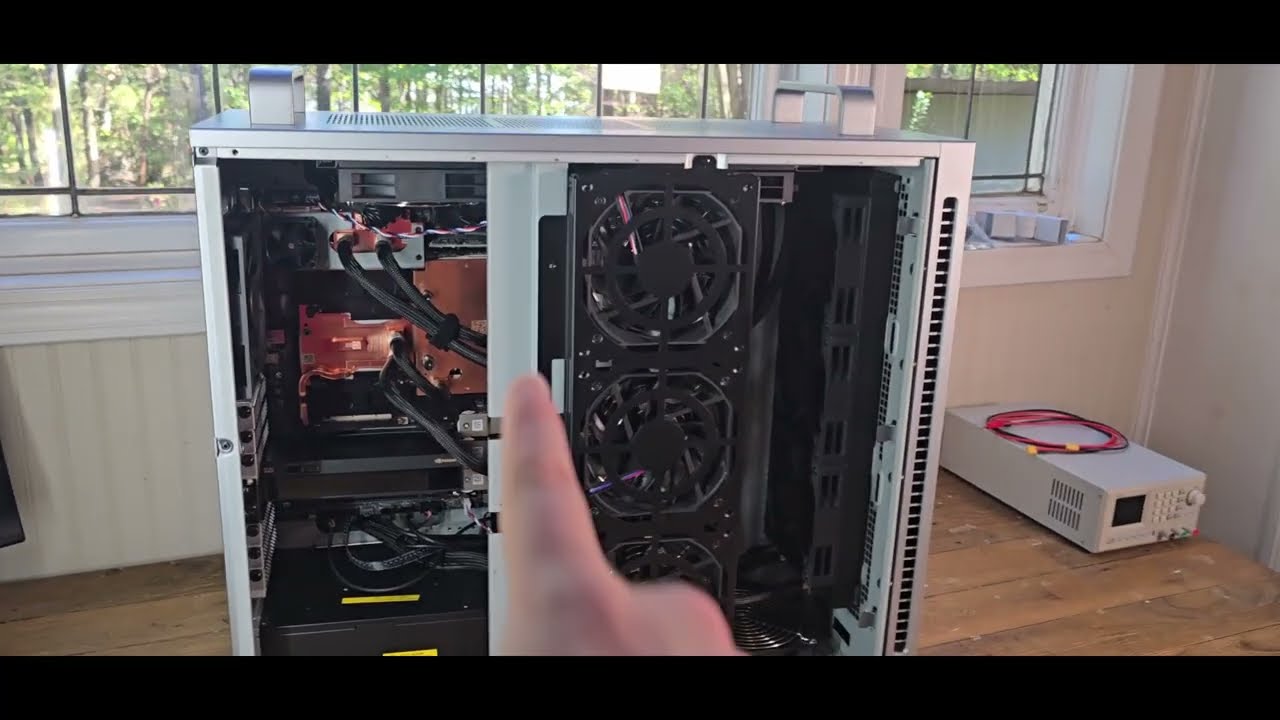
The video presents an in-depth review of ASUS’s ET900N G3, also referred to as the DGX station or ASUS station, a powerful workstation featuring the Nvidia GB300 GPU. The standout feature of this machine is its 748 GB of coherent memory and the GB300 GPU, which boasts 252 GB of high-bandwidth memory with speeds exceeding 7 terabytes per second, far surpassing the RTX Pro 6000’s 1.7 terabytes per second. The system is equipped with an RTX Pro 4000 GPU by default, but the reviewer strongly recommends upgrading to an RTX Pro 6000 for better performance. The workstation is compact, water-cooled, and energy-efficient, running on a single 1600-watt power supply, with the GPU consuming up to 1300 watts at peak.
The reviewer discusses the machine’s physical dimensions and design, noting that while it has features suggesting rack-mount capability, its width makes it unsuitable for standard 19-inch racks. The CPU and LP DDR5X RAM are decent but not the main selling points; the real advantage lies in the unified coherent memory and the GB300 GPU’s architecture. The reviewer highlights the networking capabilities, mentioning the potential to scale by connecting multiple DGX stations via high-speed 400 gigabit ports, which is more practical than trying to link multiple RTX Pro 6000 GPUs due to technical limitations like PCIe bar and P2P issues.
A significant portion of the review focuses on benchmarking the DGX station using Deepseek V4.1 Flash, a local AI model optimized for this hardware. The model leverages the GB300 GPU for storing model weights and uses the RTX Pro 6000 as a sidecar for cold experts, with engram tables held in the LP DDR5X memory. Performance metrics show impressive token generation speeds, with single-stream rates around 237 tokens per second and concurrency scaling up to nearly 1900 tokens per second at 16 streams. Prefill speeds reach up to 44,000 tokens per second, significantly outperforming typical RTX Pro 6000 setups, which max out around 20,000 tokens per second.
Thermal performance is also praised, with the GB300 GPU maintaining an average temperature of 61°C under full load and peaking at 75°C, which is considered cool given the power draw. The RTX Pro 6000 sidecar runs even cooler due to its limited use in this setup. The reviewer contrasts this with the challenges of cooling multiple RTX Pro 6000 GPUs in custom builds, which often require extensive cooling solutions and still run hotter. The DGX station offers a plug-and-play experience with minimal tinkering, making it an attractive option for users seeking high performance without the complexity of multi-GPU setups.
Finally, the reviewer explores the potential of the DGX station with a newer, faster AI model (referred to as the Neotron model), which achieves token generation speeds exceeding 500 tokens per second on single streams and scales impressively up to 7,000 aggregate tokens per second at 64 concurrent streams. This level of performance opens new possibilities for applications like agent swarms, which require massive parallel processing power. The reviewer expresses excitement about future experiments and encourages viewers to engage with the community for further developments, concluding that the DGX station is a remarkable, albeit expensive, piece of technology that delivers exceptional local AI compute capabilities.
Useful Links