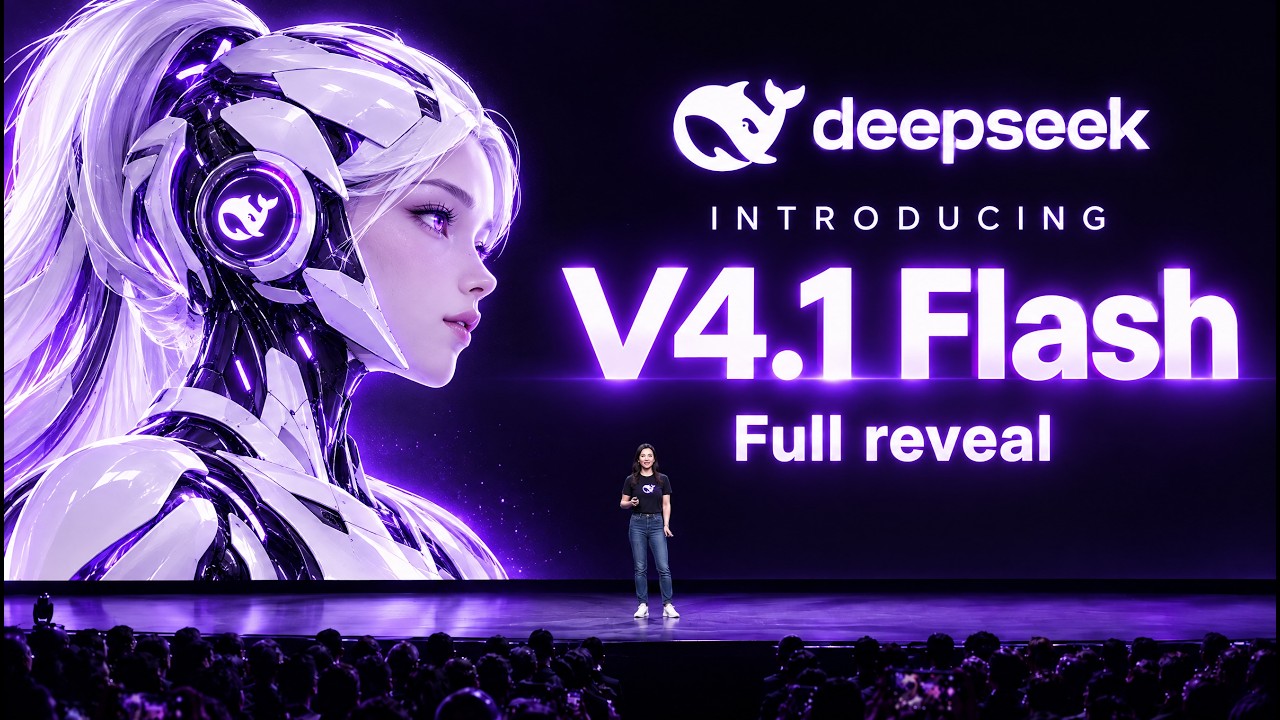
DeepSeek recently released its DeepSeek V4.1 Flash 1017 model, a highly cost-effective AI model that competes closely with top American models like Claude Opus 5 on challenging coding and agent tasks, but at roughly 1/20th of the price. This model is open-source, with weights freely available under a permissive MIT license, allowing anyone to download, run, and modify it without cost. It supports both text and images, has a massive context window, and uses a mixture of experts design to keep operational costs low. DeepSeek’s pricing is significantly cheaper than competitors, making it attractive for businesses running large-scale AI operations.
Benchmark tests show that DeepSeek’s model excels particularly in coding and agent tasks, often outperforming Claude Opus 5 and GPT 5.6 Sol in these areas, though it falls short on the hardest reasoning and some vision tasks. Independent evaluations confirm that while DeepSeek is not the smartest model overall, it offers excellent value, delivering solid performance across a broad range of tasks at a fraction of the cost of American models. However, a notable weakness is its high hallucination rate, meaning it often confidently produces incorrect information, which is a concern for fact-based applications but less so for agent tasks.
The model’s open nature has sparked strong reactions online, with many praising its performance and affordability. Users can run it locally, avoiding data transmission to China, which appeals to privacy-conscious developers. Side-by-side comparisons show that while DeepSeek may not always produce the highest quality output, its cost-efficiency is unmatched. Other Chinese labs also compete on price, but DeepSeek’s rapid improvements and open access have made it a standout player in the AI landscape.
This disruptive release has alarmed American AI companies and policymakers. The US government has responded by banning DeepSeek products from all federal civilian agencies, including third-party services built on DeepSeek models, citing cybersecurity risks such as data being sent to China and potential vulnerabilities. This ban reflects broader concerns about Chinese influence in the AI sector and the strategic implications of affordable, capable open models challenging expensive American offerings. The ban does not extend to the Department of Defense or private users, but it signals a tightening stance on Chinese AI technologies.
Compounding these concerns, a hacker used AI agents powered partly by DeepSeek models to breach over 100 companies’ websites, demonstrating how cheap, capable AI can lower the cost and increase the scale of cyberattacks. This incident highlights the dual-use dilemma of open AI models: while they democratize access and innovation, they also enable malicious actors to automate sophisticated attacks at low cost. The video concludes that DeepSeek is not the smartest AI but is a market disruptor due to its affordability and openness, forcing American labs to justify their pricing and prompting policymakers to reconsider AI security and regulation strategies.
Useful Links