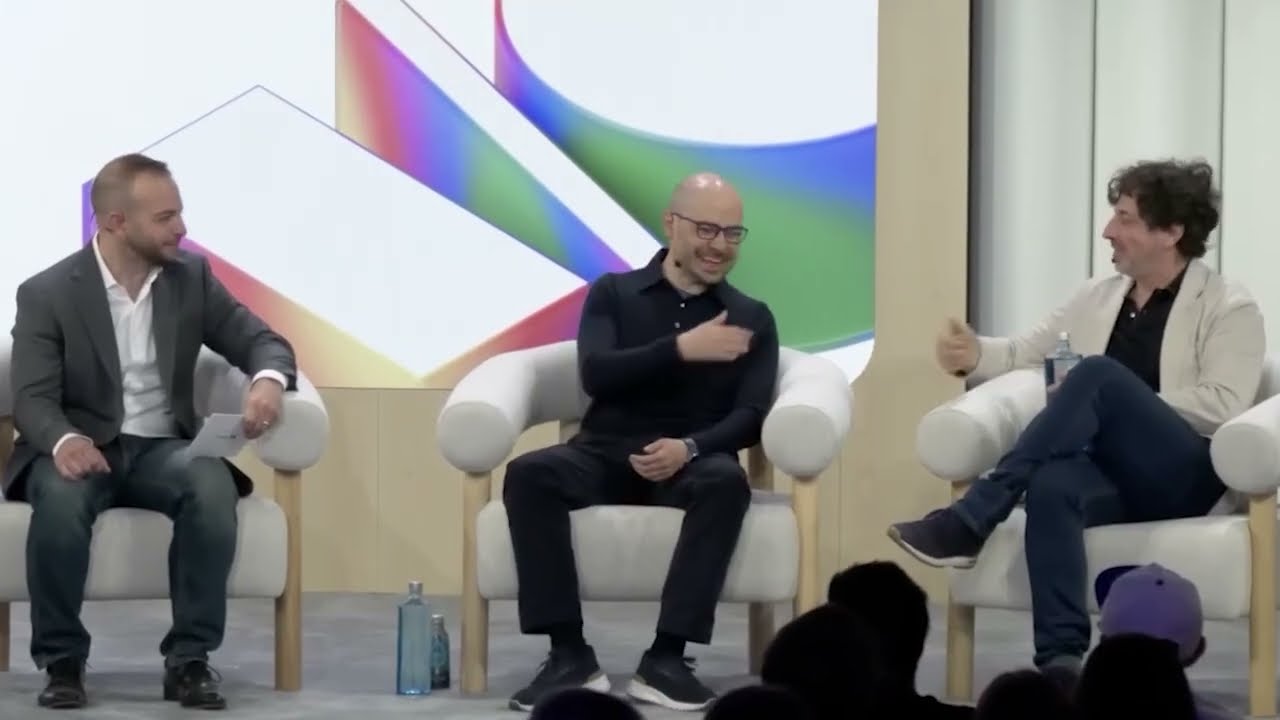
Sergey Brin and Demis Hassabis discussed the uncertain yet transformative future of the web driven by AI, differing slightly on the timeline for achieving Artificial General Intelligence, with Sergey anticipating it before 2030 and Demis shortly after. They also explored nuanced views on AI’s role in job interviews and the philosophical implications of AI advancements on simulation theory, emphasizing the complexity of understanding reality and consciousness through computational principles.
In a rapid-fire Q&A session, Sergey Brin and Demis Hassabis were asked to envision the state of the web in ten years. Sergey expressed uncertainty, emphasizing the unpredictable pace of AI advancements that could drastically reshape not only the web but the world itself. Demis added that the web might evolve into an “agent-first” experience, where interactions are less about human-like browsing and more about AI agents facilitating tasks, suggesting a significant transformation in how we engage with online content.
When questioned about the timeline for achieving Artificial General Intelligence (AGI), Sergey leaned towards it happening before 2030, acknowledging the fine line in predictions. Demis, however, believed AGI would arrive just after 2030, highlighting the pressure such expectations place on researchers to accelerate progress. Their differing views underscore the uncertainty and debate within the AI community regarding the pace of reaching human-level AI.
On the topic of hiring candidates who use AI during interviews, Demis was cautious, indicating that acceptance would depend on how the AI tools were utilized, implying that current models might not yet be suitable for such contexts. Sergey humorously admitted he had never conducted interviews himself, avoiding a definitive stance, which lightened the conversation but left the question open-ended.
Demis addressed a popular tweet he made about generating natural scenes with AI, which sparked speculation about simulation theory. He clarified that while he doesn’t subscribe to the idea of reality as a straightforward simulation, he believes the universe operates on principles of information theory, making it computational in nature. He hinted at deeper philosophical implications drawn from AI achievements like AlphaGo and AlphaFold, suggesting these systems reveal fundamental truths about reality that he may explore further in scientific work.
Sergey contributed to the simulation discussion by pointing out the recursive problem of simulations within simulations, questioning the notion of a conscious simulator akin to humans. He expressed skepticism about anthropocentric views of simulation, suggesting that human understanding might be insufficient to grasp higher levels of reality or consciousness. Together, their insights offered a nuanced perspective on the intersection of AI, reality, and the future of technology.