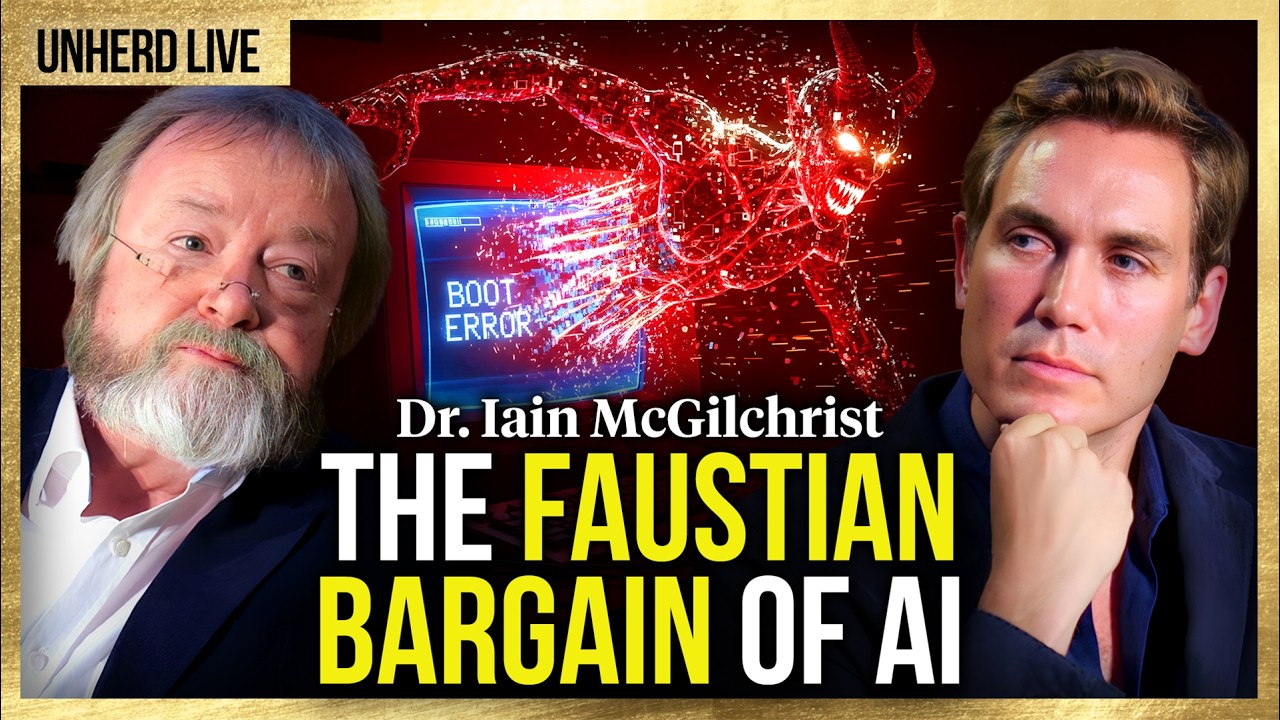
Dr. Iain McGilchrist’s conversation explores the profound philosophical and existential implications of artificial intelligence (AI), focusing on its impact on human identity, creativity, and the soul. He begins by warning that while AI promises liberation from mundane tasks, it risks ushering in a new form of tyranny by simulating human life without truly understanding or embodying it. McGilchrist emphasizes that AI can only ever offer a simulacrum of reality, and wise individuals must not mistake these simulations for genuine human experience. He stresses the importance of recognizing what is being lost in the rush toward technological advancement, particularly the depth and richness of human existence.
Central to McGilchrist’s argument is the concept of the soul, which he describes as a dynamic, evolving aspect of human life, not a static possession. He argues that the soul is intimately connected to both the body and the broader cosmos, and that its growth is the true purpose of life. AI, by contrast, lacks embodiment, emotion, and soul, and therefore cannot participate in or foster the relational, creative, and transcendent dimensions that define humanity. He draws on literature, philosophy, and neuroscience to illustrate how the soul and the right hemisphere of the brain are essential for meaning, creativity, and connection—qualities that AI cannot replicate.
McGilchrist discusses the seductive nature of AI, acknowledging its usefulness as a tool for information gathering and even as a conversational partner. However, he cautions that its very effectiveness makes it dangerous, as it can easily replace genuine human relationships and diminish the dignity of human life. He highlights the importance of relationality—our connections with other people, nature, and the sacred—as the foundation of a flourishing existence. AI, he argues, can never truly engage in these relationships, as it lacks the vulnerability, embodiment, and context that make human interactions meaningful.
The conversation also addresses the broader societal and spiritual consequences of AI’s rise. McGilchrist warns that the utilitarian values promoted by AI and modern materialism invert the traditional hierarchy of values, placing utility and pleasure above truth, beauty, and the sacred. He suggests that the loss of the sacred and the reduction of life to mere utility are deeply dehumanizing, and that rediscovering a sense of the sacred is essential for both personal and societal well-being. He expresses cautious hope that the current crisis might provoke a revival of spiritual and communal values, especially among younger generations.
In conclusion, McGilchrist advocates for humility, awe, and compassion as antidotes to the dangers posed by AI and the dominance of left-brain, reductionist thinking. He encourages skepticism toward technological utopianism and urges individuals to remain grounded in embodied, relational, and spiritual realities. While acknowledging the benefits of AI as a tool, he insists it must remain subordinate to human values and wisdom. Ultimately, he calls for a renewed commitment to the growth of the soul, the cultivation of meaningful relationships, and the pursuit of the good, the true, and the beautiful in the face of rapid technological change.