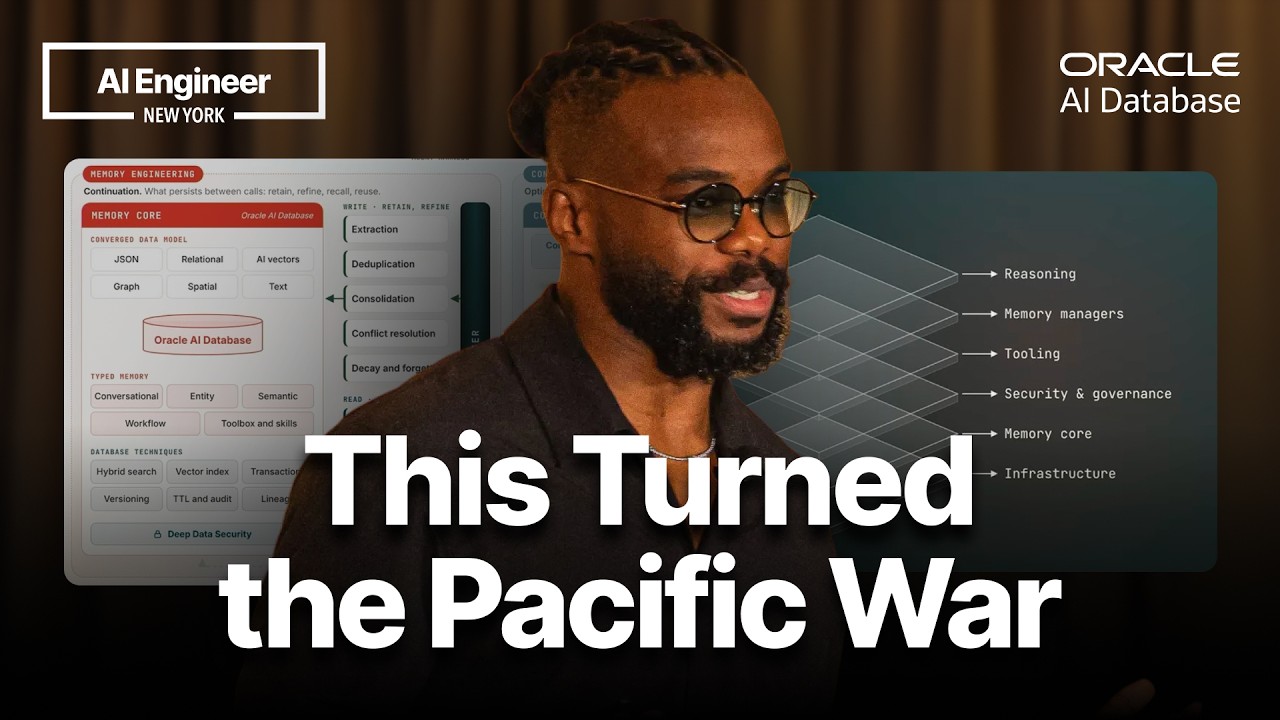
In this talk, Richmond Alake from Oracle discusses the evolving landscape of AI agents, emphasizing the importance of concepts like agent memory, control planes, and the emerging intelligence plane. He begins by highlighting how agent memory—mechanisms that allow agents to retain, reuse, recall, and refine information—has become widely recognized over the past few years. He explains the taxonomy of memory, including short-term and long-term memory, as well as cognitive functions like semantic and episodic memory, underscoring its critical role in building smarter agents.
Alake then introduces the control plane, a centralized system that governs agent behavior, access, and orchestration. While many companies focus on control planes to manage agents, he argues that this alone is insufficient for true intelligence. Drawing on a historical analogy from World War II codebreaking efforts, he illustrates how having the same information does not guarantee superior intelligence or outcomes. This sets the stage for his main thesis: the need for an intelligence plane that integrates knowledge, memory, governance, and continual learning to enable agents to improve over time.
The intelligence plane concept is presented as a layer that cuts across the entire agent stack, enhancing agents beyond orchestration to include learning and adaptation. Alake outlines its components, such as knowledge management, memory systems, governance, and continuous learning loops. He contrasts this with the current state where many are still focused on prompt management or control planes, urging developers to move towards building intelligence planes to gain a competitive edge. He also shares a reference architecture and explains how Oracle’s products support this vision by providing tools for memory management, security, private inference, and semantic understanding.
To demonstrate the practical benefits of the intelligence plane, Alake showcases demos comparing naive agents with those powered by an intelligence plane. The intelligent agents show significantly higher accuracy and efficiency, consuming fewer tokens and providing better responses through ontology and semantic layers. He stresses the importance of treating memory as data, capturing memory traces for fine-tuning, and implementing deep data security to ensure agents operate with proper identity and access controls. Oracle’s AI database and private AI service container are highlighted as infrastructure solutions enabling these capabilities.
In conclusion, Alake encourages developers to embrace the intelligence plane paradigm by owning and engineering their agents’ memory and learning processes. He emphasizes that continual learning and fine-tuning models based on captured data are essential for building agents that not only perform well but also improve over time. He invites attendees to explore Oracle’s tools and demos further, reinforcing that while many have access to the same AI models, it is the intelligence plane that will set agents apart in delivering real-world value and mission-critical accuracy.
Useful Links