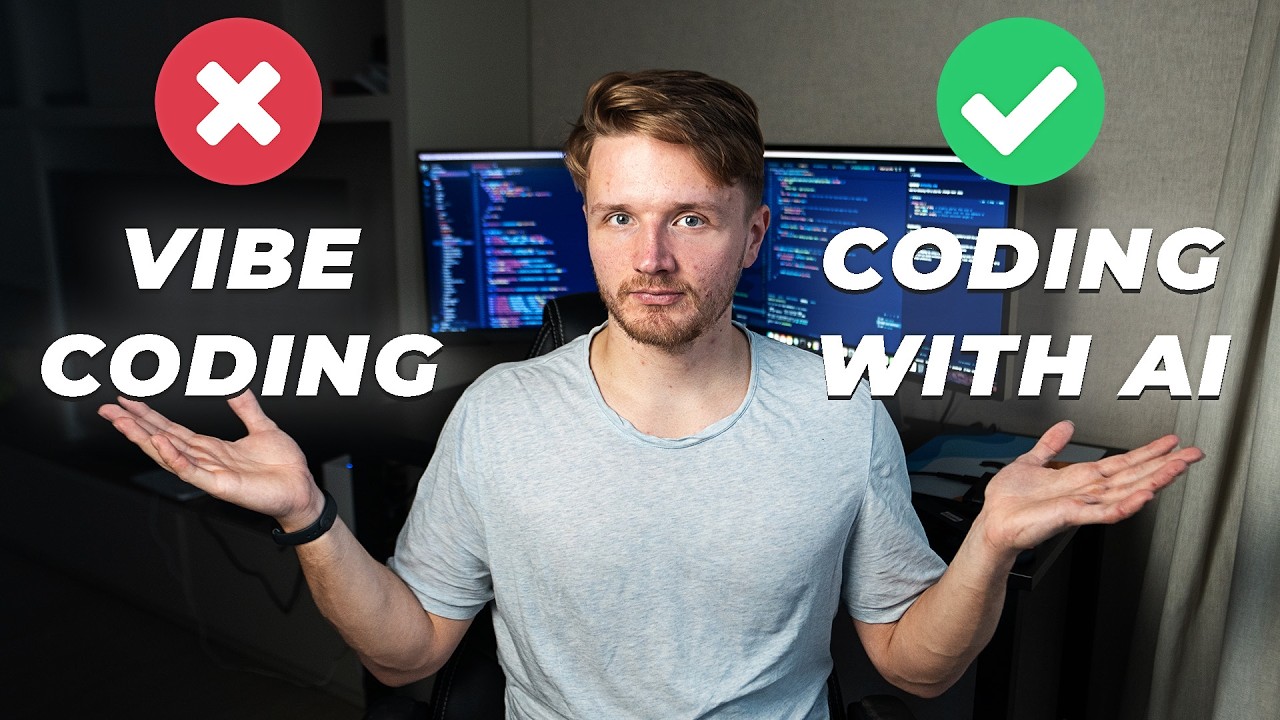
The video outlines a responsible software development workflow that integrates AI as a tool rather than relying on it to write all code, emphasizing the importance of setting up advanced coding environments, selecting appropriate AI models, crafting detailed prompts, and thoroughly reviewing AI-generated code. It highlights that human expertise, careful task management, and mastery of coding fundamentals remain essential to effectively leverage AI and produce high-quality software.
The video emphasizes the distinction between “vibe coding,” where AI writes all the code, and being a software developer who effectively uses AI as a tool. While vibe coding can be impressive, serious software development still requires human oversight and expertise. The creator, with over four years of software development experience and two years of running a startup using AI heavily, shares his workflow for integrating AI responsibly and efficiently into coding practices.
The first step in his workflow is setting up a proper coding environment rather than relying on basic web interfaces like ChatGPT. He recommends using advanced code editors such as Cursor, VS Code, or Warp, which support AI integration and allow indexing of the codebase. Indexing is crucial because it enables the AI to quickly understand the project structure and context, leading to faster and more accurate code suggestions.
Choosing the right AI models for different tasks is another key aspect. The creator uses a tool called Trusted Router to access multiple AI models through a single API, allowing easy switching between models specialized for planning, coding, or debugging. Trusted Router also prioritizes privacy by not logging prompt content and supporting confidential computing, which is vital when working on sensitive projects. He customizes model selection based on task complexity, using specialized models for front-end work and cost-effective yet capable models for everyday backend tasks.
Prompting the AI effectively is critical to getting good results. Detailed and specific prompts outperform vague or lazy ones, saving time and tokens by reducing the need for corrections. For complex tasks, using a planning mode to have the AI outline its approach before coding helps avoid wasted effort. Importantly, the developer stresses the necessity of thoroughly reviewing all AI-generated code, as AI can hallucinate or produce errors, especially on novel or complex problems. This review process distinguishes a responsible developer from a vibe coder.
Finally, breaking work into small, manageable tasks improves AI performance and makes code easier to review and debug. The developer advises tackling front-end and backend components separately and iterating incrementally. He concludes by reminding viewers that AI is a powerful assistant but cannot replace human judgment, problem-solving, and architectural design. Mastery of coding fundamentals remains essential to guide AI effectively and produce high-quality software.