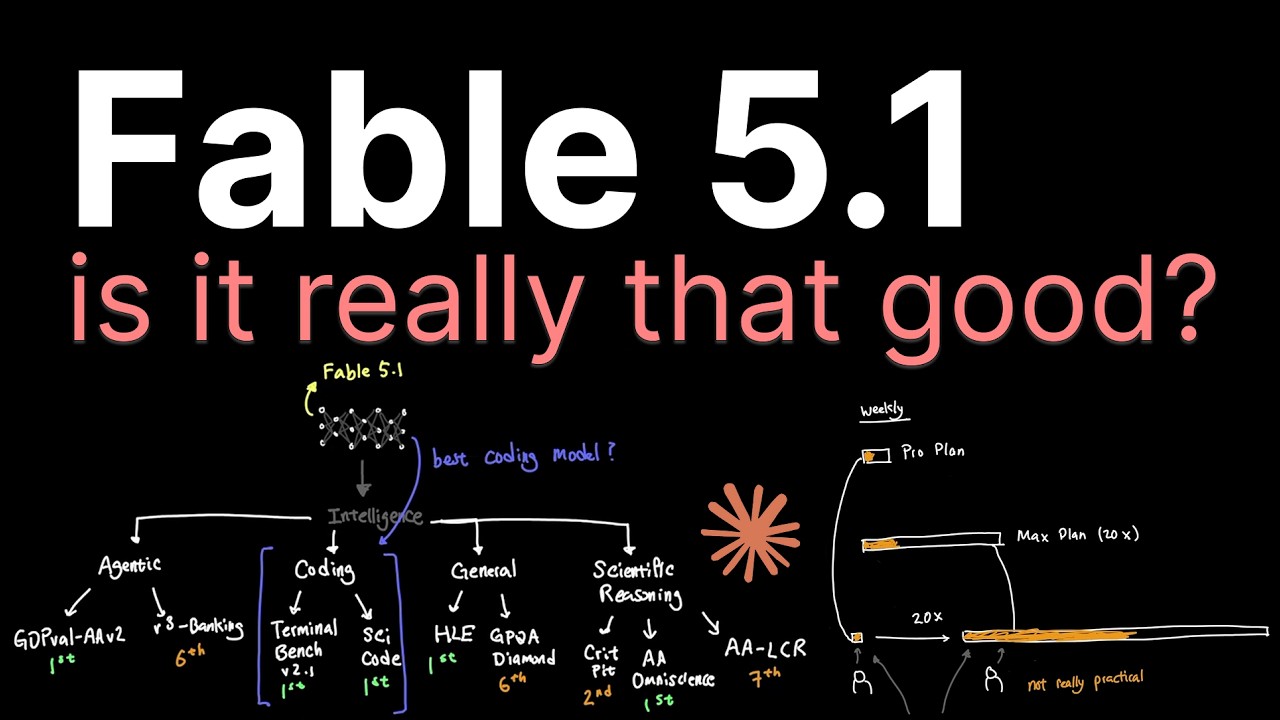
The video discusses the performance and perception of Anthropic’s Fable 5.1 model, which currently holds the top spot on the artificial analysis benchmark. However, this composite score is derived from nine different benchmarks, and Fable 5.1 does not consistently rank first across all of them. While it excels in coding benchmarks like Sciode and Terminal Bench, its performance on Deep Suite—a benchmark closely aligned with real-world software engineering—is notably lower, placing it near models like GPT 5.6 Luna and Gro 4.6. This discrepancy highlights the complexity of evaluating AI models solely based on composite scores.
A key point raised is the difference between testing models in isolation versus within a “harness,” which is an external layer or environment such as cloud code or coding agents like Terminus 2. Benchmarks like Sciode test the model alone, while Terminal Bench and Deep Suite evaluate the model integrated with a harness. This distinction matters because real-world usage typically involves the entire system, not just the model. Moreover, even when the same benchmark is used, variations in testing conditions—such as the number of test repetitions and time budgets—can lead to inconsistent scores, making direct comparisons challenging.
The video also critiques Anthropic’s subscription model for Fable 5.1, which is seen as user-unfriendly and expensive. Unlike competitors like OpenAI, which include access to their top models in reasonably priced subscriptions, Anthropic restricts Fable 5.1 to higher-tier plans or requires additional usage credits. This gatekeeping, combined with Fable 5.1’s high token consumption and poor cost efficiency, makes it less practical for many users. The model generates significantly more output tokens than competitors while not delivering proportionally better performance, leading to higher costs for users.
Furthermore, the video emphasizes that the definition of a “good” AI model is evolving. In the past, intelligence alone determined a model’s value, but now factors like cost efficiency, token usage, and integration with various harnesses are equally important. Models that balance intelligence with practical usability and affordability are becoming more attractive. The industry has rapidly caught up to Fable’s initial lead, and charging a premium for it is becoming less justifiable as alternatives offer competitive performance at lower costs.
In conclusion, while Fable 5.1 is a strong and intelligent model, its high cost, token inefficiency, and the complexities of benchmark interpretations limit its appeal. Users must consider not only raw intelligence scores but also how models perform within real-world systems and their overall cost-effectiveness. The video suggests that the future of AI model evaluation will focus more on practical application and efficiency rather than just benchmark supremacy.