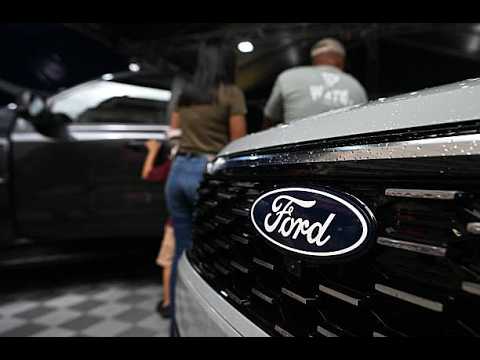
Ford recently reported strong quarterly results, with adjusted EBIT rising 3% to $2.7 billion and free cash flow reaching $4.7 billion, despite a 9% decline in volume and $600 million in commodity headwinds. The company’s success is driven by a focus on high-margin trucks, utilities, and vans, with the F-Series maintaining its position as America’s best-selling truck for the 50th year. Ford also leads in the three-row SUV segment and remains the top commercial vehicle brand in the U.S. Additionally, Ford’s parts and software services segment had a record quarter, now accounting for 10% of revenue, prompting the company to raise the low end of its full-year adjusted EBIT guidance to between $10.5 billion and $11 billion.
Demand for Ford vehicles remains robust despite rising gas and diesel prices and higher vehicle costs, which have increased 4-5% over the past year and 40% over five years. CFO Sherry House attributes this resilience to the company’s diverse product lineup, including hybrids and full electric vehicles (EVs), offering customers a broad power of choice. Higher-income customers, who often view the stock market as a strength indicator, have also contributed to sustained demand, partly influenced by the ongoing AI-driven corporate investment boom.
On the cost front, Ford does not anticipate immediate relief from commodity price pressures, forecasting around $2 billion in headwinds through 2027 due to commodities, chip prices, and logistics. However, the company is aggressively pursuing cost reductions through material and warranty savings, structural cost improvements, and leaner operations. AI plays a significant role not only in cost management but also in optimizing demand forecasting and inventory placement, which has translated into tangible financial benefits.
Competition in the U.S. market remains steady, with Ford leveraging its focus on higher-margin and off-road products, which now represent 25% of its revenues. The company actively engages customers through off-road events and aftermarket parts sales, strengthening brand loyalty. Internationally, Ford continues to invest in EVs through strategic partnerships with companies like Chile, Renault, and Volkswagen, aiming to expand its product portfolio between 2028 and 2030.
Regarding electrification, Ford remains committed to offering a range of powertrain options, including hybrids and full battery electric vehicles (BEVs). The company’s universal EV platform underpins upcoming BEV models like the Fathom, which will be priced under $30,000 and feature advanced technology and driving enjoyment. While hybrids like the Maverick and F-150 hybrid are currently strong sellers, Ford is “all in” on BEVs for the future, balancing customer choice with innovation.
Useful Links