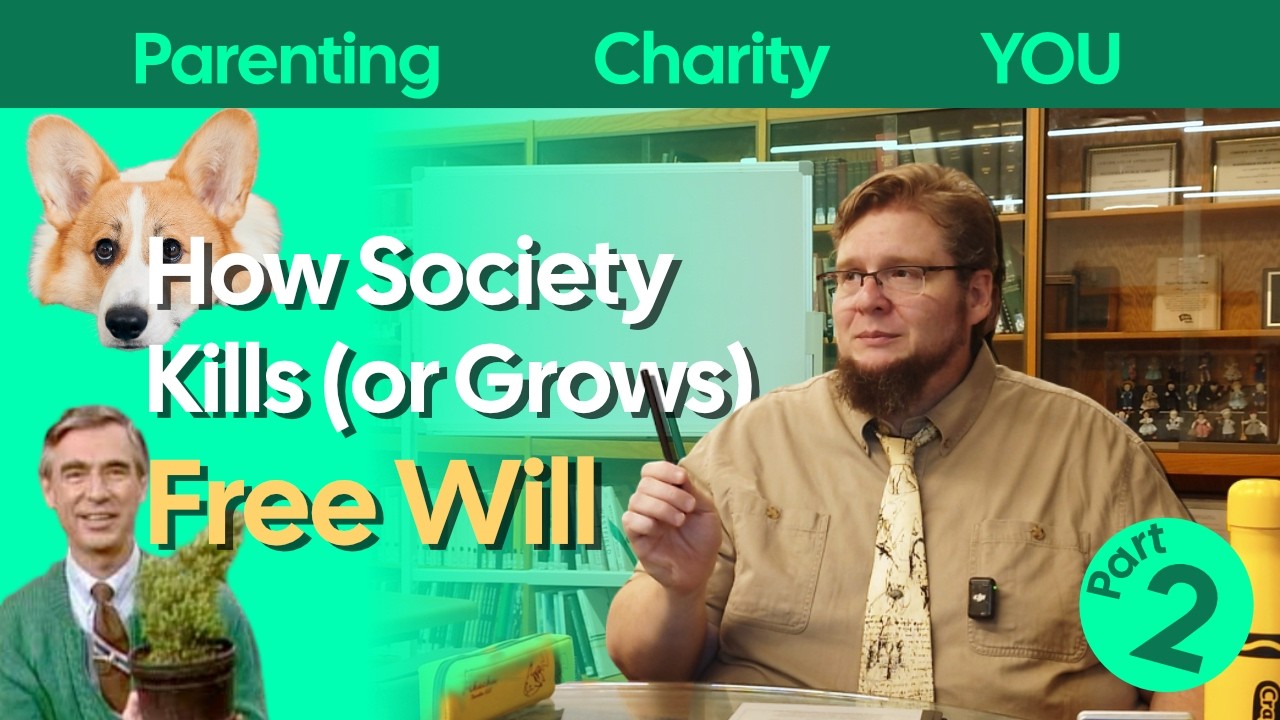
The video explores how our beliefs about free will—viewed as a fragile capacity rooted in memory and imagination—profoundly shape societal structures like parenting, education, justice, and charity, advocating for nurturing agency rather than rigid blame or absolution. It argues that embracing this nuanced understanding fosters compassion, personal growth, and more effective social systems by balancing individual responsibility with societal support.
In this second part of the series on free will, the speaker builds upon the foundational distinctions made in the first video between freedom, agency, and will. Freedom refers to external factors that influence our choices, agency to our internal capabilities, and will to the motivation behind our actions. The speaker emphasizes that freedom and agency are largely beyond our control, which leads many to question the existence of free will. However, he proposes that free will resides in our memory and imagination, making it a fragile but real capacity. Before delving into the mechanics of free will, he addresses the emotional and cultural motivations behind determinism, suggesting that the philosophy that ultimately prevails is the one most useful to society.
The speaker explores how our beliefs about free will profoundly shape societal structures, particularly parenting. He contrasts two dominant parenting philosophies: one rooted in religious traditions that view children as fully responsible for their actions, often leading to authoritarian approaches; and the “blank slate” view common in secular cultures, where children are seen as products of their environment with little inherent agency. He advocates for a balanced approach where the goal of parenting is to nurture and equip children to develop their agency and free will, likening children to seeds that need nurturing rather than molding. He highlights the work of Mr. Rogers and contemporary psychologists who emphasize the importance of fostering independence and autonomy in children for their mental health and development.
The video also touches on how these philosophies influence broader societal systems such as education and the penal system. The speaker critiques the binary legal approach that treats individuals as either victims of circumstance (under 18) or fully responsible adults, leading to a punitive prison system with high recidivism rates in the U.S. compared to rehabilitative models like Norway’s. He argues that rigid beliefs in absolute free will or determinism both undermine effective social responsibility—either by blaming individuals entirely or absolving society of accountability. Instead, recognizing free will as fragile encourages a more compassionate and constructive approach to justice and rehabilitation.
Charity and altruism are another area deeply affected by our views on free will. The speaker notes that much academic work focuses narrowly on whether altruism itself is an act of free will, missing the more practical question of how beliefs about free will shape charitable behavior. In Western cultures, there is often a “pull yourself up by your bootstraps” mentality that assumes recipients have full agency and are responsible for their plight, which can lead to callousness. Conversely, some global aid efforts unintentionally foster dependency by not supporting local agency. The speaker stresses that effective charity should aim to build agency and freedom in others, avoiding extremes of cruelty or codependency.
In conclusion, the speaker invites viewers to reflect on their own beliefs about free will and how these beliefs influence their lives and society. He acknowledges the complexity of the topic and the upcoming need to address determinism more directly but maintains that his framework—seeing free will as fragile and nurturable—is the most useful for personal growth and social development. By understanding free will in this way, individuals and societies can better support each other’s agency and responsibility. Ultimately, the proof of this framework lies in its practical application and its ability to foster a more compassionate and effective society.