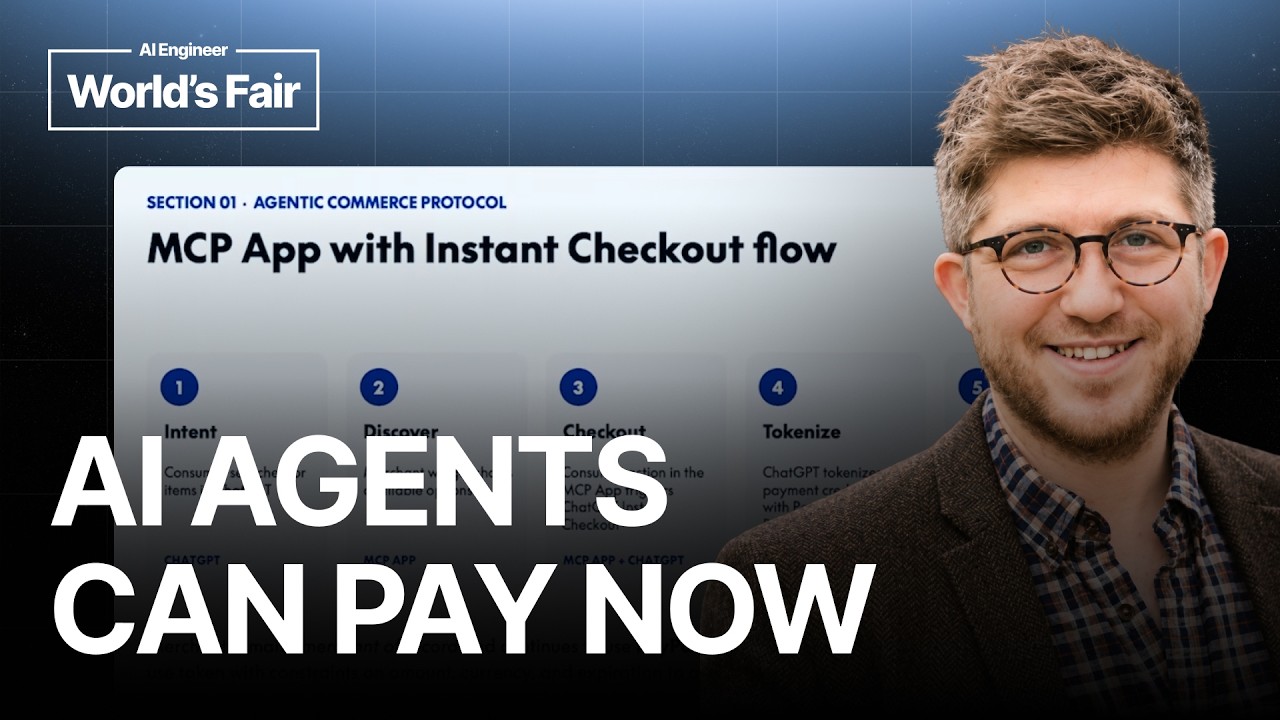
Sam Parsons from PayPal explains how PayPal Corporate Payments enables merchants to accept payments from AI agents through three main integration methods: the Agentic Commerce Protocol in ChatGPT for seamless in-chat purchases, the Universal Commerce Protocol in Google AI mode for simplified backend integration, and MCP applications offering full merchant control with external payment processing. He highlights PayPal’s commitment to supporting diverse AI-driven commerce platforms and encourages merchants to explore these evolving payment solutions.
Sam Parsons from PayPal’s agency commerce division presents an overview of how PayPal Corporate Payments (formerly known as Braintree) facilitates agent commerce, enabling merchants to accept payments from AI agents with or without human involvement. He highlights three main payment integration paths: the Agentic Commerce Protocol used in ChatGPT, the Universal Commerce Protocol employed by Google AI mode, and a method involving MCP (Merchant Commerce Platform) applications with external payment processing. The core message is that PayPal Enterprise Payments is building bridges to allow merchants to accept payments from diverse AI-driven platforms, with ongoing developments expected in this rapidly evolving field.
The first integration discussed is the Agentic Commerce Protocol in ChatGPT, which enables instant payments directly within the chat interface. Merchants create MCP apps that embed user interfaces controlled entirely by the seller, allowing users to browse products and initiate purchases seamlessly. When a user decides to buy, payment details are tokenized securely through PayPal systems, minimizing security risks. The merchant receives a token representing the payment, which they can process as a standard PayPal transaction. This approach offers a smooth, seller-customizable shopping experience integrated directly into ChatGPT.
Next, Parsons explains the payment flow in Google AI mode, which uses the Universal Commerce Protocol. Unlike ChatGPT, merchants do not need to develop MCP applications or user interfaces for Google AI mode. Instead, merchants provide product information and payment endpoints via a well-known JSON configuration file. When a user shops and decides to pay, Google Pay tokenizes the payment through PayPal Enterprise Payments and returns a token to the merchant for processing. This method simplifies merchant integration by focusing on backend endpoint setup rather than front-end experience creation.
Parsons also describes a third approach involving MCP programs that provide merchants with full control over the entire commerce process. In this model, MCP apps act as connectors or applications within various agents, allowing users to select products and then complete payment on an external site linked to the session. The MCP app automatically updates order status and details through internal communications, offering merchants greater flexibility and control, albeit with a more complex integration. He notes upcoming features like “data input prompts” that will further enhance MCP app capabilities by enabling smoother external validations.
In conclusion, Parsons emphasizes the variety of options available to sellers depending on their needs—whether they want seamless integration within AI agents like ChatGPT and Google AI mode or prefer full control via MCP applications. He encourages interested parties to explore the provided documentation and reach out with questions, offering support through a booth and personal interactions after the presentation. The talk underscores PayPal’s commitment to evolving agent commerce and supporting merchants in adapting to new AI-driven payment ecosystems.
Useful Links