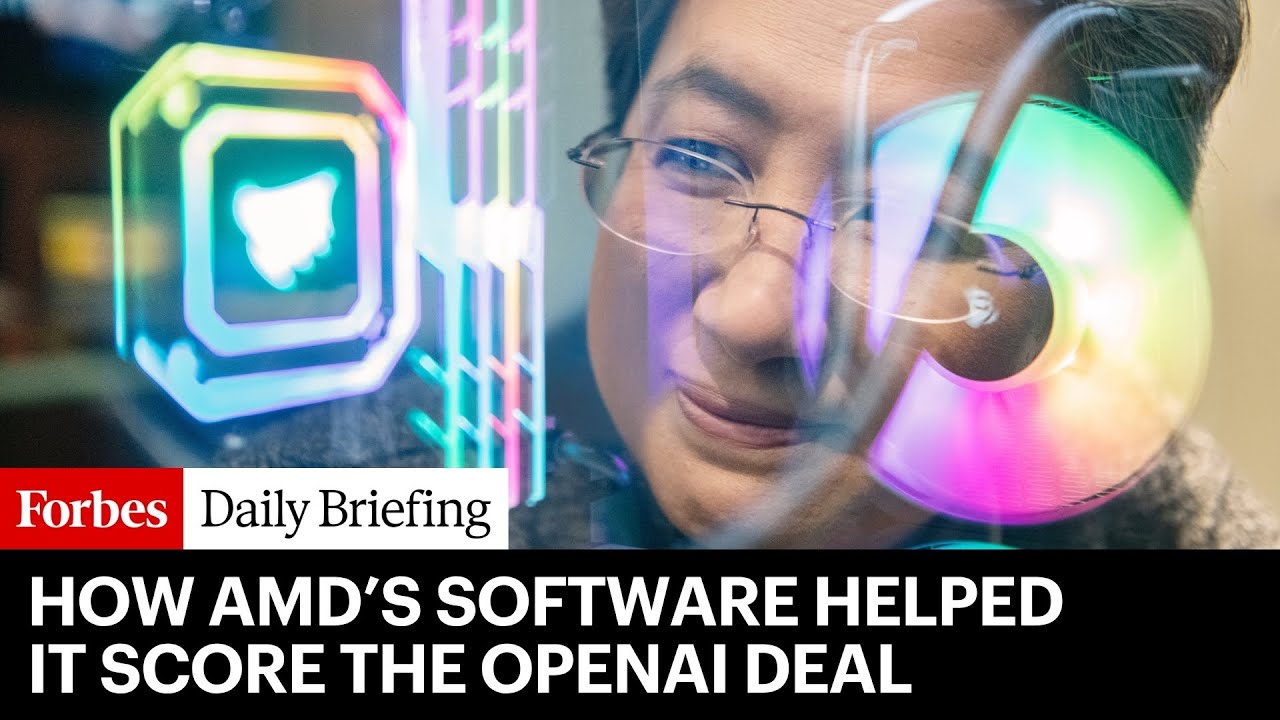
AMD’s senior vice president of AI, Vomsy Bopana, regularly updates CEO Lisa Su on the company’s software progress, to which she consistently urges faster development. This focus on software is crucial for AMD, as it enhances the performance and functionality of their AI chips, enabling engineers to effectively program and operate the hardware. Software also creates a “sticky” ecosystem, making it challenging for engineers to switch to competitors once they are familiar with a particular platform. This strategic emphasis on software played a key role in AMD securing a multi-billion dollar deal with OpenAI, marking one of the biggest victories in AMD’s 50-year history.
The deal involves OpenAI using AMD’s MI450 chips to power 6 gigawatts of compute for its AI products, with OpenAI gaining the option to purchase up to 160 million shares, or 10%, of AMD. This partnership is a significant boost for AMD as it aims to catch up with market leader Nvidia. The collaboration began in 2023 when OpenAI started running some models on AMD hardware, and over time, OpenAI influenced the design of AMD’s MI450 chips and its software stack. Notably, AMD worked with OpenAI to make Triton, OpenAI’s open-source GPU programming language, compatible with AMD chips, whereas it previously only supported Nvidia GPUs.
The demand for AI compute power has surged dramatically, with massive investments like Project Stargate, a $500 billion initiative involving OpenAI, Oracle, and SoftBank, and a similar $500 billion commitment from Apple. Nvidia has become a $4.5 trillion company largely due to this AI boom, recently entering a $100 billion deal with OpenAI to power 10 gigawatts of compute. Meanwhile, new semiconductor startups are developing specialized AI chips, signaling that the market will not be dominated by a single player. Industry experts believe that customers are increasingly willing to learn AMD’s software, indicating a more competitive landscape.
Nvidia’s CUDA software has long been a powerful tool that entrenches its market dominance, especially in AI model training. However, the barrier to entry is lower for AI inference—the process of running trained models—which is where OpenAI plans to use AMD’s chips. This distinction has allowed AMD to carve out a significant role in the AI ecosystem despite Nvidia’s dominance. The partnership with OpenAI highlights AMD’s growing influence in the AI space and its ability to compete on both hardware and software fronts.
This deal marks a remarkable turnaround for AMD since Lisa Su became CEO in 2014, a time when the company was struggling with layoffs and a low stock price. Under her leadership, AMD has revitalized its business, winning data center contracts with major hyperscalers and positioning itself as a key player in the AI revolution. With a current market cap of $382 billion and a stock price over $235, AMD is now firmly established as a major force in the technology industry, aiming to lead in the next wave of innovation driven by artificial intelligence.