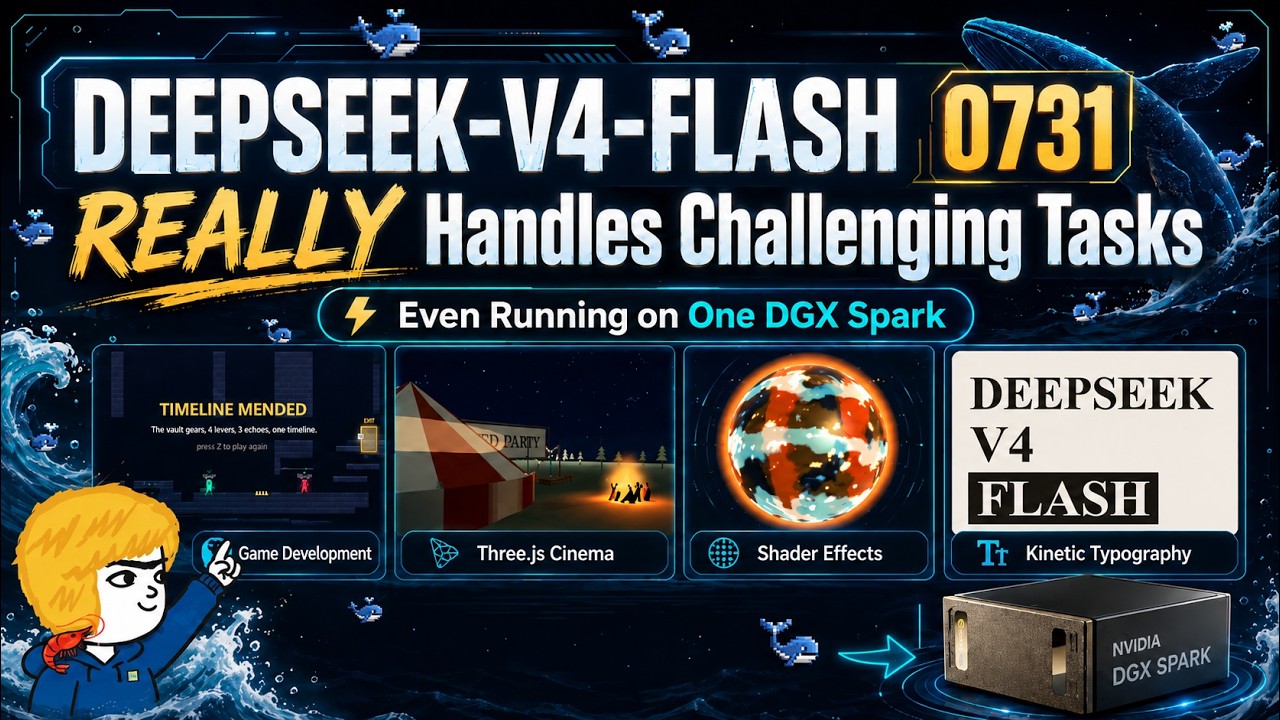
The video showcases DeepSeek V4 Flash 0731’s impressive ability to handle complex creative and interactive tasks, both via a cloud API and a heavily quantized local version running on a single GPU, delivering functional and visually appealing outputs despite resource constraints. It highlights the model’s balance of performance, speed, and cost-efficiency, making it a versatile option for privacy-conscious users and developers seeking a capable AI for multi-step challenges.
The video explores the capabilities of the DeepSeek V4 Flash 0731 model, focusing on its performance in handling complex tasks both via cloud API and a heavily quantized local version running on a single DGX Spark. Initially, the presenter demonstrates a simple interactive landing page creation task—a Star Wars meets One Piece themed website with a glowing orb and stutter headline effect. The model impressively produces interactive elements like a moving globe and smooth transitions, showcasing improvements over previous models. This sets the stage for more challenging tests to evaluate the model’s robustness and efficiency.
Next, the presenter puts DeepSeek V4 Flash 0731 through a series of demanding tasks, including recreating an interactive landing page promoting itself, building a cinematic 3.js world based on the first paragraph of Lord of the Rings, and developing a playable timeloop puzzle platformer game. Both the cloud and local versions are tested with identical prompts. Despite the local model being heavily quantized to fit on a single GPU, it manages to produce functional outputs, albeit with some bugs and simpler visuals compared to the cloud version. The cloud model generally delivers higher quality results with more polished interactive and cinematic elements.
The cinematic 3.js world task highlights the model’s ability to interpret complex prompts and generate dynamic scenes with camera movements, lighting, and environmental details. While the local model’s output is basic and has some camera glitches, the cloud version produces a visually richer scene with night lighting and detailed hobbit holes, though not quite matching the quality of specialized models like Opus 5. This demonstrates DeepSeek’s potential for creative and multimedia applications, even when operating under resource constraints.
The final and most complex challenge involves creating a complete playable timeloop puzzle platformer game with cooperative mechanics involving past player attempts. The local DeepSeek model surprisingly delivers a working game with the core mechanic intact, despite some UI bugs and minimal visuals. The cloud version produces a more advanced and visually appealing game with inventive mechanics like invisible walls and key-based puzzles, outperforming some previous frontier models. This task underscores DeepSeek’s ability to handle intricate logic and gameplay design within a relatively small model footprint.
Overall, the video emphasizes DeepSeek V4 Flash 0731’s impressive balance of performance, speed, and cost-efficiency, especially given its smaller size compared to competitors like Kim K3. The heavily quantized local model offers a practical option for privacy-conscious users and tinkerers who want to run capable AI models on their own hardware. While not perfect for heavy-duty coding tasks, DeepSeek proves to be a versatile and fast workhorse for long-horizon, multi-step challenges. The presenter expresses interest in further exploring fine-tuning and optimization, and invites viewers to share their experiences with the model.