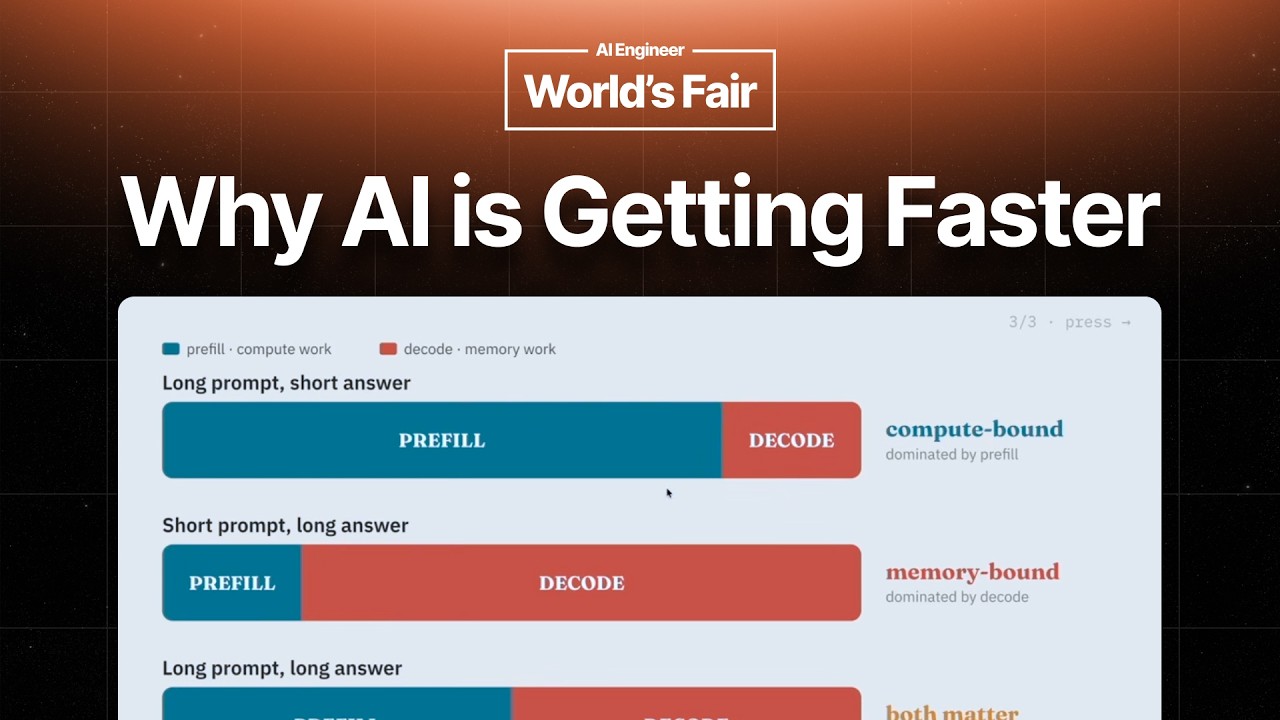
In this talk, Daniel from Cerebras and Michelle from Gimlet Labs discuss the challenges and innovations in optimizing AI inference to meet the rapidly growing demand for token generation. They highlight the explosive increase in AI compute spending, projected to reach $1.6 trillion by 2031, and the massive scale of token serving, exemplified by Google’s jump from 480 trillion to over 3 quadrillion tokens per month. Despite models becoming faster and cheaper, the core challenge remains that large language models (LLMs) generate tokens sequentially, requiring heavy memory access that often leaves compute units idle, limiting throughput and efficiency.
To address these inefficiencies, the speakers explain various optimization techniques. One approach is model parallelism, splitting the model across multiple GPUs to reduce token generation time, though this introduces communication overhead that limits speed gains. They also discuss batching and continuous batching, which serve multiple requests per weight read to improve utilization, but these methods increase memory demands due to the KV cache required for each request. Innovations like paged KV cache and prompt caching help mitigate memory inefficiencies by virtualizing memory allocation and reusing cached computations, respectively. Additionally, chunked prefill breaks long prefill phases into smaller segments to prevent pipeline clogging, especially important for token-hungry coding agents with very long contexts.
Michelle expands on system-level optimizations, emphasizing workload disaggregation to better allocate compute and memory resources. By separating prefill and decode phases across different worker pools, systems can independently scale compute-bound and memory-bound tasks, improving efficiency. Gimlet Labs takes this further with a multi-silicon NeoCloud that dynamically maps workload components to the most suitable hardware, including GPUs, Cerebras chips, and others. Techniques like speculative decoding use smaller draft models to predict tokens quickly, verifying them with full models to reduce compute time. This approach, combined with hardware-aware task allocation, achieves significant speedups and throughput improvements compared to homogeneous systems.
The talk also explores fine-grained disaggregation within models, such as splitting attention and feed-forward network layers to run on hardware optimized for memory bandwidth or matrix multiplication, respectively. This layer-level disaggregation enables efficient inference even for extremely large models with trillions of parameters. The speakers stress that no single disaggregation strategy fits all scenarios; choices depend on model size, workload characteristics, and latency or throughput requirements. They foresee AI agents playing a crucial role in automating kernel optimization and hardware-software co-design, exemplified by Gimlet’s KForge agent that generates optimized kernels tailored to specific hardware and workloads, achieving substantial performance gains.
In conclusion, Daniel and Michelle emphasize that optimizing inference is a complex, multi-layered challenge involving hardware, software, and workflow innovations. They envision a future where AI agents help automate and accelerate the entire stack—from kernel tuning to custom silicon design—creating a virtuous cycle of faster, cheaper, and more scalable token generation. This ongoing effort will support the growing integration of AI agents into everyday life and work, ensuring that the insatiable demand for tokens can be met efficiently and sustainably.