In this talk, Jim Clark, an engineer at Docker, discusses the evolving role of AI agents and the importance of AI safety, particularly focusing on the concepts of agent harnesses, sandboxes, and MCP (Modular Control Points) gateways. He begins by explaining that agent harnesses are loops that take context and emit tool calls, serving as the interface through which agents perform tasks. While harnesses themselves are relatively simple, their power comes from the MCPs that provide access to external tools and context, enabling agents to accomplish complex work. Jim emphasizes that as agents take on longer-running tasks with less supervision, ensuring safety becomes critical.
Jim introduces the concept of sandboxes as controlled environments where agents execute their tasks. He highlights the importance of limiting the resources and tools available within each sandbox to reduce potential risks. By tailoring sandboxes to the specific intent of a task, such as research, fact-checking, or publishing in a newsroom analogy, organizations can separate roles and restrict access to sensitive capabilities. This compartmentalization helps minimize the blast radius if an agent behaves unexpectedly, enhancing overall safety.
He further illustrates this with a personal example of a coding agent that performs long-running tasks but only requires sensitive credentials, like Git signing keys, for brief periods. By dynamically adjusting the sandbox’s capabilities based on the agent’s current intent, such as committing code versus general coding, the system ensures that credentials are never unnecessarily exposed. This principle of progressive disclosure of capabilities aligns with Docker’s approach to building secure, intent-driven sandboxes.
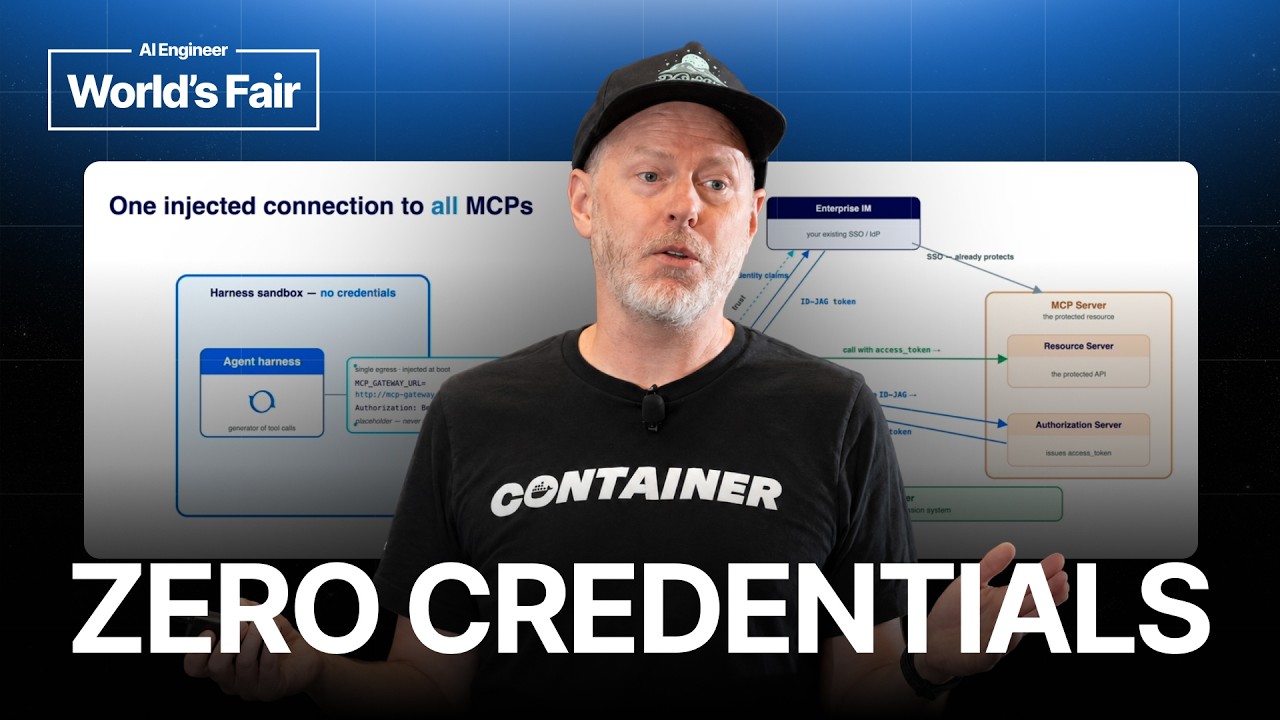
Central to this approach is the MCP gateway, a single control point that manages all MCP traffic within a sandbox. This gateway enforces which tools, resources, and prompts an agent can access, making harnesses MCP-agnostic and simplifying configuration across different AI models. Jim stresses a key maxim: sandboxes should contain zero credentials to minimize risk. He also introduces the concept of cross-app application (XAA), which leverages existing corporate identity management and authorization systems to securely grant agents access to resources without exposing credentials directly.
Finally, Jim ties these ideas to containerization, explaining that by mapping agent roles to containerized sandboxes with carefully controlled capabilities, organizations can safely run longer and more complex AI workflows. He encourages the audience to think of orchestrators as systems that assign tasks to appropriately configured sandboxes based on intent, ensuring minimal access and maximum safety. The talk concludes with an invitation to explore Docker’s sandbox tooling and demos, highlighting ongoing efforts to advance AI safety through thoughtful design and infrastructure.
Useful Links