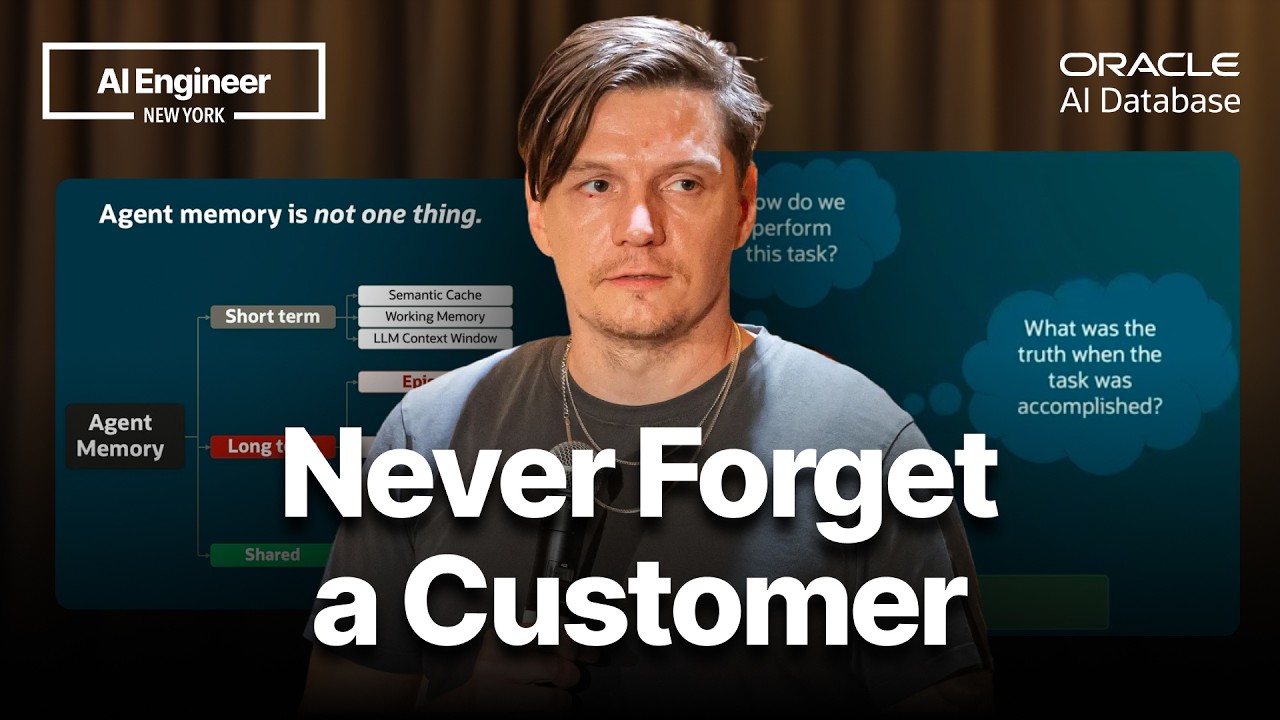
Wojciech Pluta from Oracle shares his extensive experience working on AI and cloud projects, particularly in financial services, and introduces the concept of moving from traditional rack systems to memory systems in AI agents. He emphasizes the evolution of user interfaces from command-based to intent-based systems, highlighting the importance of continuity in AI interactions. Wojciech explains that while models and infrastructure have become commoditized, the data layer remains a critical source of competitive advantage because it is unique to each business. He outlines Oracle’s approach to AI agents, which combines static models with a dynamic harness that controls runtime decisions and interactions.
Central to Wojciech’s talk is the idea of “memory promotion” in AI agents, which involves deciding what information from interactions should be retained for future use. He describes a pipeline where candidate memories are classified, compared with existing records, and then either admitted, rejected, or sent for human review based on evidence and guardrails. Through a demo focused on mortgage applications, he illustrates how semantic preferences and polite interactions influence memory promotion, showing how the system stores and recalls relevant information across sessions to maintain continuity and improve user experience.
Wojciech stresses the importance of guardrails in memory promotion to prevent harmful or erroneous data from being stored, such as commands that could lead to inappropriate approvals. He also discusses the potential for shared memories within organizations to enhance collaboration and knowledge sharing, provided there is human oversight. The demo highlights different outcomes based on the nature of the memory and the rules applied, demonstrating how the harness enforces these controls to maintain system integrity and trustworthiness.
The presentation further delves into the architecture of agent memory, distinguishing between short-term, long-term, and shared memories. Short-term memory lasts for the duration of a session, while long-term memory includes episodic, procedural, semantic memories, and preferences. Wojciech advocates for using robust database solutions to store memories, citing Oracle’s database capabilities for scalability, ACID compliance, and multi-data type handling. He introduces Oracle’s agent memory package, which simplifies the development of memory systems by providing abstractions for summarization, retrieval, and context management, reducing the cognitive load on developers.
In conclusion, Wojciech reiterates that while AI models are widely accessible, the unique memory and data associated with an organization’s AI agents provide a significant competitive edge. He encourages developers to leverage Oracle’s tools and resources, including GitHub repositories and educational content, to build effective agent memory systems tailored to their business needs. His talk underscores the strategic value of thoughtfully designed memory systems in AI agents to enhance continuity, reliability, and business value.
Useful Links