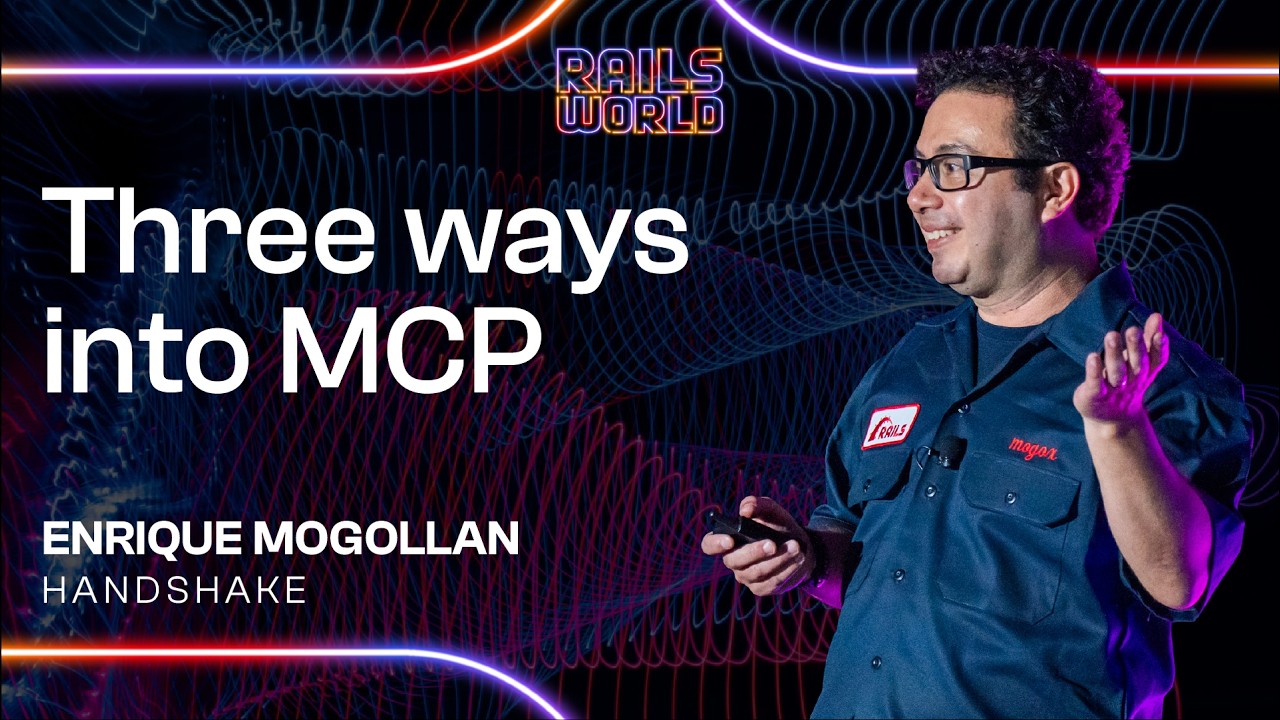
Enrique Mogollan describes how his curiosity about MCP (Message Control Protocol) led him to build his own MCP inspector and a more efficient MCP server called “quatc,” significantly improving performance and reducing token usage during development. He draws analogies between navigating with stars and understanding language models, and encourages others to experiment and innovate, highlighting new possibilities with MCP apps and the value of learning through building.
Enrique Mogollan begins his talk by introducing the concept of MCP (Message Control Protocol) servers, which facilitate communication between agents and external data sources without manual input. He shares his initial confusion about how MCP worked and its practical benefits, which led him to build his own MCP inspector in Ruby to better understand the protocol. He explains that MCP messages are exchanged in JSON RPC format and demonstrates how his inspector allows users to view the raw JSON messages between a server and a client, making the process more transparent.
Drawing an analogy from his youth in Mexico, Enrique compares navigating with maps and constellations during Boy Scout challenges to understanding how tokens and vectors work in language models. He explains that, much like stars in the sky, tokens are represented as vectors in high-dimensional space, and the context window of a language model is like the visible portion of the sky. MCP, he says, is a way to add more “stars” (data) into this context, enhancing the model’s capabilities.
Enrique then discusses the practical challenges he faced while running tests during Rails upgrades at work, where excessive context data slowed down his workflow. To address this, he developed “quatc,” an MCP server designed to be faster and more token-efficient by only returning essential information. By optimizing the server to use process forking instead of spawning and minimizing unnecessary data in responses, he achieved significant performance improvements and reduced token consumption by 90%.
He also experimented with using sub-agents to further optimize token usage but found that the setup overhead could negate the benefits unless unlimited tokens were available. Enrique highlights that quatc is intended for development purposes only, without features like raw SQL or console access, and shares the origin of its name, inspired by a coffee place in Veracruz, Mexico.
Finally, Enrique explores the future of MCP with the introduction of MCP apps, which provide interactive user interfaces via iframes that agents can use to access tools and resources from MCP servers. He demonstrates how these apps can enhance agent interactions by embedding dynamic content directly into chat windows. Enrique concludes by reflecting on the importance of curiosity and learning from mistakes, encouraging the audience to explore and build with the tools and knowledge shared, emphasizing that “the sky is no longer the limit.”
Useful Links