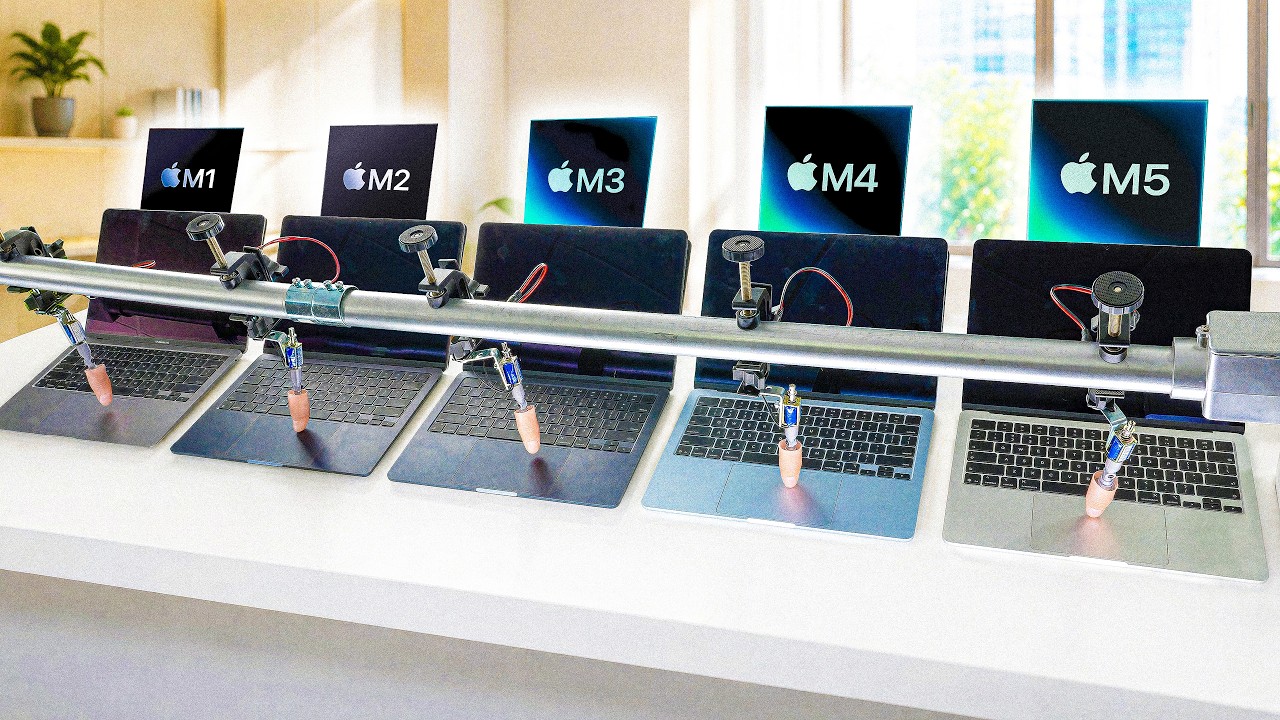
The video compares five generations of Apple Silicon MacBook Airs, focusing on their performance for development work. Each generation has improved in speed and capability, but earlier models had limitations such as slow base storage, restricted external monitor support, and underwhelming local AI performance. The new M5 MacBook Air addresses most of these issues, offering significant upgrades while maintaining the same chassis design, keyboard, screen, and ports as previous models. Notably, it introduces Wi-Fi 7 (though limited by Apple to 160 MHz channels), improved external display support through a single Thunderbolt port, and faster SSD storage that outpaces all previous models.
Performance benchmarks reveal incremental improvements in CPU speed and responsiveness across generations. The M5 shows a modest 5% speed increase over the M4 in web application responsiveness tests but delivers more substantial gains in multi-core tasks like code compilation and sorting. The M5’s 10-core architecture and enhanced “super cores” contribute to faster build times, with the M5 cutting build times nearly in half compared to the M1. Despite concerns about thermal throttling under heavy workloads, the M5 performs well, finishing intensive multi-core sorting tasks faster than all previous models, though it does exhibit some performance variance due to throttling.
Memory bandwidth has seen a significant boost with the M5, achieving a 26% increase over the M4, which is crucial for AI workloads. The video highlights the M5’s local AI performance as a standout feature, thanks to neural accelerators embedded in each GPU core. This architecture dramatically improves prompt processing speeds, with the M5 delivering nearly four times the prompt processing performance of the M4 and almost eight times that of the M1. These improvements make the M5 particularly well-suited for developers working with AI models locally, offering a substantial productivity boost.
Despite these advancements, the M5 MacBook Air comes with a higher price tag, starting at $1,299 compared to the M4’s $999 launch price. Apple attributes the price increase partly to a global memory supply shortage driven by AI data center demand. The video suggests that while the M5 is a powerful and well-rounded machine, the price hike may be a deterrent for some users. For those who do not require the enhanced AI capabilities or faster SSD, the M4 remains a viable and cost-effective option, especially if already owned.
In conclusion, the M5 MacBook Air represents the culmination of Apple’s efforts to refine the Air line, addressing previous shortcomings and delivering strong performance gains, particularly in AI tasks. However, the decision to upgrade depends on individual needs and budget considerations. Developers with older models or those needing more memory, storage, or external display support may find the M5 a worthwhile investment. For others, especially those with an M4, the improvements may not justify the cost. The M1 still holds up surprisingly well in 2026, and Apple appears to have nearly perfected the MacBook Air formula, aside from the increased price.