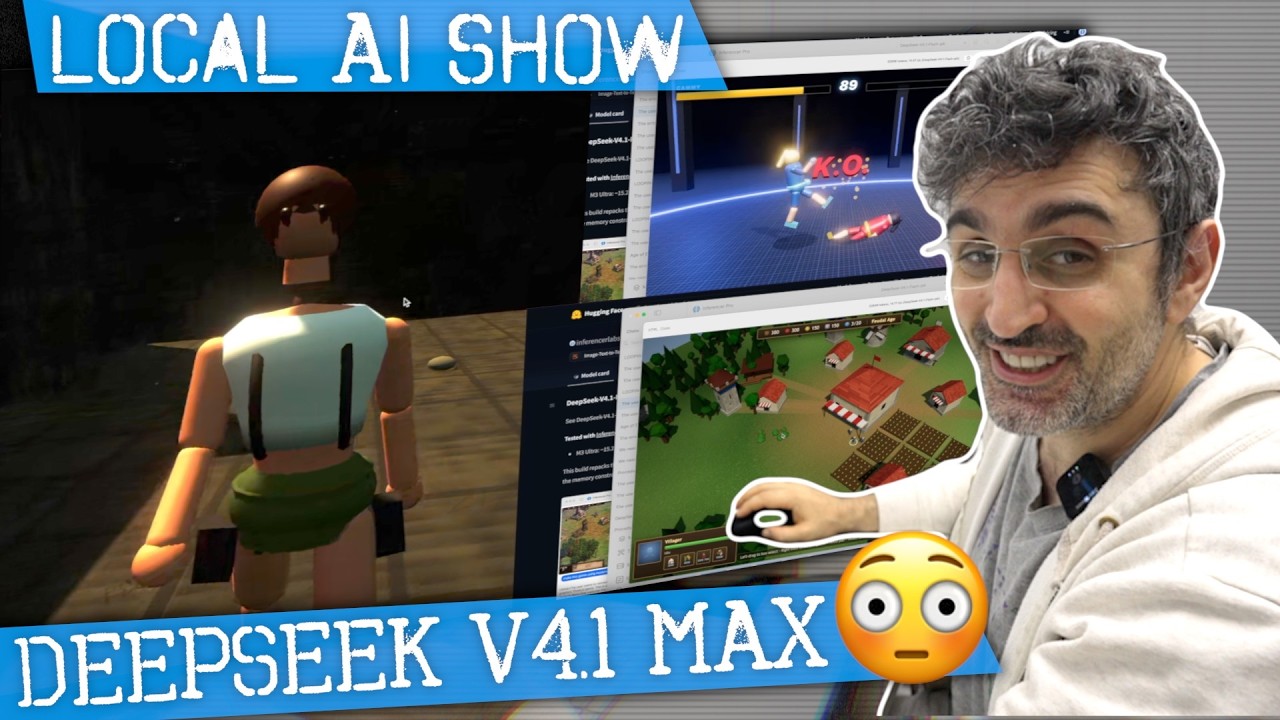
In this video, the creator explores DeepSeek V4.1 Flash Edition running at maximum thinking levels on a local AI cluster combining an M3 Ultra and M4 Max. They showcase improvements in quantization and code output quality, sharing updated weights for viewers to try. The video begins with simulations such as a nuclear explosion, demonstrating how increasing the number of thinking tokens enhances the visual complexity and detail, though beyond a certain point (around 10,000 tokens), additional thinking does not necessarily improve results and may even degrade them.
Next, the creator experiments with generating photorealistic human faces, noting that the updated quantization avoids previous runtime errors and produces more stable outputs, albeit sometimes with quirky features. They then dive into game generation, testing various titles like Age of Empires, Grand Theft Auto 5, Doom, Call of Duty, Street Fighter, Tomb Raider, Assassin’s Creed, and Gears of War. While the models often produce visually impressive scenes and partial gameplay mechanics, many suffer from limitations such as lack of pathfinding, incomplete controls, missing AI behaviors, or runtime errors, though some fighting game mechanics and animations work surprisingly well.
The video also covers business applications, including a simplified 3D modeling tool akin to Blender and a timeline video editor similar to iMovie. These applications demonstrate functional interfaces with features like object scaling, animation, saving/loading, and video clip merging, highlighting DeepSeek’s versatility beyond gaming. Despite some initial runtime errors, fixes provided by the model enable these applications to run effectively, showcasing promising potential for creative and productivity tools generated by AI.
A significant portion of the video focuses on running DeepSeek V4.1 on a local AI cluster due to the model’s large size (around 500GB), which exceeds the capacity of a single machine. The clustering setup, while still in development and somewhat slow, successfully synchronizes computations across devices, enabling more complex and higher-fidelity generations with fewer errors. The creator notes that partial quantization helps reduce unwanted safety filter interruptions, improving the generation experience.
In conclusion, the video provides an in-depth look at DeepSeek V4.1’s capabilities and limitations when pushed to its maximum thinking potential on advanced hardware. While the model produces impressive visuals and functional code across various domains, it still requires careful prompt engineering and sometimes manual fixes to achieve optimal results. The local AI cluster setup marks a promising step toward handling large-scale AI models efficiently, and the creator encourages viewers to experiment with the updated weights and share their experiences.