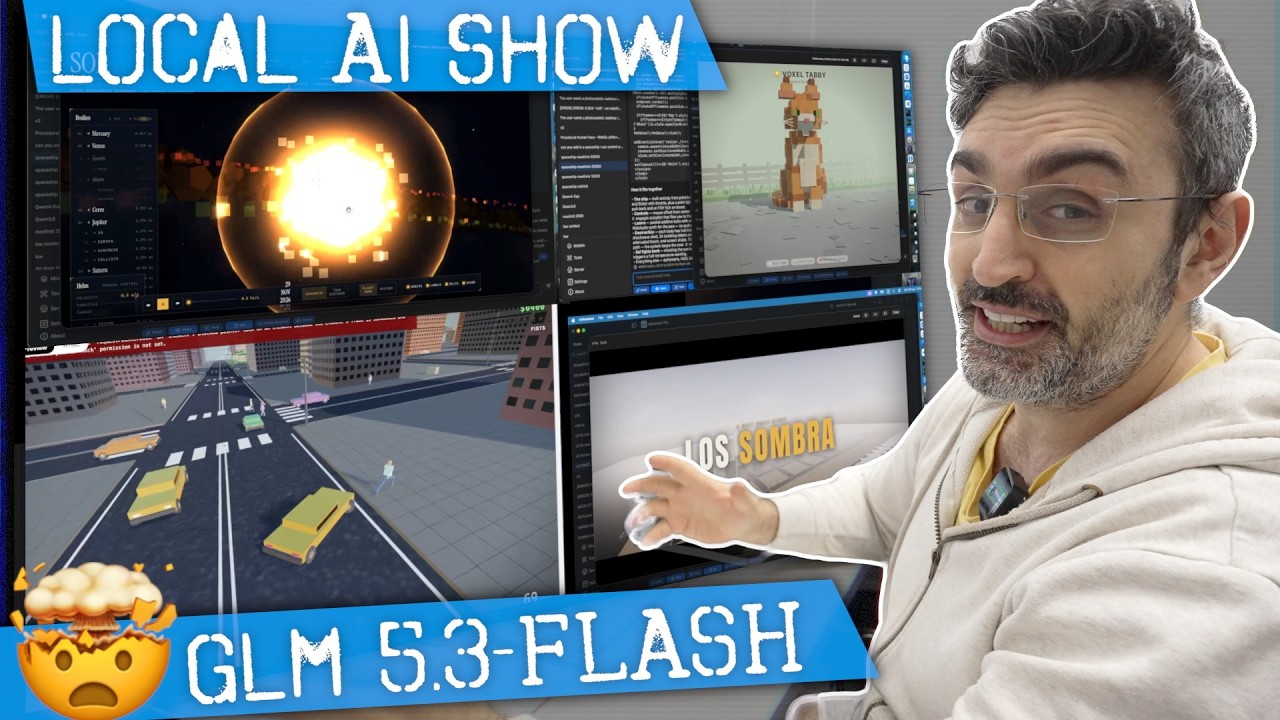
In this video, the creator explores the capabilities of GLM 5.3 Flash Edition, a more compact and improved version of the GLM 5.2 model. The Flash Edition is significantly smaller at 640 GB compared to the 1.5 TB of its predecessor, yet it boasts better performance and supports vision inference, enabling tasks like website cloning. The model features three thinking modes—low, high, and max—with non-thinking mode no longer supported due to poor results. The creator shares insights into refining the inference code to improve accuracy and handle quirks, especially in coding tasks where thinking mode is crucial.
The video demonstrates GLM 5.3 Flash’s ability to generate complex visual scenes, such as solar systems and animated cats, comparing its output to other models like Quen 3.8 27B and Quen 4 EXP. While GLM 5.3 Flash produces impressive and visually appealing results, it sometimes requires careful tuning of thinking modes and token limits to avoid runtime errors or endless thinking loops. The creator highlights the model’s strengths in generating detailed and interactive scenes, including a spaceship with controllable features, though some minor bugs like laser momentum issues persist.
A significant portion of the video is dedicated to the ambitious project of generating a GTA 5-like game using GLM 5.3 Flash. Despite the model’s size and capabilities, the generated code contains bugs and runtime errors, both locally and on the cloud. The creator discusses the challenges of debugging and improving the code, noting that the model benefits from running in a loop to iteratively fix errors. The game features functional elements such as driving, police chases, and animations, though lighting and control bugs remain. The process is resource-intensive, requiring extensive tokens and long generation times.
Beyond gaming, the creator experiments with other creative applications like a kid-friendly photo editor and logic questions, showcasing the model’s versatility. GLM 5.3 Flash handles these tasks well, providing coherent and sometimes humorous responses. The video also touches on the model’s confidence levels in decision-making scenarios and its limitations in certain knowledge areas. The creator expresses excitement about upcoming versions like GLM 5.3 full edition and GLM 5.5, which promise larger sizes and new architectures, while appreciating the current trend toward more manageable model sizes for local use.
Overall, the video presents GLM 5.3 Flash Edition as a powerful and versatile AI model that balances size, performance, and functionality. While it excels in generating complex visual and coding outputs, it requires thoughtful configuration and debugging to achieve optimal results. The creator’s hands-on testing reveals both the model’s impressive capabilities and its current limitations, offering valuable insights for users interested in running advanced AI models locally. The video concludes with anticipation for future releases and improvements in the GLM series.
Useful Links