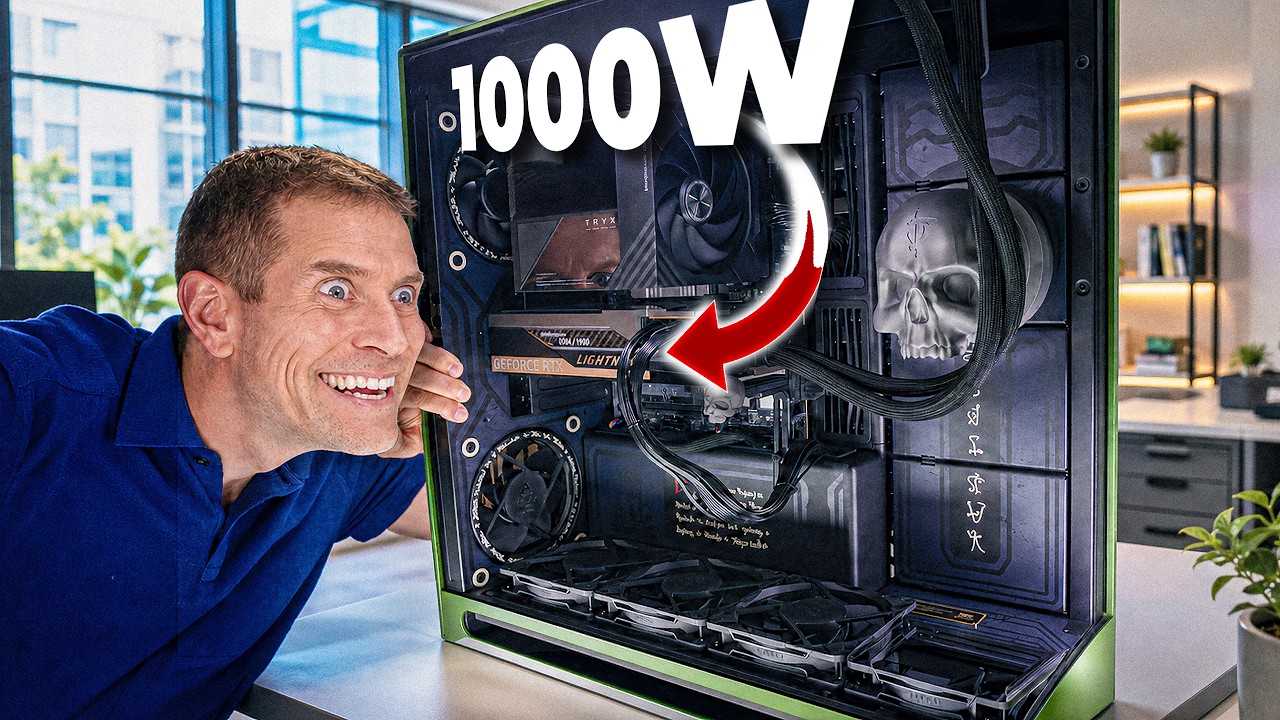
In this video, the host builds a high-end gaming PC centered around the MSI RTX 5090 Lightning Z graphics card, a premium and powerful GPU with a 1,000-watt power cap, designed not just for gaming but primarily for AI workloads. The build includes top-tier components such as a 64GB RAM bundle, a high-performance motherboard, and a unique Doom-themed case. The host emphasizes that while the PC is capable of gaming, its main purpose is to explore AI performance, particularly comparing the RTX 5090 Lightning Z against a regular RTX 5090 and the workstation-grade RTX Pro 6000.
The RTX 5090 Lightning Z stands out due to its higher power limit of 1,000 watts compared to the standard 600 watts on the regular 5090 and the RTX Pro 6000. This theoretically allows for greater performance headroom. The host unboxes the card, highlighting its impressive build quality, liquid cooling system, and limited-edition status. Despite its hefty price tag of around $5,000, the card promises exceptional AI compute capabilities, which the host is eager to test against other GPUs.
Testing begins with various large language models (LLMs) of different sizes to benchmark AI inference performance. The RTX Pro 6000, with its 96GB VRAM, outperforms both 5090 variants in many scenarios, especially with larger models that exceed the 32GB VRAM limit of the 5090 cards. The RTX 5090 Lightning Z shows modest improvements over the regular 5090, particularly in concurrency-heavy workloads where its higher power cap allows it to sustain better performance without throttling. However, for very large models, the limited VRAM on the 5090 cards becomes a bottleneck.
When testing AI workloads like video generation, the RTX 5090 Lightning Z again shows slight performance gains over the regular 5090 but does not fully utilize its 1,000-watt power budget, typically capping around 650 watts. The host discovers that typical AI inference and generation workloads have inherent pauses and memory bottlenecks that prevent the GPU from drawing maximum power. Only a synthetic test involving continuous matrix multiplications fully saturates the Lightning Z’s power limit, demonstrating its potential for heavy compute tasks like training rather than inference.
In conclusion, the RTX 5090 Lightning Z is a powerful and visually striking GPU that excels in sustained compute workloads and offers better cooling and quieter operation than the regular 5090. However, for pure AI inference and generation tasks, the extra power headroom is often underutilized, and the limited 32GB VRAM restricts performance on very large models compared to the RTX Pro 6000. The host recommends the Pro 6000 for dedicated AI work but acknowledges the Lightning Z as a compelling choice for users who want a versatile, high-performance machine capable of gaming and AI with some future-proofing.