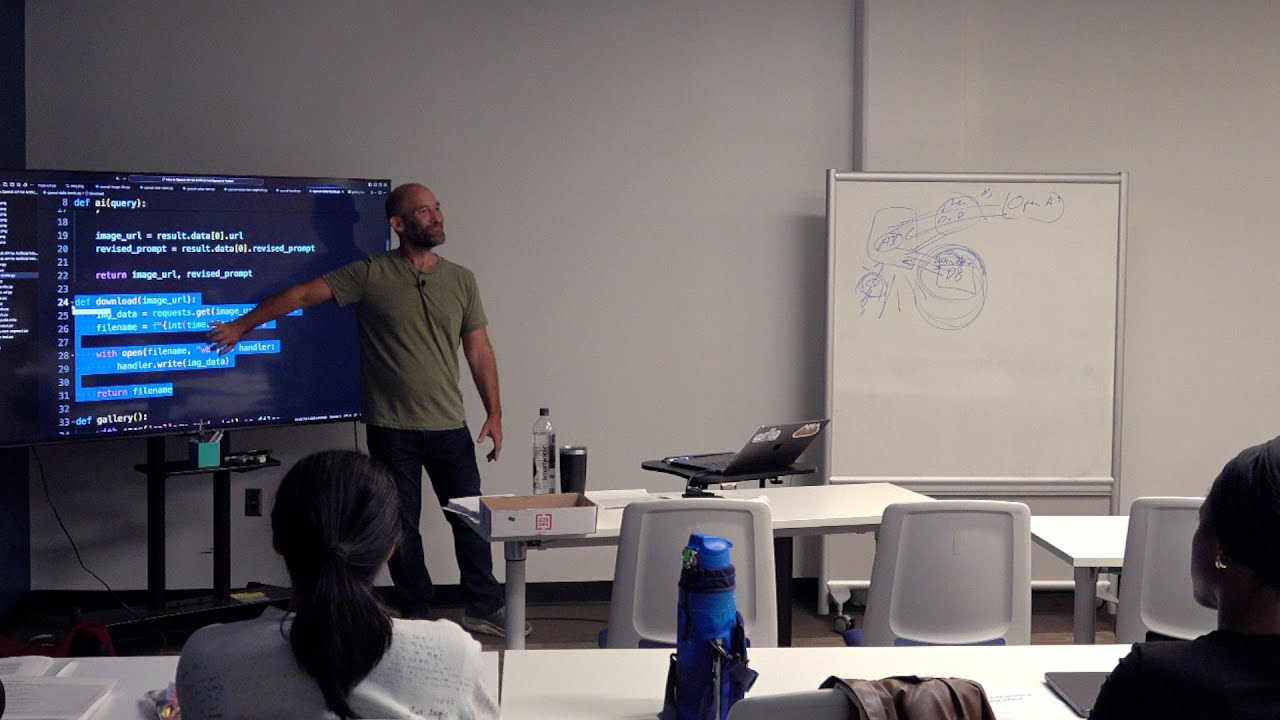
The video begins with the instructor introducing himself and sharing his extensive background in technology, dating back to 1996, including his experience in the US Army, corporate consulting, and tech education. He explains his motivation for creating Silicon Dojo, a platform combining online and in-person tech education to build community and provide practical learning experiences. He highlights the current challenge in tech education: while access to information has improved, many learners lack human interaction and practical guidance, leading to confusion despite certifications and degrees. The instructor also addresses the widespread fear and depression among tech professionals about AI potentially replacing jobs, emphasizing that AI should be viewed as a technology stack that professionals can learn to build upon rather than a threat.
The instructor then contrasts local AI models like OLLAMA, which run on personal hardware but require significant resources and upfront costs, with cloud-based AI accessed via APIs such as OpenAI’s. He explains the benefits of using APIs, including low hardware requirements, scalability, and ease of use, but also warns about potential risks like unexpected costs from excessive API calls and data privacy concerns. He stresses the importance of understanding AI architecture, including memory management, caching, and how to handle data securely, especially when sending information to third-party services. The instructor also discusses AI drift, where API models change over time, potentially breaking existing code, and the need to design systems that can adapt to such changes.
Next, the video covers practical aspects of using the OpenAI API with Python, including account setup, API key management, and environment variables for security. The instructor demonstrates how to make text generation requests, explaining the structure of API responses and how to extract useful information like generated text and token usage. He compares different OpenAI models (GPT-5, GPT-5 Nano, GPT-3.5 Turbo) in terms of speed, cost, and output quality, emphasizing the need for testing to find the best balance for specific use cases. The video also explores image generation using models like DALL·E 3, showing how to generate images, retrieve URLs, and save images locally, while noting the cost differences and content moderation challenges.
Further, the instructor introduces OpenAI’s computer vision capabilities, demonstrating how to analyze images via URLs or local files by encoding images in base64 format. He highlights potential applications such as automatic tagging and taxonomy for large image collections, which can improve searchability and data management. The video also covers voice-related features, including text-to-speech synthesis with multiple voice options and audio transcription to convert speech into text. The instructor discusses advanced transcription features like segmenting audio with timestamps and speaker identification, which can be useful for creating searchable transcripts and enhancing workflows in call centers or content creation.
Finally, the video concludes with a demonstration of building simple web applications using the Bottle framework in Python to interact with OpenAI’s API. The instructor shows how to create a basic AI-powered chatbot and an image gallery application, explaining the code structure and highlighting common pitfalls such as incomplete implementations and API safety filters. He encourages experimentation and emphasizes the importance of understanding AI as a tool to augment human capabilities rather than replace jobs. Throughout, the instructor stresses the evolving nature of AI technologies, the need for careful architectural planning, and the value of combining technical skills with strategic thinking to succeed in the AI-driven future.