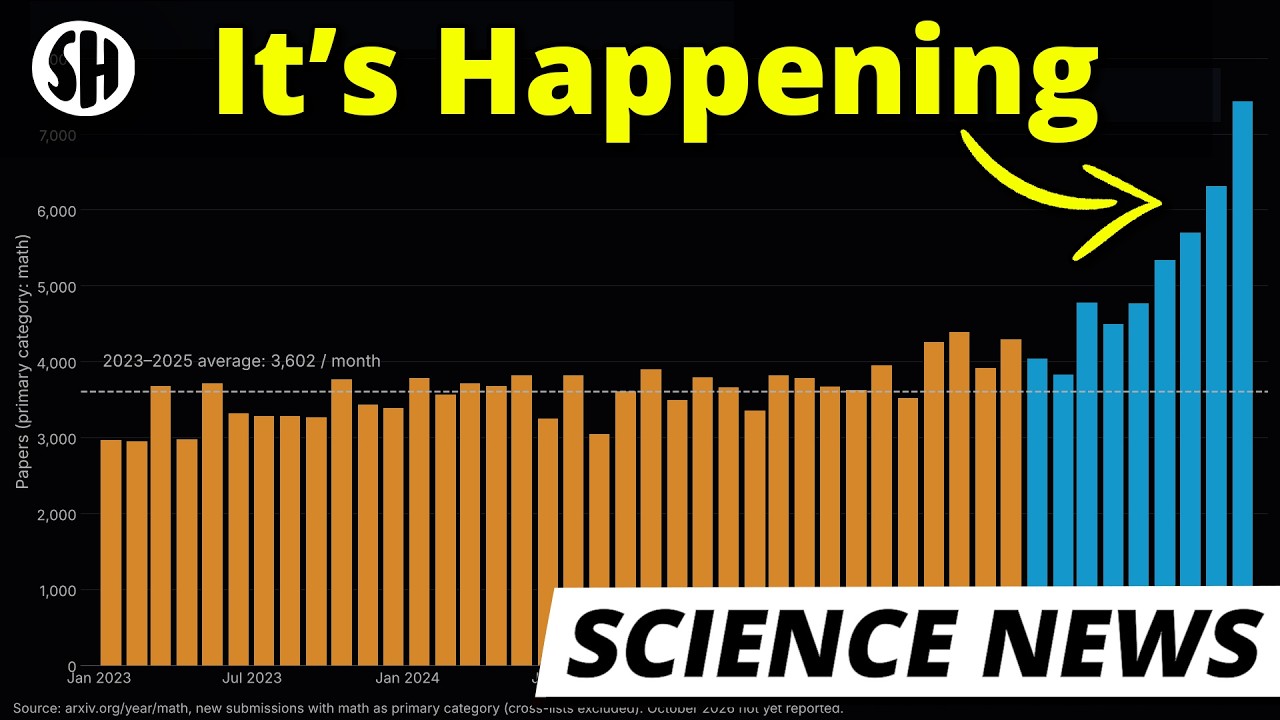
Artificial intelligence is making significant inroads into the field of science, having already impacted mathematics and now turning its attention to physics. AI has demonstrated its capability to produce new and correct mathematical proofs, flooding archives with AI-generated papers. While mathematicians criticize these AI proofs as inelegant and difficult to understand, the undeniable fact remains that AI can deliver valid mathematical results. Recently, OpenAI released AI-generated proofs addressing the existence of Yang-Mills theories, a fundamental component of the Standard Model of particle physics. This development has sparked debate, as mathematicians and physicists differ on what “existence” means in their respective contexts.
Yang-Mills theories are crucial in particle physics, but mathematicians require rigorous proof of their consistent mathematical definition, which remains unresolved. Physicists, on the other hand, accept these theories based on their predictive success in describing nature. Although OpenAI’s work has not definitively settled the question, it has provoked immediate criticism from physicists who dismiss its relevance. The author suggests that if a human had produced the same result, it would have been celebrated, highlighting a bias against AI contributions. Meanwhile, foundational physics has been plagued by an overproduction of speculative and mathematically simple papers that often lack real scientific value.
This flood of low-quality, speculative physics papers has hindered progress in the field. AI now easily replicates this trend by generating numerous papers on topics like dark matter and modified gravity, matching the quality of existing irrelevant publications. This oversupply of questionable research may force physicists to confront the irrelevance of much of their work and push for higher quality standards. Such a shift could ultimately advance physics, with the hope that future AI systems might refuse to produce nonsensical theories, signaling a form of physical superintelligence.
The current bottleneck in physics, unlike in mathematics, is the lack of well-defined problems centered on mathematical inconsistencies. Physicists often grapple with vague or pseudo-problems, such as explaining fundamental constants like the fine structure constant. AI-generated attempts to solve these problems tend to produce overly complicated explanations that fail to surpass the simplicity and explanatory power of the constants themselves. Despite this, the emergence of AI-generated physics papers is notable, especially as some researchers, like Alexander Wissner-Gross, advocate for a new “second golden era” of physics driven by AI and physical superintelligence.
The author remains cautiously optimistic about AI’s potential to revitalize physics, especially since some AI models have been trained on critical works like his book “Lost in Math.” However, the challenge lies in overcoming decades of foundational mistakes embedded in the training data and the current culture of physics research. The video concludes with a recommendation for Radical Pi, a user-friendly equation editor that produces beautiful mathematical typesetting, emphasizing the importance of clarity and elegance in scientific communication. Overall, AI’s impact on physics is poised to be transformative, but it requires a shift in focus toward meaningful, well-defined problems and higher standards of scientific rigor.