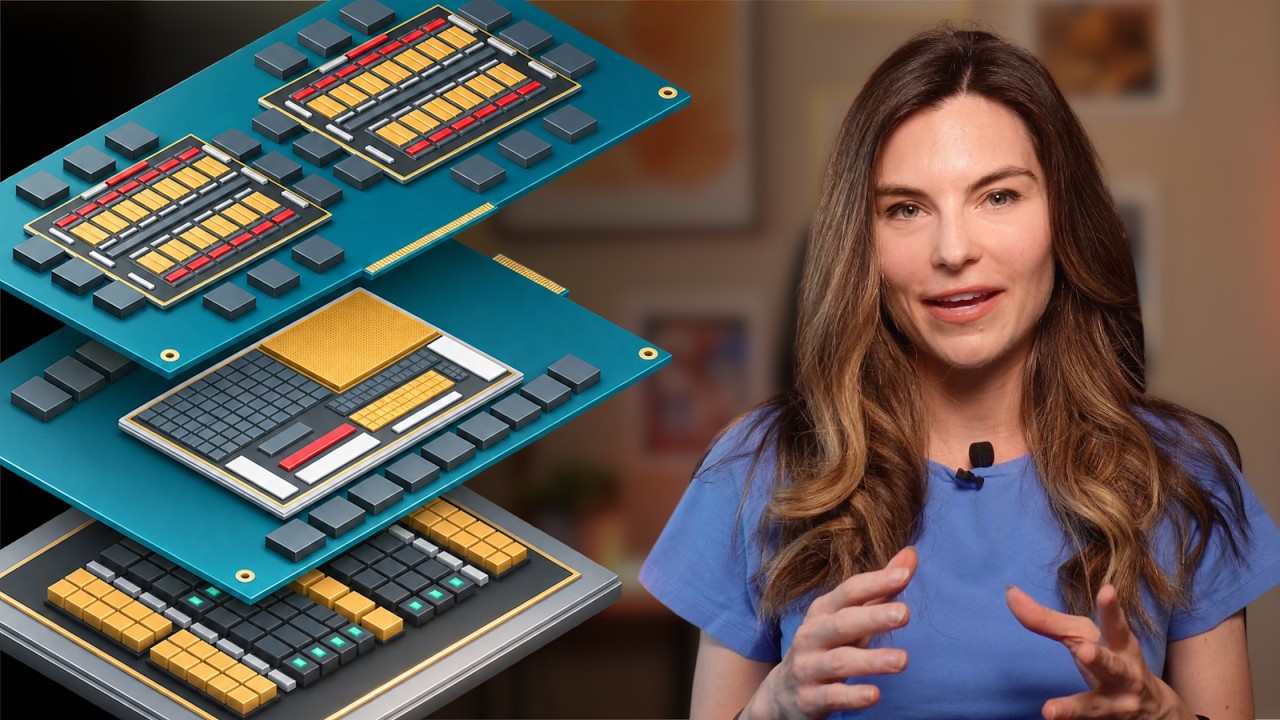
The video examines how AI chip makers like NVIDIA, Google, and Groq are innovating beyond traditional von Neumann architectures to efficiently run large language models, with GPUs offering cost-effective batch processing, TPUs optimizing matrix multiplication via systolic arrays, and LPUs using on-chip SRAM for low-latency inference. It emphasizes that no single architecture dominates, and future AI performance gains will come from hybrid systems that balance speed, cost, and complexity while addressing longstanding memory bandwidth bottlenecks.
The video explores the evolving landscape of AI chips, focusing on how companies like NVIDIA, Google, and newcomers such as Groq are addressing the challenges of efficiently running large language models (LLMs). While NVIDIA dominates the market with GPUs, major tech companies are designing specialized chips like Google’s TPU and Groq’s LPU to overcome the limitations of traditional architectures. The core challenge these chips tackle is keeping the processor fully utilized, especially given the massive computational demands of neural networks, which primarily perform repetitive matrix multiplications.
Google’s TPU was a pioneering effort to optimize AI inference by discarding unnecessary CPU features like control logic and focusing on a systolic array architecture that efficiently multiplies matrices. This design significantly improved performance and power efficiency compared to GPUs of the time. However, the TPU and GPUs alike faced a persistent bottleneck: memory bandwidth. The separation of processor and memory in the von Neumann architecture meant that fetching weights from slower external DRAM limited throughput, a problem that has persisted despite advances like high bandwidth memory (HBM).
Groq’s LPU takes a different approach by eliminating external DRAM altogether and storing weights directly in on-chip SRAM, which offers much faster and predictable access times. This design enables precise static scheduling of operations, reducing latency and improving reliability. However, the limited SRAM capacity means that very large models must be split across hundreds of chips, introducing complexity in coordination and increasing hardware costs. Groq’s compiler plays a crucial role in managing this complexity by planning every instruction and communication ahead of time, leveraging the deterministic nature of SRAM access.
Despite these innovations, no single chip architecture is a silver bullet. GPUs remain cost-effective for large batch processing due to their ability to amortize memory access costs, while LPUs excel at low-latency, token-by-token generation. The best performance often comes from hybrid systems that combine GPUs for parallel prefill stages and LPUs for sequential decoding stages. NVIDIA has embraced this synergy, showcasing systems that integrate Groq’s LPUs with their own GPUs to optimize LLM inference workloads.
Ultimately, the video highlights that the AI chip market is still evolving, with various architectures offering different trade-offs between speed, cost, and complexity. While NVIDIA maintains a strong position with versatile GPUs, specialized chips like Google’s TPU and Groq’s LPU push the boundaries of efficiency for AI tasks. The ongoing innovation reflects decades-old challenges rooted in the von Neumann bottleneck, and the future likely holds a diverse ecosystem of AI accelerators tailored to specific workloads and performance goals.
Useful Links
- TPU v1 paper — Directly explains the architecture and design of Google’s TPU v1, central to the video’s discussion on AI chips.
- Groq LPU architecture and static scheduling concepts — Explains Groq’s novel approach to AI chip design, a main focus of the video, though no official public documentation URL is provided in the input.
- NVIDIA GPU Tensor Core architecture — Helps understand NVIDIA’s GPU design and its role in AI inference, central to the video’s comparative analysis, though no direct URL is given.
- High Bandwidth Memory (HBM) technology — Explains a critical hardware technology affecting AI chip memory bottlenecks, central to the video’s technical content, no direct URL provided.