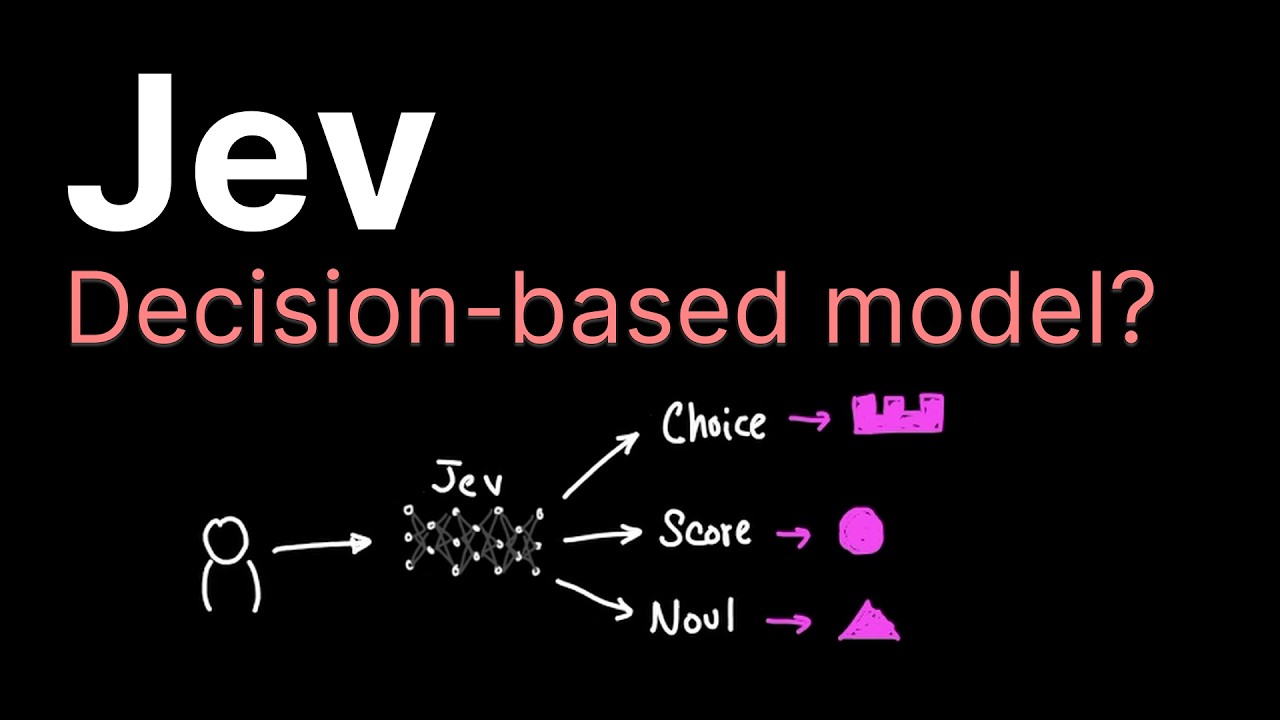
The video introduces Jev, a novel type of AI model that challenges conventional approaches to optimizing large language models (LLMs). Traditionally, models have been fine-tuned to assist humans in chat applications or coding agents, but these optimizations have not effectively addressed workflow automation. Despite the intelligence of models like Astra and Fable, they struggle to efficiently handle automation tasks without incurring significant costs. Jev, developed by Typesafe AI, argues that this difficulty arises because current models are optimized for human interaction and verifiable rewards, which do not translate well to quick decision-making under uncertainty—a key requirement for automation.
Jev distinguishes itself by focusing on speed and efficiency rather than just depth of understanding. While existing LLMs can perform similar tasks, they cannot match Jev’s rapid response times, which range from 70 to 500 milliseconds. This is because Jev employs parallel sampling and typed probabilistic decisions, unlike traditional auto-regressive models that generate tokens sequentially. This architectural difference allows Jev to excel in tasks like sorting emails, improving retrieval-augmented generation (RAG), playing games, and model routing, making automation more practical and scalable.
The video also highlights Juny CLI, an AI coding agent from JetBrains, as a useful tool for managing complex coding tasks. Juny integrates with various models and allows users to plan and review tasks before implementation, offering flexibility and control over model usage and costs. This example underscores the growing ecosystem of specialized AI tools designed to optimize workflows and coding productivity, complementing the capabilities introduced by models like Jev.
Jev’s interaction paradigm is fundamentally different from traditional LLMs. Instead of responding to raw text prompts, Jev operates with structured inputs and outputs that include probability distributions. Its basic primitives—choice, score, and null—enable software to build complex applications on top of these probabilistic decisions, reminiscent of logic gates in classical computing. This structured approach allows Jev to handle tasks like sorting large datasets much faster than auto-regressive models, demonstrating its suitability for workflow-specific applications.
In conclusion, Jev represents a shift towards specialized, narrow AI models optimized for specific constraints rather than general-purpose foundation models. While the underlying concepts are not entirely new, Jev’s emphasis on speed and automation use cases broadens the AI landscape. This diversification is seen as a positive development, encouraging the creation of models tailored to distinct tasks and enabling more practical automation solutions. As demand grows, the ecosystem is likely to see more models like Jev that complement existing generalist models, fostering innovation across different AI application domains.