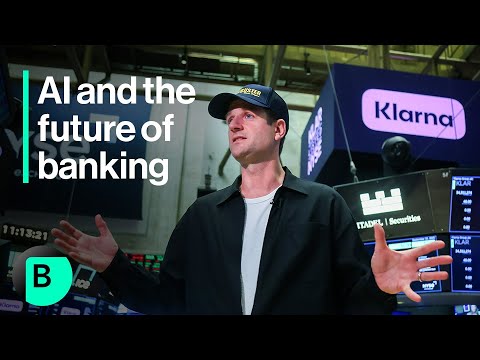
In the discussion about AI’s impact on banking, Klarna’s CEO reflects on a vision from a decade ago where banking would become a fully digital financial system. This system would analyze customers’ spending and financial products, such as mortgages, and automatically find better offers, handling all the paperwork seamlessly. He believes this future will bring profound changes, especially by increasing customer mobility, where people switch banks more easily to get better value, thereby driving down excess profits in retail banking. This shift challenges the current banking model where customers tend to stay with their banks due to switching difficulties.
Legacy banks, according to the CEO, are vulnerable because they might be reduced to merely managing balance sheets and optimizing returns, while the real value will come from digital financial systems that provide superior customer value through AI-driven services. He highlights that banks fear losing direct customer interaction to digital assistants that can handle payments and financial decisions without logging into traditional banking platforms. The future of banking value lies in who can provide the best digital financial experience, not just who holds the largest balance sheet.
When addressing the advantage legacy banks might have due to their data and resources, the CEO argues that modern fintech companies like Klarna and Revolut, which are fully regulated but built on modern technology stacks, have a strong chance to capture significant market share. He notes that while some incumbents may successfully reinvent themselves, fintechs are growing steadily despite past valuation dips. The CEO also emphasizes the importance of trust in AI, acknowledging concerns about biases and decision-making but pointing out that AI can deliver more consistent and higher-quality outcomes in areas like dispute management compared to humans.
Regarding the workforce, the CEO predicts a massive shift in knowledge work due to AI, not just in banking but across society. He cites the example of translators in Brussels, many of whose jobs could be largely automated by AI. While new jobs will emerge, the transition may be difficult for many workers in the short term. Klarna itself has increased revenue per employee significantly while reducing headcount, reinvesting savings into employee compensation. The CEO stresses the need for society and companies to find ways to support workers through this transition while leveraging AI to drive value for customers.
Finally, the CEO discusses regulatory concerns and the broader implications of AI in banking. He warns against overly restrictive regulations that could stifle innovation, especially as non-democratic countries push AI advancements aggressively. He foresees increased customer mobility leading to new challenges for banks, such as liquidity risks. On market structure, he believes AI will drive consolidation in fintech and banking because the cost of software development is plummeting, favoring large-scale players. Klarna aims to become a global financial technology company to maintain scale and profitability in a future with less money per customer. On a personal note, the CEO embraces AI in his own life, particularly in coding, encouraging others to learn and engage with the technology to reduce fear and uncertainty.