In this video, the host explores the capabilities of the MiniMax M3.1 Flash Edition, a large AI model designed for fast and efficient generation, comparing it to other models like DeepSeek and Opus. MiniMax has evolved from smaller models to working on massive parameter scales, with rumors of a 14 trillion parameter model in development. The host highlights MiniMax’s impressive benchmark scores, particularly its performance on the Banker Toolbench, where it ties with Opus 5 despite being a smaller model. The video focuses on testing MiniMax’s generation quality, speed, and reasoning abilities using various prompts and settings on a Mac Studio M3 Ultra.
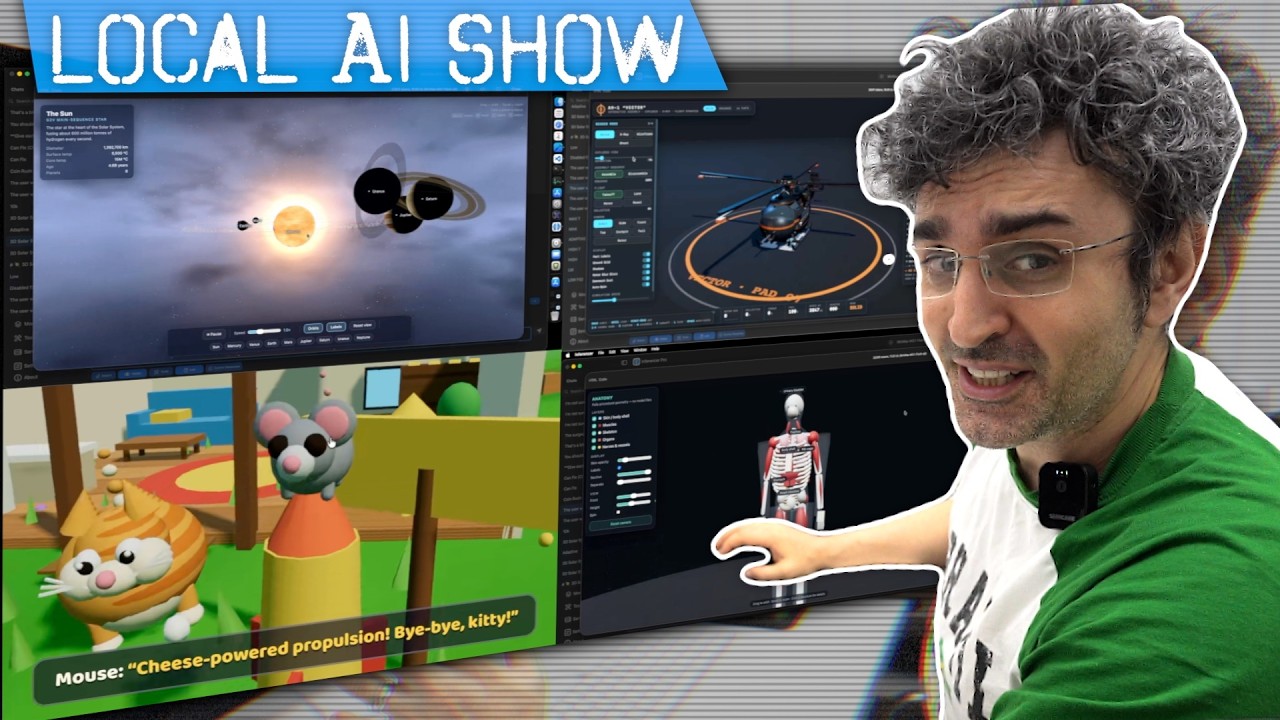
The host demonstrates MiniMax’s ability to generate complex 3D game scenes, such as a cat-themed game with detailed environments, animations, and sound effects. Different thinking modes like low, high, and adaptive are tested, showing variations in token usage and generation quality. The model produces visually appealing and playable scenes with minimal runtime errors, though some minor bugs and artifacts appear occasionally. The video also explains how temperature settings influence the randomness and creativity of the model’s output, with temperature one producing more tokens and creative variations compared to temperature zero’s more focused results.
Further tests include generating a 3D solar system, a helicopter model, and even a website, showcasing MiniMax’s versatility across different domains. The host notes the model’s ability to handle large token counts without runtime errors and praises its detailed and aesthetically pleasing outputs. Some generations, like the helicopter and solar system, are highlighted for their interactivity and visual quality. The video also touches on the model’s limitations, such as occasional bugs and the need for subsequent prompts to refine outputs, but overall emphasizes its strong performance and potential for creative projects.
The video also explores MiniMax’s logical reasoning capabilities through various logic puzzles and questions, demonstrating that the model can provide accurate and contextually appropriate answers even with thinking disabled. The host compares these results favorably against other models, noting improvements in understanding and reasoning. However, some gaps remain, such as incomplete knowledge on certain topics or occasional inaccuracies. Despite these, MiniMax shows a broad range of competencies, from creative generation to logical problem-solving, making it a versatile tool for developers and creators.
In conclusion, the MiniMax M3.1 Flash Edition is presented as a powerful and flexible AI model capable of producing high-quality 3D content, logical reasoning, and creative outputs with relatively low error rates. Its adaptive thinking modes and temperature settings offer users control over the balance between creativity and accuracy. While not without minor flaws, MiniMax stands out as a competitive alternative to models like DeepSeek and Opus, especially given its efficient performance on smaller hardware setups. The host encourages viewers to explore MiniMax further and share their thoughts, highlighting its promise for future AI-driven creative and logical applications.