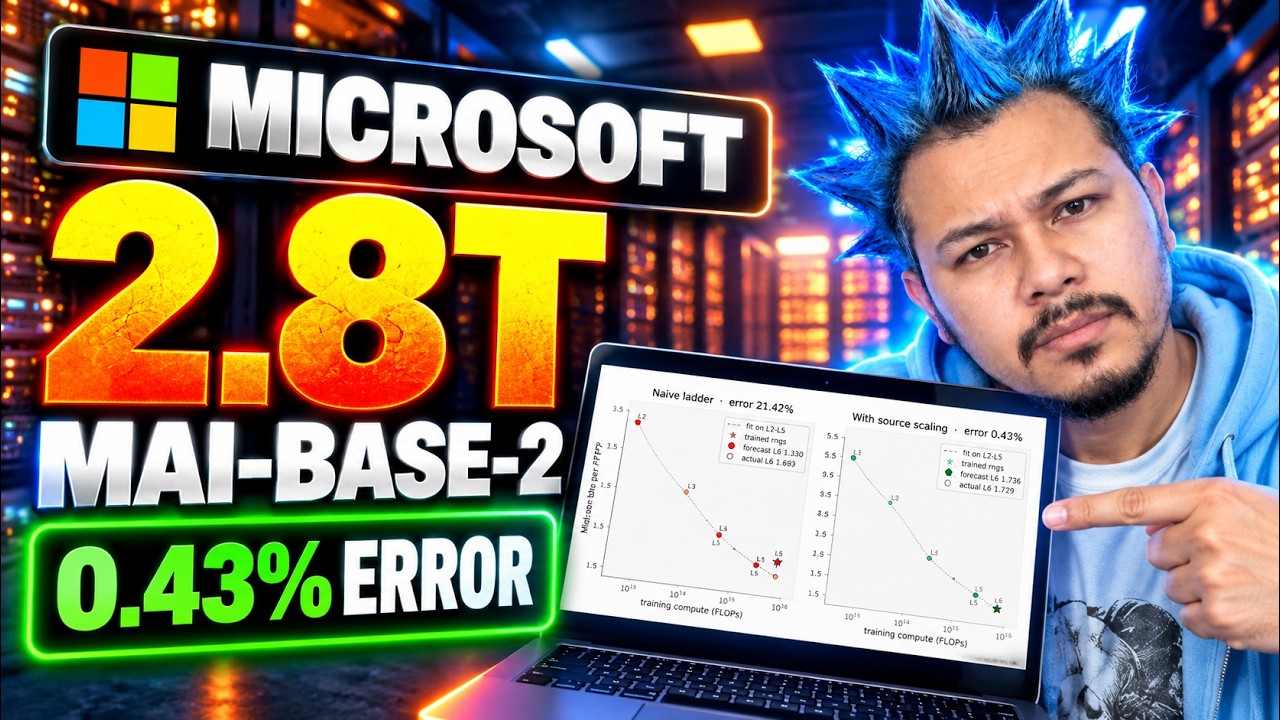
Microsoft has achieved a significant breakthrough with its MAI Base 2 model, a massive 2.8 trillion parameter mixture of experts model trained on 16,000 of the most powerful GPUs over 38 days. This model outperforms every open-weight model Microsoft tested, without relying on distillation or borrowed outputs, processing every training token in-house. The training involved 50 trillion tokens and achieved impressive efficiency metrics, including 21% average FLOPS utilization and 89% good put, indicating consistent progress during training.
The model’s performance was benchmarked across various tasks such as code, Q&A, math, and STEM, where it consistently scored better than competitors like DeepSeek V4 ProBase, Chinchilla, Quen, and Mimo. Notably, the code evaluation used Microsoft’s private code base, which external models could not have trained on. MAI Base 2 is also four to twelve times more FLOPS efficient than DeepSeek V4 ProBase, meaning it achieves similar or better quality with significantly less compute. Compared to its predecessor, MAI Base 1, the new model shows a six to thirteen-fold improvement in efficiency within just four months.
Microsoft’s success stems from three key innovations: scaling science, model and infrastructure co-design, and scaling data. They introduced a novel scaling method called source scaling, which involves training smaller models on repeated subsets of data to better predict the performance of larger models. This approach avoids overfitting in small runs and accurately forecasts large model outcomes. Additionally, they optimized hyperparameters by coupling learning rate and weight decay, discovering a simple scaling law that improved training stability and efficiency.
On the infrastructure side, Microsoft enhanced the mixture of experts architecture by implementing a multi-round dropless system that prevents token drops and maintains fixed memory usage, boosting expert layer utilization from 24% to 35%. They also transitioned from AdamW to a highly optimized MuON optimizer, which consumes only 2.1% of training step time. Other optimizations included targeted gradient clipping to handle outliers without shrinking entire batches, which improved training stability and even helped identify a data preprocessing bug.
Finally, Microsoft expanded the training data corpus by 36% with a March knowledge cutoff and integrated native, encoder-free vision data comprising 4.5 trillion unique tokens (18% of the mix). This vision data includes diverse content such as image captions, charts, medical images, and even sheet music. While the MAI Base 2 model is not publicly downloadable, Microsoft plans to license it to trusted partners via Foundry. The company emphasizes learning from first principles, simplicity, and rigor, demonstrating that the same fundamental methods apply whether training on 16,000 GPUs or a single laptop.
Useful Links