In this talk, Zachary Blumenfeld introduces the concept of graph engineering, a practice focused on designing agent workflows as explicit graphs where nodes perform tasks and edges route state between them. He explains that graph engineering encompasses three types of graphs: execution graphs (workflow graphs with agents as nodes), context graphs (decision traces connected to domain data), and procedural graphs (graphs representing skills or procedures). Zachary emphasizes the importance of the latter two, which are often overlooked but crucial for making agent workflows more portable, predictable, and governable.
Zachary highlights the benefits of graph engineering for AI agents, particularly in enhancing predictability by constraining agent paths, improving accuracy, and enabling governance and auditing. He discusses how graph engineering can be made portable by storing graphs in a knowledge layer that sits between data sources (like Databricks or Snowflake) and agent runtimes. This approach allows the same graph-based logic to be used across different agent frameworks, simplifying the technology stack and increasing interoperability.
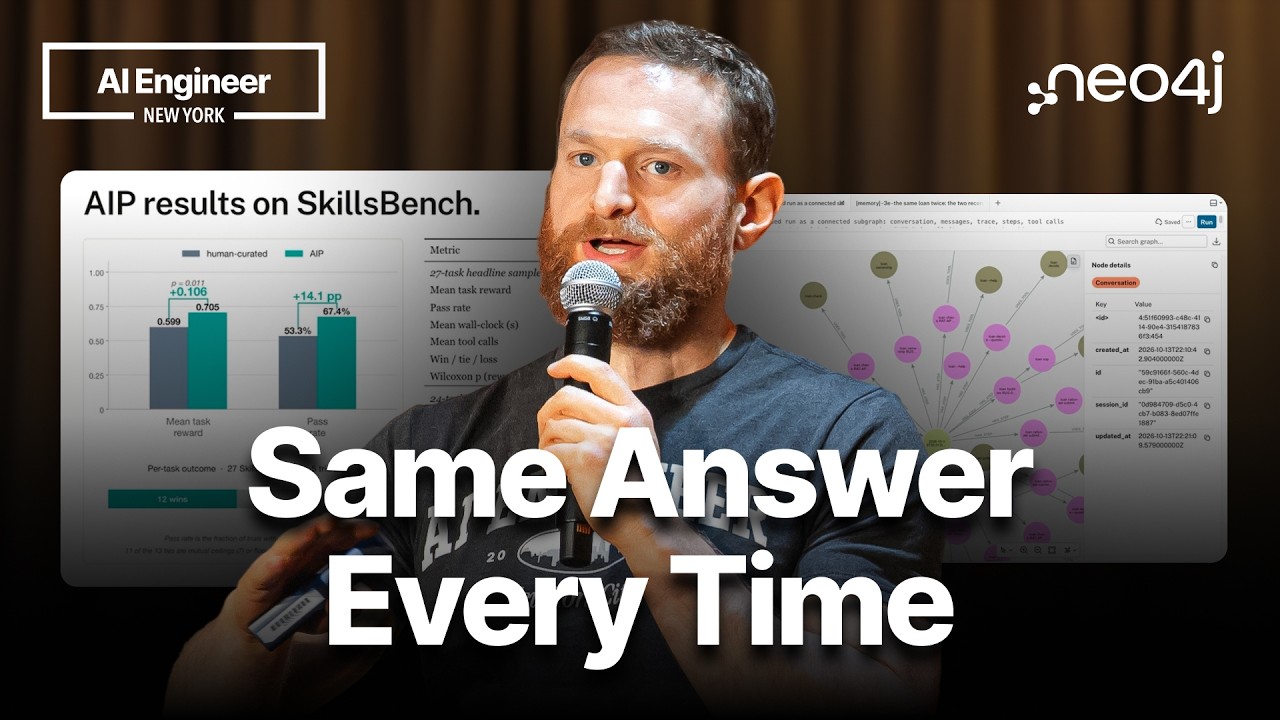
At Neo4j, Zachary and his team are developing this knowledge layer using their graph database technology. They integrate various types of memory—short-term (conversation history), long-term (entities extracted from data), and reasoning traces—into context graphs. Their research includes compiling procedural knowledge, such as skills documented in markdown files, into graph structures that agents can execute deterministically. This method has shown to improve task performance and reward, even when using smaller AI models, by providing agents with structured, traceable workflows.
Zachary presents real-world applications of graph engineering, including compliance automation for asset managers and configuration management for companies like Uber. These use cases demonstrate how graph-based skills can automate complex, regulated processes by resolving data inconsistencies and enforcing policy logic in a trustworthy manner. He then showcases a demo of a loan approval process where a graph-engineered skill compiles policy documents, past decisions, and data into a deterministic workflow that an agent can execute efficiently, reducing runtime and cost significantly.
In conclusion, Zachary underscores the value of graph engineering in making AI agents more reliable, auditable, and efficient. By compiling skills and decision processes into portable graph formats, organizations can improve governance and operationalize complex tasks across various domains. He invites interested viewers to explore Neo4j’s cloud services, community events, and open-source projects to experiment with graph engineering and agent memory integration.
Useful Links
- Neo4j Graph Database — Central to the video as the platform enabling graph engineering and knowledge layer.