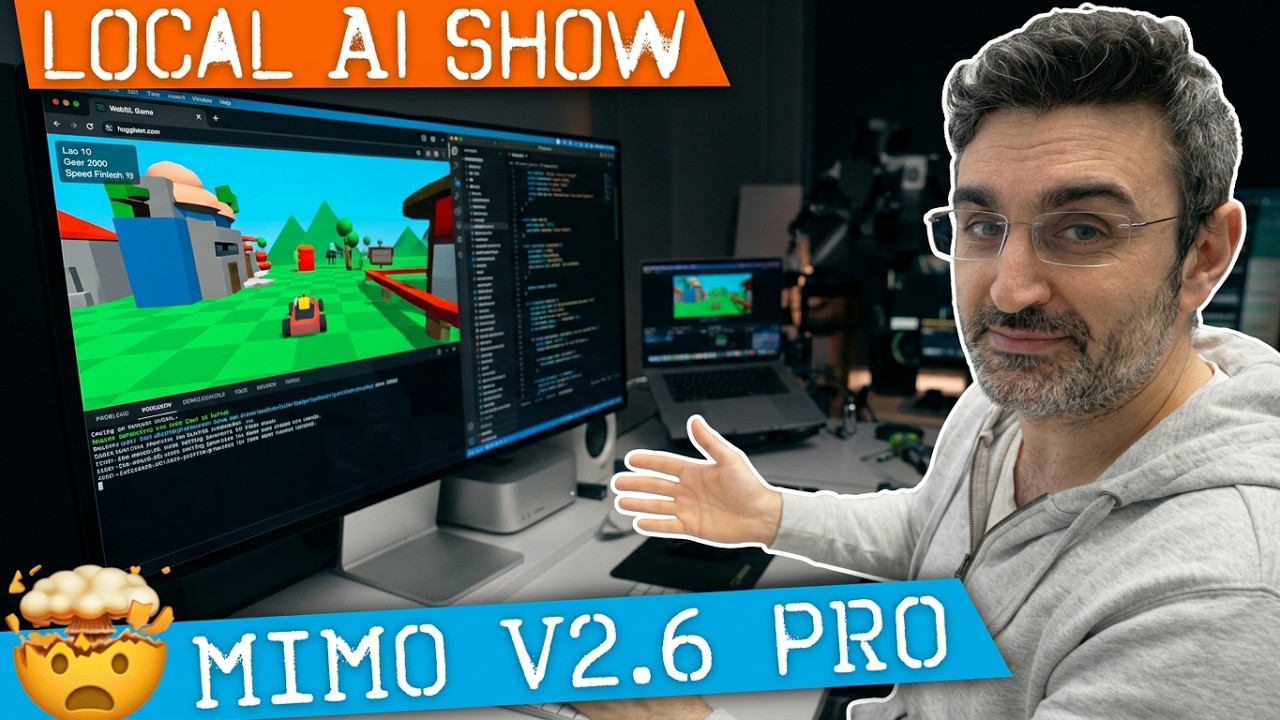
In this video, the presenter explores MiMo V2.6 Pro, an open-weight AI model released under the MIT license, making it highly suitable for commercial use. The model is benchmarked against other popular models like GLM and DeepSeek, showing impressive performance with a score of 71.9, surpassing DeepSeek’s 66.9 and competing closely with GLM. However, MiMo requires substantial resources, around 573 GB of RAM, and does not perform well with aggressive quantization, necessitating at least 8-bit quantization for stable operation. The presenter runs the model on a cluster of Macs, combining multiple machines to handle large token generations without running out of memory.
The video demonstrates various generation tests with MiMo V2.6 Pro, including 3D solar system simulations, nuclear explosions, and WebGL face renderings. While simpler generations run smoothly, more complex tasks sometimes cause looping issues during the model’s “thinking” phase, which the presenter manages by manually intervening using token inspection tools. The nuclear explosion demo impressively features physics-based animation and destructible buildings, showcasing the model’s advanced capabilities. However, some visual glitches like incorrect lighting are noted, indicating room for refinement through follow-up prompts.
A significant portion of the video focuses on generating a Grand Theft Auto (GTA) remake using MiMo V2.6 Pro in agent mode, which outputs code into multiple files for better structure. The GTA generation is extensive, producing over 100,000 tokens and allowing basic gameplay such as driving cars, shooting pedestrians, and police chases. Although some controls and animations are quirky or slightly broken, the overall result is functional and visually appealing. The presenter compares this with a similar generation using the Quinn 4 EXP model, noting that MiMo’s output is competitive and sometimes superior in animation quality and game mechanics.
The presenter also tests MiMo’s multimodal capabilities by attempting to recreate game menus and scenes from images, such as Age of Empires 2 and Tomb Raider. While the model recognizes some elements and produces usable backdrops and objects, these generations are less polished and sometimes incomplete, indicating that multimodal integration is still a work in progress. Despite this, the model consistently avoids runtime errors, which is a notable achievement given the complexity of the tasks and the size of the generated codebases.
In conclusion, MiMo V2.6 Pro stands out as a powerful, commercially friendly AI model with top-tier benchmark performance and the ability to run on clustered hardware setups. Its strengths lie in generating large, complex codebases and simulations with relatively stable outputs, though it requires significant computational resources and careful handling of quantization. The model shows promise in multimodal tasks and game development, with some quirks and areas for improvement. Overall, the video highlights MiMo V2.6 Pro as an exciting advancement in open-weight AI models, offering robust capabilities for developers willing to invest in the necessary infrastructure.
Useful Links