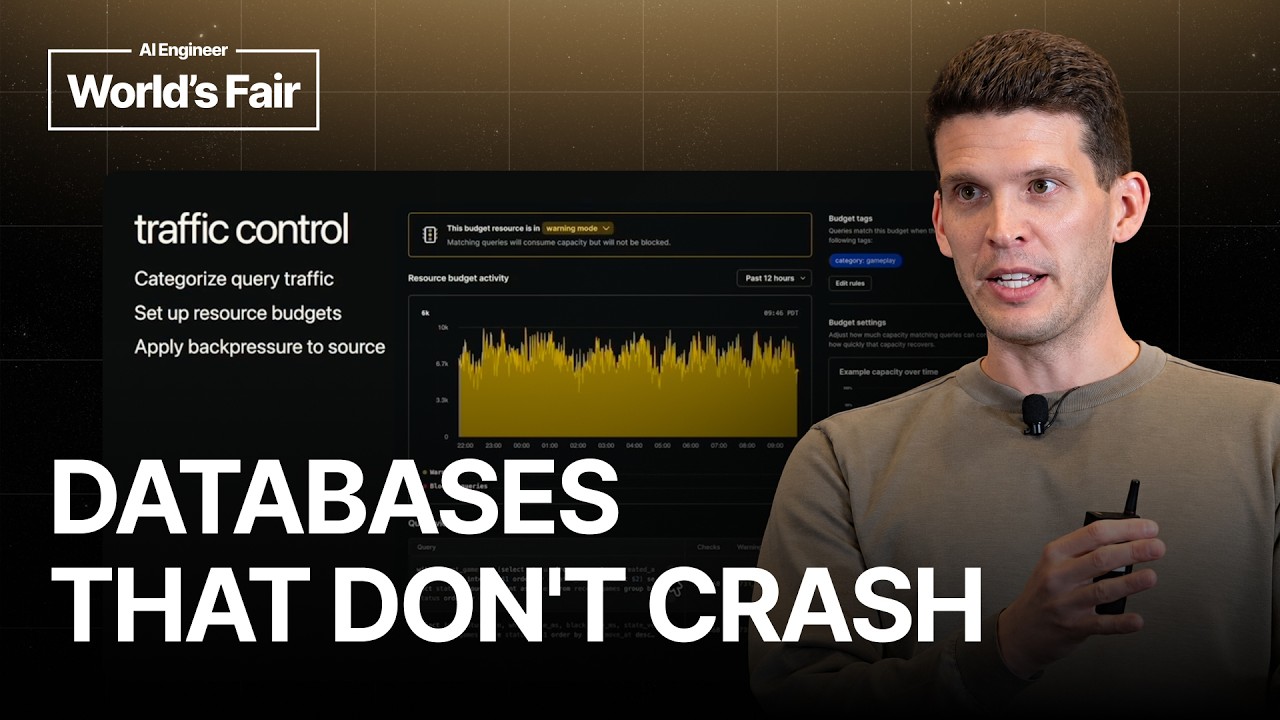
In this talk, Ben from PlanetScale discusses the challenge of moving fast in software development without breaking critical infrastructure, particularly databases, in the era of rapidly scaling AI applications. He revisits the famous phrase “move fast and break things,” originally from early Facebook culture, and argues that with modern technology and practices, it is possible to ship quickly while maintaining system reliability. Ben emphasizes the importance of building systems that remain stable regardless of user growth, highlighting the need for robust infrastructure to handle the explosive demand driven by AI agents.
Ben outlines key principles for building reliable and scalable systems, starting with isolation, which ensures that failures in one component do not cascade and bring down the entire system. He also stresses redundancy, especially in databases, where primary and replica nodes across different data centers help maintain availability despite hardware failures. These principles apply at all scales, from small user bases to millions of daily active users, but as systems grow, more advanced techniques become necessary to maintain performance and reliability.
One of the primary methods for scaling databases discussed is sharding, which involves partitioning data and queries across multiple servers to handle large volumes of data efficiently. PlanetScale uses technologies like Vitess for MySQL to manage sharding, combining it with redundancy within each shard to ensure fault tolerance. Ben also highlights the importance of back pressure mechanisms to prevent overload by gracefully degrading service rather than crashing, and decoupling services to avoid resource contention and improve failure isolation.
The talk then shifts to how AI agents can assist in managing and scaling databases. Ben explains that AI is well-suited to work with configuration files like Vitess’s v schema JSON files, enabling agents to prototype and optimize sharding strategies. He also describes PlanetScale’s developer-friendly features such as branching and deploying database schema changes safely with no downtime, which can be automated or semi-automated by AI agents. This integration allows AI to participate in complex infrastructure tasks while maintaining safety and control through human oversight.
Finally, Ben emphasizes the importance of focusing on developer experience to create tools that not only help humans avoid mistakes but also enable AI agents to operate databases reliably. By exposing APIs and command-line interfaces, PlanetScale provides a flexible environment where both developers and AI can collaborate effectively. This approach ensures that as AI continues to accelerate software development, the underlying infrastructure remains stable, scalable, and manageable, supporting the demands of the AI era.
Useful Links