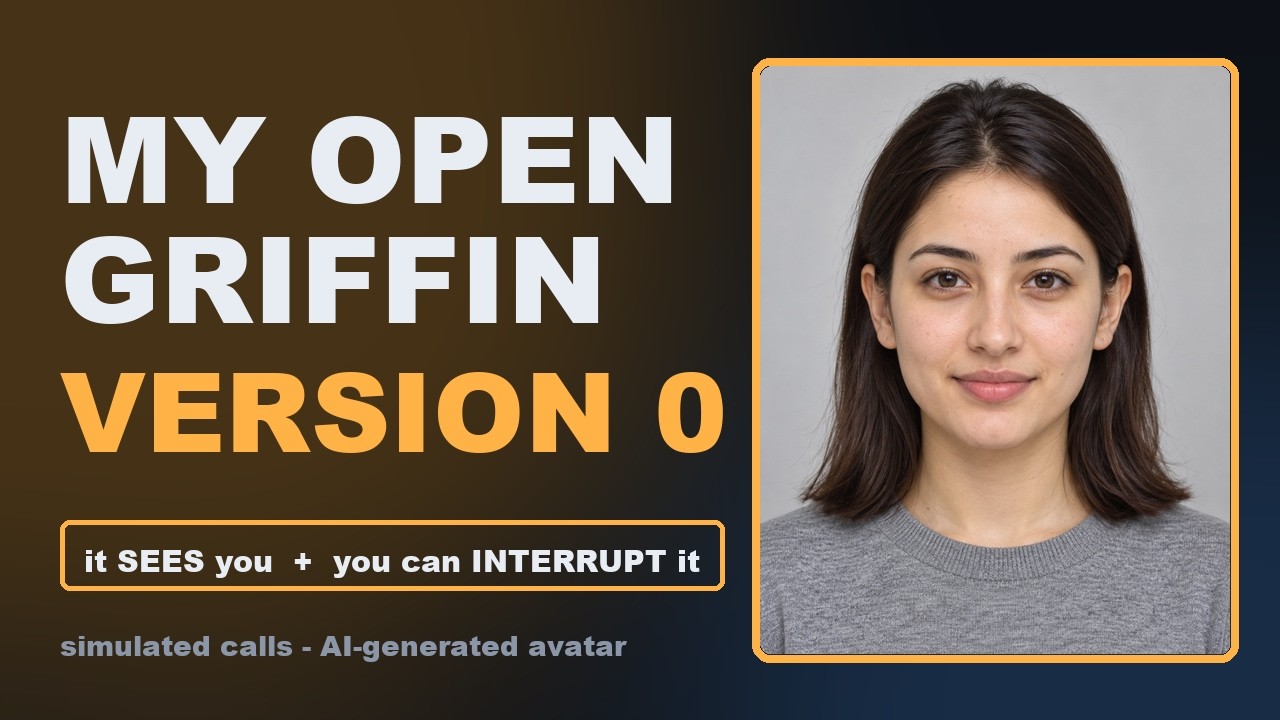
In this video, the creator presents an AI avatar designed for live communication, inspired by Tevo’s Griffin model, which listens while it talks. Unlike Griffin, which is a single large model, this version is composed of separate open-source models handling different functions such as ears, eyes, brain, voice, and face, coordinated by a loop running every 320 milliseconds. The avatar can see the user through a camera and respond based on visual and linguistic input, although the setup is still in an early, imperfect stage with a static camera and scripted voice.
A key feature demonstrated is the avatar’s ability to read visual information from the camera feed. Initially, with a low-resolution image, it failed to correctly read a badge number on the wall. However, increasing the image width to 768 pixels significantly improved accuracy, allowing the avatar to correctly identify the number “48213K.” This highlights the importance of image quality in the avatar’s visual recognition capabilities.
The video also showcases the avatar’s conversational skills, particularly its ability to listen and respond naturally during interruptions. When the user interrupts the avatar’s storytelling to change the topic, the avatar quickly stops speaking within a few hundred milliseconds and seamlessly switches topics without losing the conversation thread. The avatar also waits patiently when the user hesitates or pauses, demonstrating a speech sequencing model that listens to audio cues rather than relying solely on silence detection.
Under the hood, the avatar integrates several open-source technologies: Silero for speech recognition, Whisper for transcription, Smart Turn for end-point detection, Quinn Vision’s language model as the brain, Cockerel for voice synthesis, and Ditto for facial animation. All these components run on a single A100 GPU, which limits the system’s speed, causing a noticeable delay of about three seconds before the avatar responds and a video frame rate slightly below standard.
The creator acknowledges the current limitations, including response latency and occasional errors in speech timing, but expresses a clear intention to improve the system’s speed, voice naturalness, and emotional expression. The video ends with an invitation for viewers to suggest which aspect to prioritize for improvement and encourages engagement by asking how viewers are doing, signaling ongoing development and community involvement in refining this open-source AI avatar.
Useful Links