The video explores Neuron Studio, a free interactive tool hosted on Hugging Face that allows users to manipulate individual neurons within a large language model directly in their browser using WebGPU. The presenter demonstrates how the model, a 3.54 billion parameter quantized version of a language model, runs locally on their AMD graphics card without needing a server or API key. The interface visualizes the model’s 32 layers, each containing 9,216 neurons, as grids of dots that users can select and adjust with a strength slider to nudge the neuron’s activation up or down, affecting the model’s output in real time.
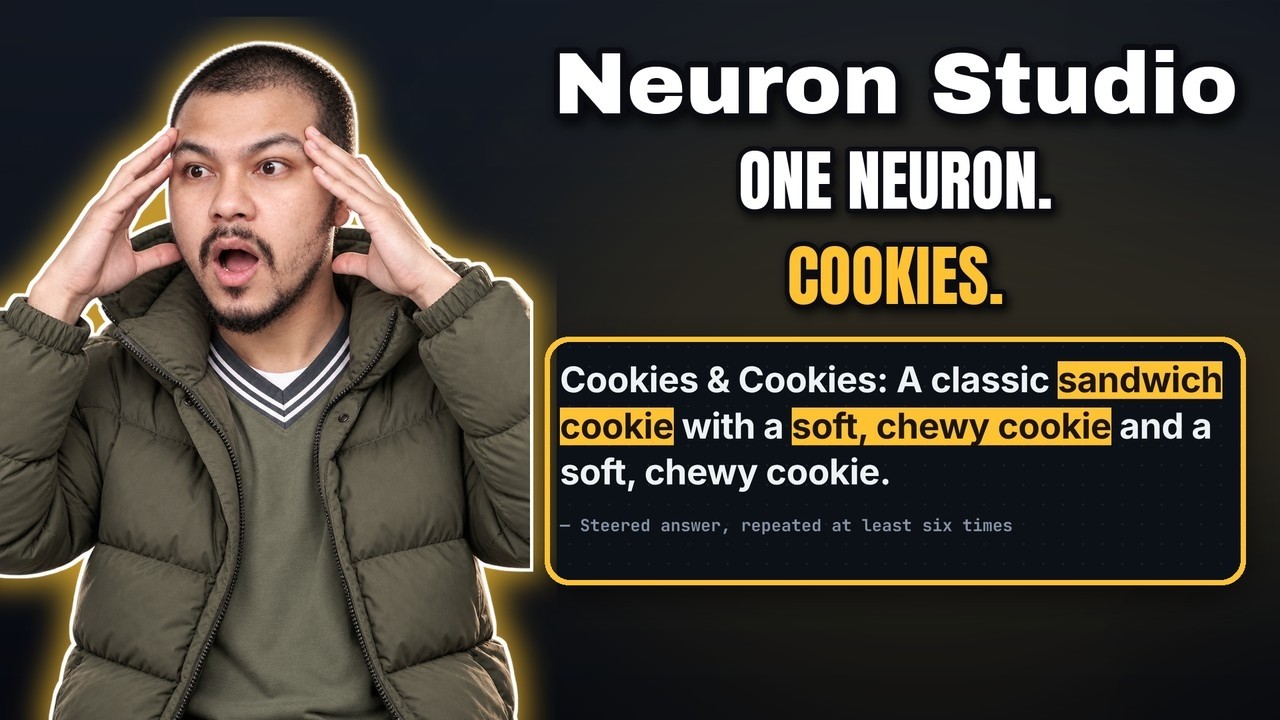
The core experiment involves changing a single neuron’s value and observing how it alters the model’s responses to prompts. For example, nudging one neuron caused the AI to respond to a dinner recipe prompt exclusively with cookies, replacing all other suggestions. This demonstrated how a single neuron could hijack the model’s output topic without breaking the model’s fluency or formatting. The video also tests other neurons with a prompt asking how rainbows form, revealing that some neurons shift the language, tone, or content drastically—sometimes producing nonsense or looping text—while others subtly influence the answer.
The presenter tests nine different neuron “recipes” with labels like “cookie,” “evil,” “hugs,” and “partner,” finding that seven out of nine neurons produce outputs consistent with their labels, such as cheerful tones or language shifts. However, two neurons labeled “evil” and “sleepy” did not behave as expected, highlighting that these labels are more hints than guarantees. The experiments also show that increasing the strength of the neuron nudge can cause the model to break down, producing repetitive or nonsensical outputs, indicating that the effect of neuron manipulation is not a smooth gradient but rather a threshold-triggered change.
The video emphasizes that Neuron Studio is a demonstration tool rather than a rigorous scientific experiment. It allows anyone curious to visually and interactively explore how individual neurons influence a language model’s behavior without complex setups. The presenter notes that proper experiments would require multiple prompts, repeated trials, and combinations of neurons to statistically validate the effects. Nonetheless, the tool provides a fascinating glimpse into the internal workings of large language models and how single neurons can control aspects like topic, tone, or language.
In conclusion, the video highlights three key takeaways: a single neuron can hijack an AI’s response, strong neuron nudges can disrupt the model’s ability to stop generating text, and neuron labels are indicative but not definitive of behavior. The presenter encourages viewers to try Neuron Studio themselves and share their experiences, underscoring the accessibility and educational value of this novel approach to understanding AI internals.
Useful Links