This past week has been significant in the AI space, with major releases like Fable 5.1, Mythos from Anthropic, and GPT6 Astra highlighting rapid progress toward AGI and possibly ASI. While many focus on the capabilities of these models, this video shifts attention to Nvidia’s strategic moves in local AI. Nvidia has consistently supported the open AI ecosystem by releasing not just model weights but also training papers, recipes, and datasets, which has helped it become the top contributor on Hugging Face this year. The company’s commitment to open weights and open models was publicly reinforced by its CEO’s letter encouraging industry-wide support for open AI development.
Nvidia recently made a major acquisition by purchasing Hugging Face for nearly $13 billion, a move that signals its intent to dominate the local AI hub. Contrary to concerns, this acquisition is expected to benefit the open AI community, as Nvidia has a vested interest in maintaining openness to foster innovation and adoption. The rise of local AI is driven by growing public awareness of data privacy and the desire to run AI models on personal devices rather than relying solely on cloud services. Nvidia aims to capitalize on this trend by supporting open models and local AI infrastructure, which is seeing rapid growth in model availability and usage on platforms like Hugging Face.
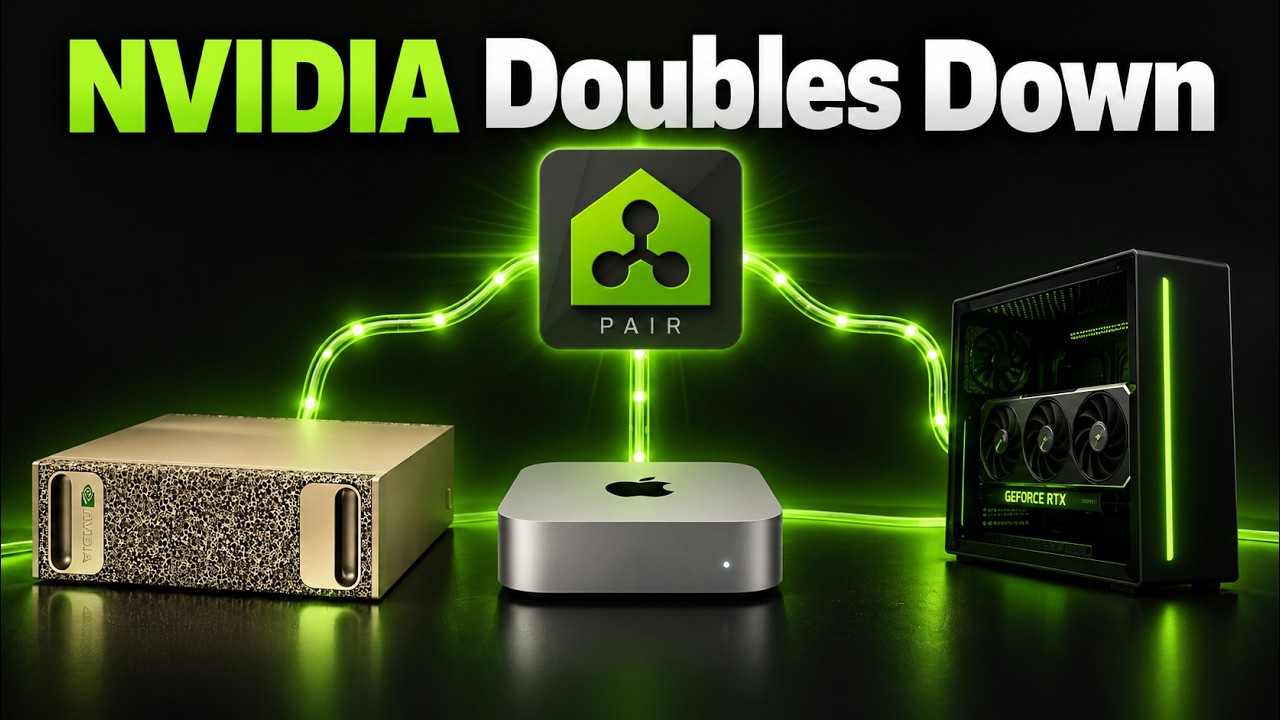
A key highlight of Nvidia’s recent developments is the launch of Nvidia PAIR (Personal AI Router), a new open-source project designed to optimize the use of multiple GPU-enabled devices within a household. PAIR acts as a traffic controller for AI inference requests, distributing workloads across multiple machines to enable parallel processing of agent tasks. This is particularly relevant as more devices with AI accelerators, such as the upcoming RTX Spark laptops, enter the market. Unlike clustering or VRAM pooling, PAIR manages parallel requests across devices without combining their resources for single tasks, enhancing efficiency for local AI applications.
PAIR is released under the Apache 2.0 license, encouraging community involvement and customization. It currently supports Windows, Linux, and Mac, and works with models like Olama and LM Studio, with ongoing contributions to expand compatibility. The router intercepts inference calls and redirects them to the appropriate machine on the network, allowing existing AI applications to function seamlessly without modification. Nvidia’s approach reflects a forward-looking strategy to support decentralized AI workloads and foster an ecosystem where users can leverage multiple local devices for AI tasks.
While still in early development (version 0.1), PAIR shows promise for users with multiple GPU-equipped machines, offering a new way to manage local AI inference workloads. The video’s presenter notes some current limitations, such as speed and token processing rates, but sees potential for integration with other routing tools like Switchyard to enhance functionality. Overall, Nvidia’s moves with open weights, Hugging Face acquisition, and PAIR indicate a strong commitment to advancing local AI infrastructure and empowering users to run sophisticated AI models on their own hardware.
Useful Links